
Italian buoyancy technology returns to the safety conversation
Sea Fend, an Italian-developed auxiliary buoyancy system intended to help a damaged boat remain afloat, is attracting fresh attention in marine-equipment reporting ahead of the November trade-show period. The system's underlying concept was described publicly earlier in 2026, so this is not a claim of a world premiere on 13 November. Rather, the current interest is how internal inflatable support equipment might be assessed by owners and builders of small leisure boats exposed to flooding after a collision, grounding or failed through-hull fitting.
The manufacturer describes a modular set of inflatable elements arranged low along the hull and activated when a serious loss of watertight integrity threatens buoyancy. That is an ambitious technical claim, and it should not be presented as proof that any vessel fitted with Sea Fend cannot sink. Independent evidence for a particular hull and flooding scenario is essential. The possibility of retaining buoyancy after damage is worth investigating, but a boat owner must continue to prioritise normal maintenance, damage prevention and emergency preparation.
The problem that designers are attempting to solve
Small craft can lose stability and buoyancy when water enters through a damaged hull, an open seacock, a failed hose or a fitting that has come loose. Even with bilge pumps operating, a large opening may allow water to enter faster than the installed equipment can remove it. A crew might then have limited time to establish the cause, reduce the flow and call for assistance. The challenges are especially demanding on a boat with few people aboard or one that is some distance from a safe harbour.
Traditional safety planning concentrates on avoiding damage, maintaining watertight systems, carrying pumps and alarms and ensuring that people can survive if the boat must be abandoned. Sea Fend proposes another layer: adding buoyancy that may support a compromised vessel. Its promise deserves serious attention because the consequences of rapid flooding can be severe. At the same time, owners should resist any suggestion that a new device can remove the need for competent boat handling or properly installed safety equipment.
How the inflatable elements are described
Sea Fend's official website explains that compressed airbag-like elements are housed inside protective bumpers or dedicated hull arrangements near the lower topsides. When activated, the elements inflate to provide additional support. The company refers to both new-build integration and retrofit installations, with the intended arrangement differing according to the boat's structure. It presents the system as a way to gain time after a hull breach, not as a replacement for the hull's original watertight construction.
A description of an inflatable module is not enough to determine its performance. The placement, total displacement volume and structural attachment all influence the outcome, especially if water is already moving through the interior. A system that offers useful support on one test craft might behave differently on a heavier vessel, or one with a different centre of gravity and compartment layout. The correct assessment must be specific to the individual boat and its damage-stability characteristics.
Activation and the importance of a clear procedure
The company says activation may be initiated from the helm or remotely through a dedicated application. The idea is to provide a relatively quick response when the crew detects a serious problem. Activation needs to be available in circumstances where the boat is already in distress, perhaps with compromised electrical power or damaged onboard communications. Buyers should ask what the system requires to work, how much stored energy or gas is available and whether a dependable manual procedure exists.
Instructions also need to distinguish an appropriate activation event from an ordinary alarm. A serious flooding situation can be confusing, and a skipper must know what to do before moving to other emergency actions. The manufacturer's current documents should explain how to verify readiness, how to respond to a false activation and what follows if only part of the system operates. Any electronic notification feature must be understood as a supplement to, not a substitute for, a marine distress call when one is necessary.
New-build integration versus retrofit
Sea Fend describes a new-build approach in which equipment is coordinated with the hull during construction. That may allow designers to allocate space, manage structural loads and conceal the installation without obvious changes to the boat's appearance. Such work requires the boatbuilder and naval architect to consider the shape and strength of the relevant hull areas. The position of the buoyancy elements must be compatible with existing watertight boundaries and the normal operation of the vessel.
Retrofits raise different questions. A finished hull has existing laminates, stiffeners, fittings and internal systems, and there may be limited access to the ideal installation position. The manufacturer promotes a retrofit arrangement, but that should not be interpreted as permission for an owner to cut, drill or attach hardware without professional guidance. A surveyor or qualified installer must identify which locations are structurally suitable and how the system can be inspected, secured and serviced without impairing the hull.
Thirty-to-sixty-five-foot application range
The company's material identifies boats approximately thirty to sixty-five feet in length as one potential market. That range includes many small leisure boats, especially the thirty-to-thirty-nine-foot models that fall within Leisure Boat Guide's under-twelve-metre scope. Larger vessels in the manufacturer's market description belong in other editorial categories, and the quoted range should not be used to imply that every model has been independently approved or installed successfully. Suitability depends on more than overall length.
An eight-metre dayboat with limited interior volume is not equivalent to an eleven-metre cruiser carrying several cabins, heavy engines and substantial fuel. They may have different reserve buoyancy and behave differently when water enters. The type and distribution of buoyancy added by a product should be evaluated alongside the actual loaded displacement and stability characteristics. Owners should seek written confirmation of the applicable vessel range and any independent assessment of the configuration being proposed.
Flooding, stability and structural loading
Additional buoyancy may help keep an inundated hull from descending as quickly, but preventing sinking is only one part of a complex safety problem. A flooded boat can lose stability, develop a persistent list or become dangerous to move around. Its electrical systems may be damaged, machinery may stop and dangerous water movement can develop inside compartments. A system intended to supply lift must be evaluated for how that lift affects trim and stability, not just for the total volume it displaces.
The inflatable equipment must also transfer forces into the hull or its attachment points. The magnitude and direction of those forces may change as the boat floods or waves strike the side. A credible design assessment therefore needs to examine structures, attachment loads, inflation controls and the circumstances under which a module could be damaged. A product's patent status and manufacturer demonstration may be useful background, but neither replaces independent safety analysis for the boat in which it will be installed.
What independent testing should show
A buyer should ask Sea Fend for documented tests demonstrating how the system performs under specific damage and flooding conditions. Useful information would include the test boat's hull form, loaded displacement, initial stability, location and size of the simulated breach, time to activation and changes in trim and freeboard. Without those conditions, a statement that the system can keep a boat afloat has limited value for a different owner deciding whether to invest in protection.
Where certifications or approval documents are cited, the owner should verify precisely which product version, installation and performance claims they cover. Approval for a component, a gas reservoir or an electrical control does not necessarily amount to approval of the entire craft's damage-stability arrangement. This is especially important if an installation is later modified or transferred to another vessel. Genuine evidence should withstand scrutiny by an independent naval architect or surveyor, rather than depend on a dramatic demonstration video.
No substitute for bilge pumps and alarms
For most small-boat owners, the first defence against flooding remains well maintained through-hull fittings, hoses, seacocks and bilge systems. Pumps and alarms should be checked as directed by their manufacturers and installed so that their operation remains understandable to the crew. Spare plugs, accessible isolation points and suitable emergency equipment may help in some situations. Sea Fend should be considered as a possible additional measure within that wider plan, not a reason to defer essential maintenance.
The crew must also be prepared to call for help. An electronic message to a list of private contacts is not the same as a formal distress alert through the appropriate maritime communications channels. A boat that appears to be remaining afloat after a serious breach can still be in grave danger, particularly if weather deteriorates or the engine becomes unavailable. Emergency response should follow the circumstances and the authorities' guidance, not a promotional claim of continued flotation.
Ownership costs and long-term readiness
If an inflatable safety system is installed but never required, it still needs a programme of inspection and readiness checks. Owners should clarify the service life of the inflatable elements, the condition of any stored inflation medium, the integrity of electrical controls and the consequences of accidental activation. A device may appear unobtrusive in a brochure but still require periodic access, replacement parts and professional servicing. Those obligations should be included in any serious evaluation.
A quotation should set out the complete installed cost, not merely the price of one module. Design work, hull preparation, electrical integration, inspections, certification and ongoing maintenance can be significant. Buyers should also establish whether the installation affects their insurance terms, survey recommendations or vessel documentation. Any insurer's decision must be obtained directly from the insurer rather than inferred from the manufacturer's own safety claims. Financial and technical diligence are linked here because a poorly maintained system may create false confidence.
What METSTRADE-period interest means
Sea Fend's product message has resurfaced in November marine trade coverage during the approach to METSTRADE, a period when boatbuilders and equipment dealers compare innovations for future use. The company has already made its concept public, and the present report does not treat the November coverage as a newly completed sea trial or as proof of commercial uptake across the fleet. The more meaningful next step is transparent information about actual installations and the engineering evidence behind them.
Professional visitors should ask about available drawings, approved installation practices, maintenance schedules, product liability, testing and the specific criteria used to size a system for a boat. Owners with an existing hull should seek a surveyor's assessment before deciding whether the equipment merits further investigation. In a safety-critical area, detailed answers and clear operating limits are more reassuring than broad claims that one technology can remove the danger of sinking altogether.
A promising concept that needs careful scrutiny
Sea Fend addresses a serious maritime problem: how to preserve useful buoyancy after damage has compromised a boat. Its idea of inflatable auxiliary support could become relevant to certain small-craft designs if independently demonstrated and installed correctly. That is enough reason to report the concept, its intended application range and the manufacturer's description of how it works. It is not enough reason to advise a buyer to rely on it without a boat-specific safety assessment.
Leisure Boat Guide has not tested Sea Fend or verified its ability to prevent sinking under a particular set of conditions. Owners should continue to inspect their hulls, maintain watertight fittings, carry suitable emergency equipment and practise a realistic response to flooding. The appropriate conclusion is measured: auxiliary buoyancy technology may offer another tool for designers and skippers, but reliability, stability, inspection and the responsibilities of the crew remain fundamental to small-boat safety.
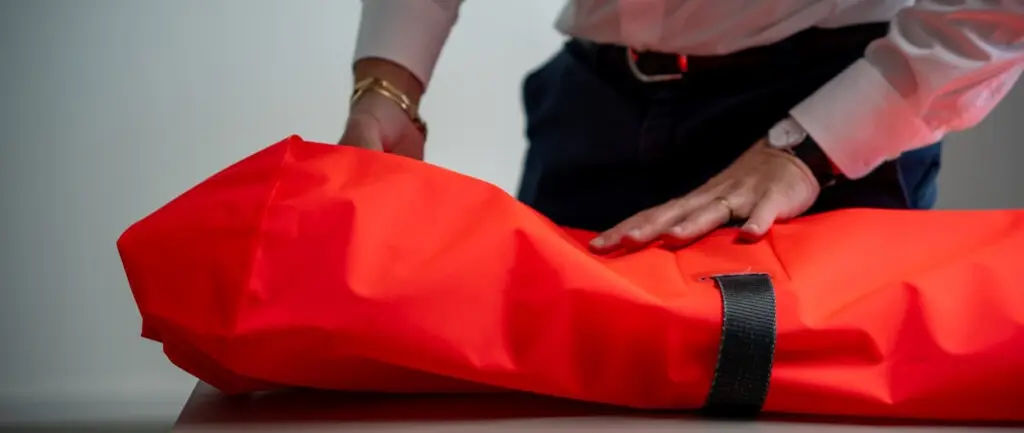
Official editorial source: seafend.it. Sea Fend official photograph of an inflatable buoyancy module during product handling.