
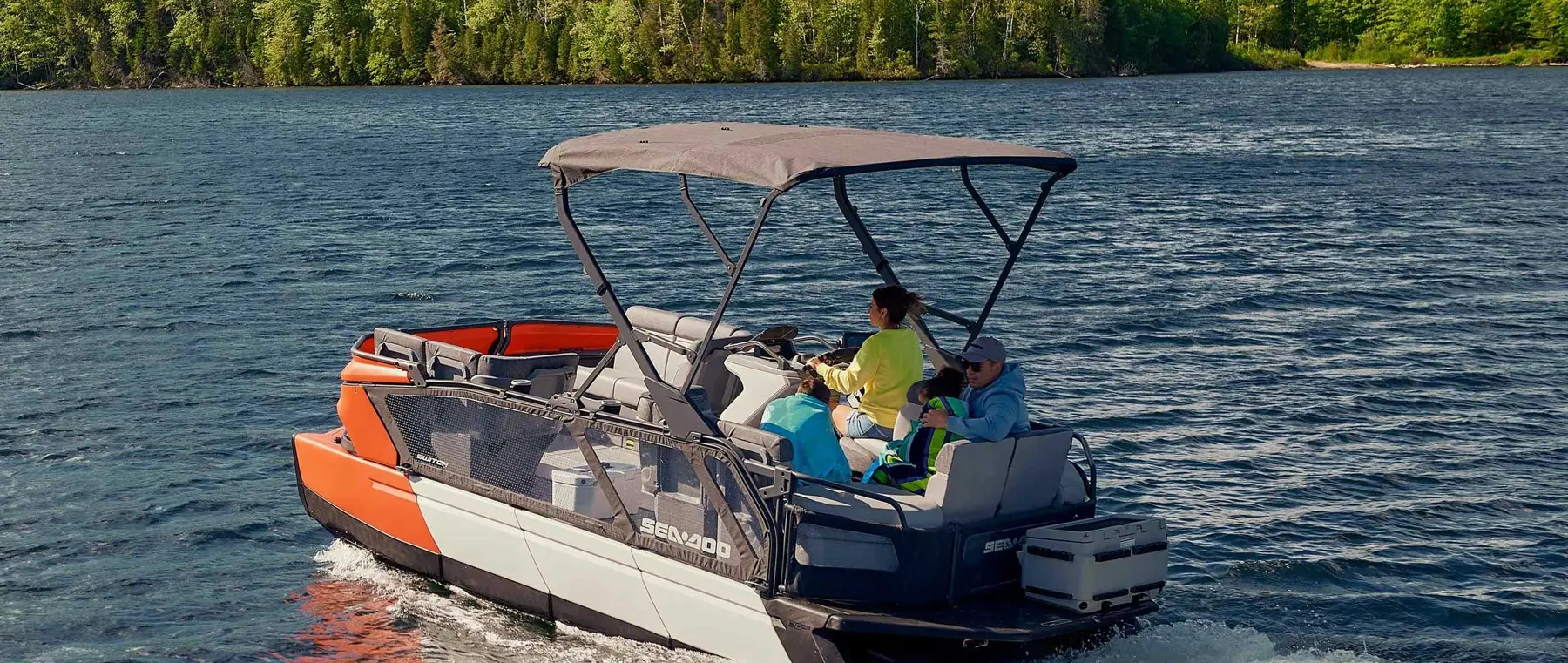
An active safety message for Sea-Doo Switch owners
BRP is urging owners of affected Sea-Doo Switch pontoon boats to complete an updated safety-recall repair addressing the risk of bow overloading, nose-diving and capsizing. The manufacturer's current safety-information page says it is reminding owners who have not yet participated in the programme to arrange the outstanding work. This is an active follow-up to an earlier recall, not an announcement that a new recall began on 26 October 2026.
The underlying updated recall notice is dated 17 October 2025 and carries Bulletin 2026-1. BRP identifies model years 2022 through 2026 of the Sea-Doo Switch as involved and says owners must not assume that work done under an earlier bulletin is sufficient. Anyone who owns, has recently bought, or is considering buying one of these craft should verify its individual recall completion directly with an authorised Sea-Doo dealer.
Why the updated remedy requires another visit
BRP's explanation separates the loading hazard from the hull-water evacuation issue that can make it worse. If people and equipment are concentrated at the bow, the Switch can become excessively nose-down and take water over the deck. The manufacturer says the condition can worsen where water evacuation from the hull is not functioning optimally, potentially creating a danger of swamping or capsizing.
The updated remedy replaces two previous service bulletins, 2025-4 and 2025-10. BRP says the sealant used as part of an earlier repair may not meet its durability expectations, so the new procedure calls for three gaskets in specific hull locations. Boats already fitted with gaskets still require an inspection to confirm that all three are present.
That is the detail most likely to surprise an existing owner. A receipt for prior recall work or a statement that the boat was repaired at the factory does not, by itself, establish completion of Bulletin 2026-1. The owner should ask a dealer to check the craft's identification and recorded campaign status rather than relying on memory or the existence of older paperwork.
The repair, labels and revised operating information
Under the manufacturer's notice, authorised dealers carry out the updated work without charging the owner for parts or labour. BRP estimates a maximum procedure time of about two and a half hours, although an appointment, parts availability and the dealer's workshop schedule are separate practical questions. Owners are instructed to contact an authorised Sea-Doo Switch dealer promptly.
The recall programme also requires safety warning labels at two specified locations and an addition to the operator's guide where applicable. BRP notes that the model-year 2026 operator's guide already contains the relevant additional information, but that does not remove the separate requirement to have the hull portion checked or repaired. The manufacturer's safety video and operator documentation are supporting materials, not replacements for the repair.
For a second-hand boat, a prudent buyer should make recall verification part of the pre-purchase documentation check. Ask for the actual completion status of Bulletin 2026-1 and confirmation that the correct gasket inspection or replacement was performed. A favourable sea trial or the absence of visible damage does not prove that the water-evacuation remedy has been completed.
Load distribution is a safety issue at every speed
BRP's owner guidance emphasises that weight distribution is just as important as the total number of people aboard. All passengers, equipment, coolers and fitted accessories count toward the capacity calculation, while the load must also be balanced fore and aft and from port to starboard. The capacity label near the helm is the relevant reference, not the number of available places to sit.
A boat can have unoccupied seats and still be too heavily loaded, particularly if passengers are large or a substantial amount of equipment has been added. Conversely, a total load below the maximum does not make it safe to gather everyone on the forward deck. The captain must position people appropriately before getting under way and revisit that arrangement when passengers move.
The manufacturer's page describes front-loaded handling problems in the approximate 9–13 km/h range, equivalent to 6–8 mph. Under those conditions the bow can dive or submerge enough for water to come aboard. That speed range is part of BRP's reported example of the hazard; it is not a special speed at which all other loading rules cease to apply.
What to do if the bow starts diving
BRP's emergency guidance is unusually direct: if a Switch begins to nose-dive, stop the boat and move passengers away from the front so the load is properly balanced. It specifically warns against trying to use additional engine power to force the bow back upward. More throttle in that condition may drive the boat farther down and increase the danger.
Owners should discuss these instructions with all regular users and make sure the operator understands the warning labels before each trip. A passenger changing seats can alter trim significantly on a comparatively light pontoon boat, especially when several people move at once. Anyone at the helm needs the authority to ask passengers to return to safer positions before proceeding.
If water has entered the boat or control is uncertain, protecting people takes priority over saving time on the passage. Safe action will depend on the actual situation, available flotation equipment and the immediate surroundings, so this article must not substitute for emergency training or the model-specific operator's guide. Any craft showing abnormal trim or flooding should be assessed before further use.
What owners should do now
The first step is to identify the boat's model year and have an authorised BRP Sea-Doo dealer check whether Bulletin 2026-1 is outstanding. Owners who completed the two superseded bulletins need the same check, because BRP expressly states that the newer campaign is required even after earlier repair work. Keep written confirmation of the completed remedy with the vessel's other maintenance and ownership documents.
The next step is to reread the updated loading guidance and confirm the correct passenger capacity and permitted weight from the boat's actual label. Account for accessories and cargo, brief guests to avoid gathering at the bow and maintain sensible fore-and-aft balance throughout the journey. A captain should not treat the warning as relevant only in rough weather or only while travelling fast.
Finally, rely on BRP's own published recall information and the authorised dealer network for repair requirements. The manufacturer identifies the applicable years, the required gaskets and the safety labels; independent commentary cannot certify an individual boat as compliant. Completing the remedy and following the loading instructions are complementary protections, and neither should be regarded as a substitute for the other.