
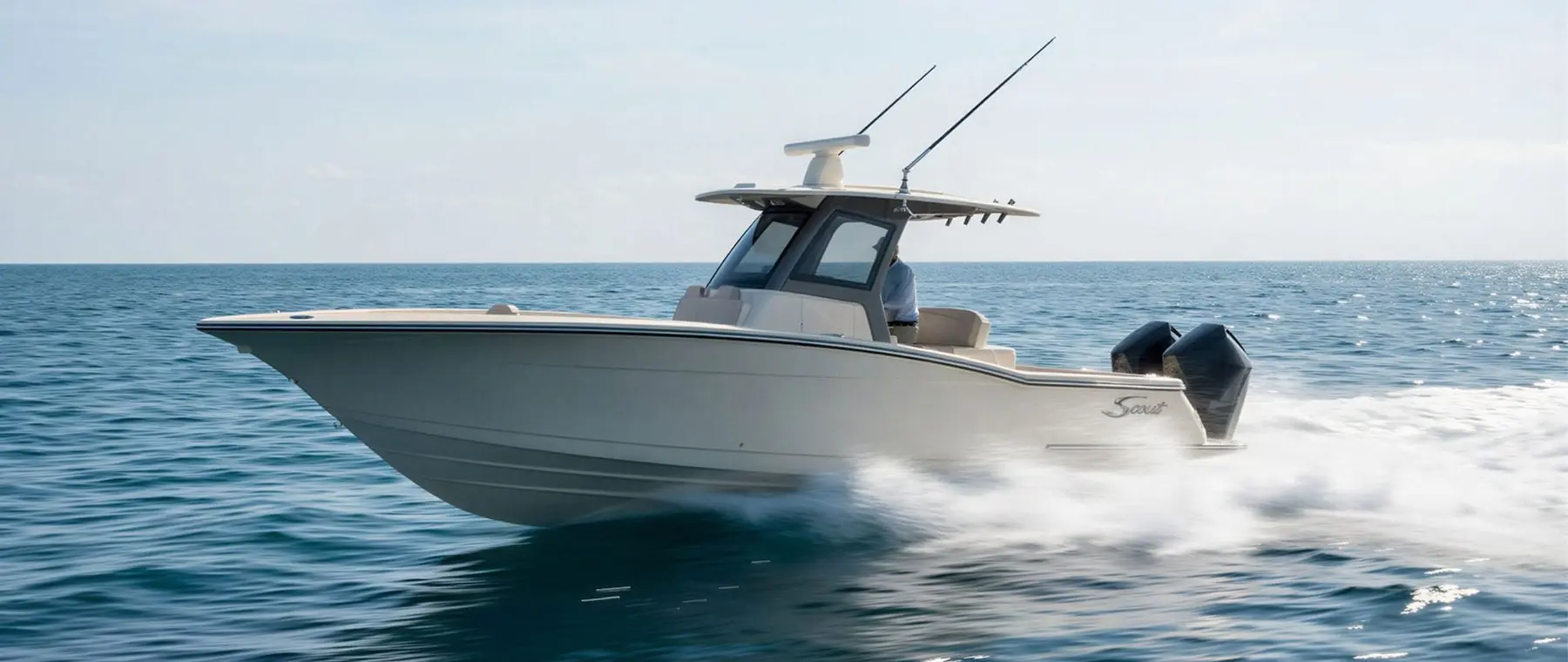
A new Scout model enters the boat-show conversation
The Scout 315 LXF is one of the fresh luxury centre-console designs attracting attention ahead of the 2026 Fort Lauderdale International Boat Show. Positioned in Scout's LXF line, the 31-foot model combines a serious offshore layout with features designed to make swimming, entertaining and family cruising equally important parts of ownership. Industry show previews identify it as an anticipated world debut, while Scout has already published technical specifications and official model imagery.
That distinction between a show premiere and practical availability matters. A first public appearance gives prospective owners a chance to inspect a new design, but it does not automatically settle every question about delivery timing or equipment combinations. The official website currently presents pricing for the 2027 model year, and buyers should obtain their own written dealer quotation rather than assuming a display specification represents the final price of a particular order.
An easily understood 31-foot platform
According to Scout, the 315 LXF measures 31 feet 5 inches in overall length, with a beam of 10 feet 4 inches. Those dimensions place it firmly in the growing market for capable outboard centre consoles that also offer refined social areas. The maker publishes an approximate draft of one foot 8.5 inches, although owners should confirm the load and engine position underlying that figure before planning shallow-water passages.
A wide beam relative to length creates space for seating, circulation and built-in equipment, but it also affects transport and berthing decisions. Owners planning to keep the boat on a lift should consider not just beam and hull weight but the distribution of loads and the equipment actually installed. Similarly, marina berth selection should allow for engines and exterior fittings beyond a single headline hull dimension.
Two powered terraces transform the waterline
The model's defining social feature is a pair of electrically actuated beach platforms, positioned to port and starboard. Scout says these add usable space alongside the cockpit when deployed, expanding the area where guests can enjoy time near the water. For a boat designed to fish offshore one day and host swimmers the next, the ability to change the deck edge is an appealing way of supporting different activities.
Mechanically operated terraces should be examined with a practical eye as well as admired for their appearance. Buyers should ask how the locking and control systems operate, what weight and sea-state restrictions apply and how each platform is secured for passage. A sea trial and a supervised dockside demonstration can establish whether the mechanisms are convenient for the people who will actually use them.
An LXF interpretation of the working cockpit
The LXF identity stands for a luxury-minded centre-console configuration rather than a fishing specification abandoned for cushions. Scout explicitly says the 315 LXF retains fishing features while adding finer appointments above and below deck. That combination makes it attractive to owners who want rods, coolers and tackle aboard without expecting every guest to spend the day focused on catching fish.
A serious equipment review is still worthwhile. Rod storage, access to livewells, the space behind seating and the route from bow to cockpit all determine whether a boat remains useful when several anglers are working at once. The manufacturer offers separate standard and optional equipment lists, so prospective buyers should establish precisely what is included before relying on a photograph of a heavily specified show example.
The carbon-fibre hardtop design
Scout identifies integrated carbon-fibre hardtop legs as a patented aspect of the 315 LXF's exterior arrangement. The goal is a distinctive, modern support structure that complements the large hardtop without overwhelming the centre-console silhouette. Overhead protection matters in a market where owners may alternate between blazing midday sun, spray and sudden seasonal showers.
Structural material alone does not define how well the helm is sheltered. A buyer should check sightlines through the windscreen, shade coverage at different times of day and the ease of moving forward when the boat is under way. Accessories mounted above the roof can also alter the height that matters for a particular bridge or indoor-storage arrangement, so a final as-equipped measurement is more useful than a bare catalogue figure.
Power options and a sensible performance conversation
The manufacturer lists a maximum rating of 700 horsepower and says more than one outboard configuration is available. That should give owners some choice over performance character and the long-term maintenance profile. However, horsepower figures alone say very little about the cruising economy a family will see with fuel tanks, coolers, passengers and equipment aboard.
Scout provides a link to model-specific performance bulletins, which should be reviewed together with the precise engine package being quoted. Real-world speed, range and handling will depend on propellers, trim, hull condition and sea state. Owners who value quiet cruising as much as reaching an offshore ground quickly should compare sound levels and fuel use at ordinary cruising settings rather than choosing solely on maximum installed power.
Fuel and trip planning
A published fuel capacity of 253 US gallons is substantial for a leisure boat of this length. The figure opens possibilities for longer coastal runs but does not amount to an assured range. A responsible plan must allow for real consumption, sea and current conditions, detours and enough fuel reserve for safe return to harbour or an alternative landing point.
Storage for fishing equipment, swimming gear and emergency supplies should also feature in a trial. One advantage of a day boat that can serve several roles is flexibility, but it can also accumulate a great deal of personal equipment. Heavy items need secure locations and should be distributed within the builder's guidance to preserve balance and avoid unnecessarily increasing the tendency to pitch or roll.
Accommodation and optional climate control
The 315 LXF's official introduction highlights comfort below deck as part of its broader appeal. Scout also lists air conditioning as an option, acknowledging that boaters in warmer locations may spend substantial time aboard while at anchor or during slow passages. Below-deck accommodation should be evaluated on actual usable headroom, ventilation, privacy and access to essential fittings, not by imagery alone.
Where climate control is offered, owners should confirm the power source and the realistic operating time while engines are shut down. Shore power, batteries and generator arrangements have different cost and maintenance implications. An option that appears simple in a sales list can influence the whole electrical installation, so these questions belong in the initial equipment discussion rather than being left until delivery.
What to expect at Fort Lauderdale
The 2026 Fort Lauderdale International Boat Show runs from 28 October to 1 November, bringing together new boats and equipment for comparison. The Scout 315 LXF has been identified in previews as a significant new centre-console arrival. Prospective visitors should confirm the exact boat location, display status and available appointments with Scout or its authorised dealer before travelling.
A show walkthrough can reveal whether the decks, terraces and centre-console movement work for the intended crew. It cannot reproduce the operational demands of an offshore day in varying seas. For a meaningful decision, pair any static inspection with a sea trial, an itemised equipment list and a discussion of warranty and local service arrangements.
Why the 315 LXF is worth a closer look
The 315 LXF illustrates a wider change in leisure boat design: serious fishing layouts increasingly share deck space with family-friendly amenities and broad waterfront terraces. Scout's concept is distinctive because those terraces are powered and built into a relatively manageable 31-foot platform. The configuration may appeal particularly to owners who regard their boat as both a working fishing craft and a social gathering place.
The official Scout 315 LXF model page is the authoritative source for the basic dimensions, power limit and equipment links. Check the latest specifications, get a realistic fully equipped price and test the boat in conditions relevant to normal use. The design has attractive features on paper; the real measure will be how effortlessly they function together on the water.