
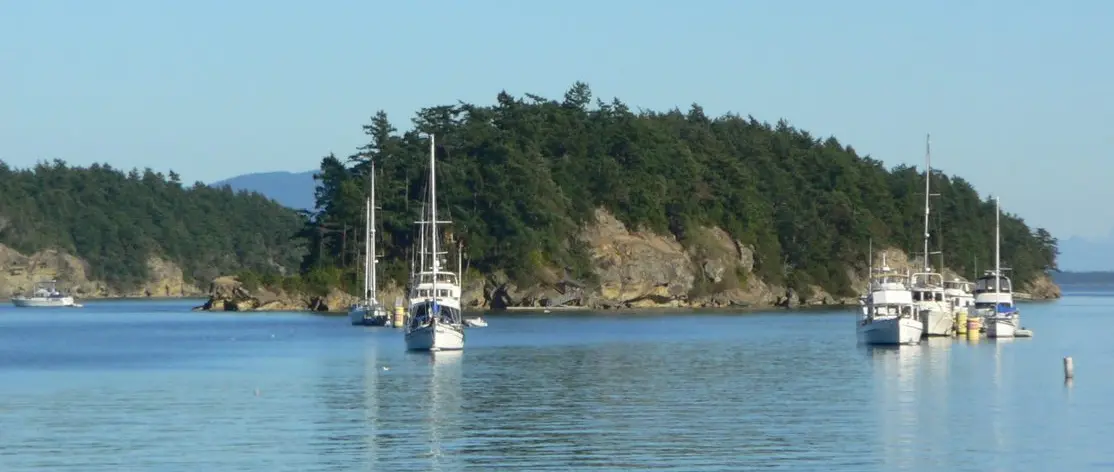
Construction begins at two island harbours
Boaters planning a late-autumn passage through Washington’s San Juan Islands will encounter a changing shore-side picture at two of the archipelago’s best-known marine parks. Washington State Parks began improvements at Reid Harbor on Stuart Island on 13 October 2026 and expects work at Sucia Island’s Fossil Bay to begin in November. The current programme runs through February 2027, so operators arranging an overnight stop should separate the question of whether a bay is open from whether its normal landing and waste-disposal facilities are usable.
The agency says both harbours will remain open to visiting boats, with mooring buoys available during the projects. That does not mean uninterrupted access to every berth or a quiet anchorage. Work barges, a large crane, construction noise and limited local closures may affect how boats manoeuvre and where visitors can safely land. Skippers should verify the latest park notice before entering, especially when arriving after dark or in unsettled conditions.
What changes at Reid Harbor
At Stuart Island, the project centres on replacing an ageing dock, improving access and repairing the pumpout station. The new dock is intended to offer a flatter approach rather than the steeper configuration it replaces. State Parks also plans to remove a string of linear mooring buoys that has reached the end of its service life, so a charted or remembered arrangement should not be assumed to remain in place throughout construction.
The old creosote-treated piles associated with the pumpout facility will be replaced with galvanised steel piles. This is not just a maintenance detail: reducing the use of creosote materials can contribute to better conditions in a sheltered marine environment. Grated decking on the replacement dock is designed to allow more daylight through to the shallow water, a practical consideration for vegetation and other life below waterfront structures.
During the work, State Parks specifically warns that Reid Harbor will be without its dock and pumpout station and that easy shore access may not be available. Its current Stuart Island notice also says drinking water will not be available at the marine park from 1 October until 15 April. For a trailerable cruiser or compact cabin boat, this makes tank capacity, shore plans and the possibility of spending the entire night aboard more important than usual.
Fossil Bay gains a pumpout installation
At Sucia Island, the planned works are concentrated around Fossil Bay, one of the island’s established cruising stops. The project provides a new pumpout station, with galvanised steel piles secured into underwater bedrock and positioned to keep the approach manageable for visiting craft. The stated objective is a more durable waste-disposal facility rather than a restriction on recreational access to the island as a whole.
State Parks currently advises that construction at Fossil Bay will start in mid-November, with a barge and crane operating around the tides. The bay is expected to retain mooring opportunities, but mooring availability should not be confused with clear access to the immediate work zone. Crews may establish temporary exclusion areas; passing skippers should follow site signs and directions and leave working vessels room to manoeuvre.
Sucia has several other coves that can offer a different setting while Fossil Bay is busy. The park’s listed moorage locations include Echo Bay, Ewing Cove, Fox Cove, Shallow Bay and Snoring Bay. Not every alternative is suitable for every craft or forecast, and the park explicitly cautions visitors about reefs and rocky approaches in parts of the island group. Choosing another bay therefore calls for proper chart work, not merely copying an anchorage recommendation from social media.
Practical alternatives for a quieter stop
For Stuart Island visitors who want to avoid the works at Reid Harbor, Washington State Parks points to Prevost Harbor as an alternative. Its park guidance also warns that, except for kayaks, skippers should not attempt the eastern entrance to Prevost, where rocks and reefs make the approach hazardous. The advised entrance is on the western side of Satellite Island, followed by careful navigation along the channel. The final route must still be determined using current charts and local conditions.
At Sucia, boaters may be able to move to another sheltered cove, depending on weather, traffic and depth. The term ‘sheltered’ is relative in this part of the Salish Sea: wind direction, tidal stream, passing wakes and anchoring room can change the character of a berth. A small powerboat whose crew hopes to explore on foot also needs a realistic tender or landing plan, because a buoy does not automatically provide accessible shore transport.
Before committing to a night stop, owners should check the current moorage system and fee rules. State Parks maintains a network of docks and buoys across the San Juan Islands and charges for overnight use in the stated time window. Registration, availability and dimensions can vary by park and season. Where a specific berth is essential, do not treat a general map or a dated travel article as proof that the facility is operating today.
Environmental benefits alongside the disruption
These improvements illustrate the practical connection between convenient boating facilities and the health of the waters that attract visitors. A functioning pumpout helps crews manage holding-tank waste correctly and reduces pressure on fragile inshore areas. Durable piles and light-permeable decking can address some of the ecological issues associated with older waterfront infrastructure. That matters in shallow coves where multiple boats may be anchored close to sensitive habitat.
The Reid Harbor programme is partly supported through the Clean Vessel Act grant programme administered through the State Parks Boating Program. State Parks also identifies National Fish and Wildlife Foundation support for Fossil Bay’s pumpout work and Recreation and Conservation Office support for Reid Harbor. Those partnerships reinforce the wider significance of infrastructure that may look modest from a cockpit but provides long-term environmental and accessibility benefits.
The published timetable is a forecast, not a guaranteed reopening date for each installation. Marine construction depends on suitable work windows, tides, weather and site conditions. A sound cruise plan should allow for schedule changes, especially when relying on shore services rather than simply passing through. The park pages and State Parks’ current alerts are more reliable for operational decisions than the original construction announcement alone.
Checklist for a small-boat autumn passage
Begin with an honest review of the boat’s range, heating, protection from weather and available daylight. October and November cruising in the Pacific Northwest can offer striking empty anchorages, but it is not the same proposition as a summer trip. Carry clothing and safety equipment appropriate for cold water, establish an alternative overnight destination, and avoid an arrival that leaves no time to inspect an unfamiliar berth in daylight.
Next, account for the facilities that may be missing. A closed pumpout is significant if the holding tank is nearing capacity, while unreliable shore access is important when anyone aboard needs to land for medical, mobility or practical reasons. Carry drinking water, check fuel and communications, confirm the vessel’s anchor and tender arrangements, and avoid counting on a park dock to make up for shortcomings in onboard planning.
Finally, consult Washington State Parks’ detailed Reid Harbor project page, the Sucia Island marine park alert and the general moorage guidance immediately before departure. They distinguish between the continued ability to visit these islands and the temporary reduction in certain services. Both are worth understanding: the water remains an exceptional small-boat cruising ground, while the facilities that support responsible visits are being renewed.
What boaters should take away
The key message is neither to avoid the San Juans nor to assume business as usual. Reid Harbor and Fossil Bay remain part of the cruising picture, but the October-to-February projects change shore access, pumpout availability and the space in which crews can safely manoeuvre. Operators who plan around those limitations can still consider the islands, with alternative coves and harbours held in reserve rather than chosen only after arrival.
As construction advances, it will be the live park alerts—not the original dates—that determine whether a particular landing, buoy or pumpout is ready. Owners of smaller boats are especially well served by leaving margin for changing forecasts and keeping their cruising plans flexible. The reward should be updated infrastructure that improves both the visitor experience and stewardship of the San Juan Islands’ marine environment.
Official updates and planning resources
For the latest operational information, consult Washington State Parks’ construction announcement and its Reid Harbor project overview. The Sucia Island park alert and state moorage guidance provide the separate operational detail that skippers need before departing. These agency notices can change as work proceeds, so review them again close to the planned trip.