
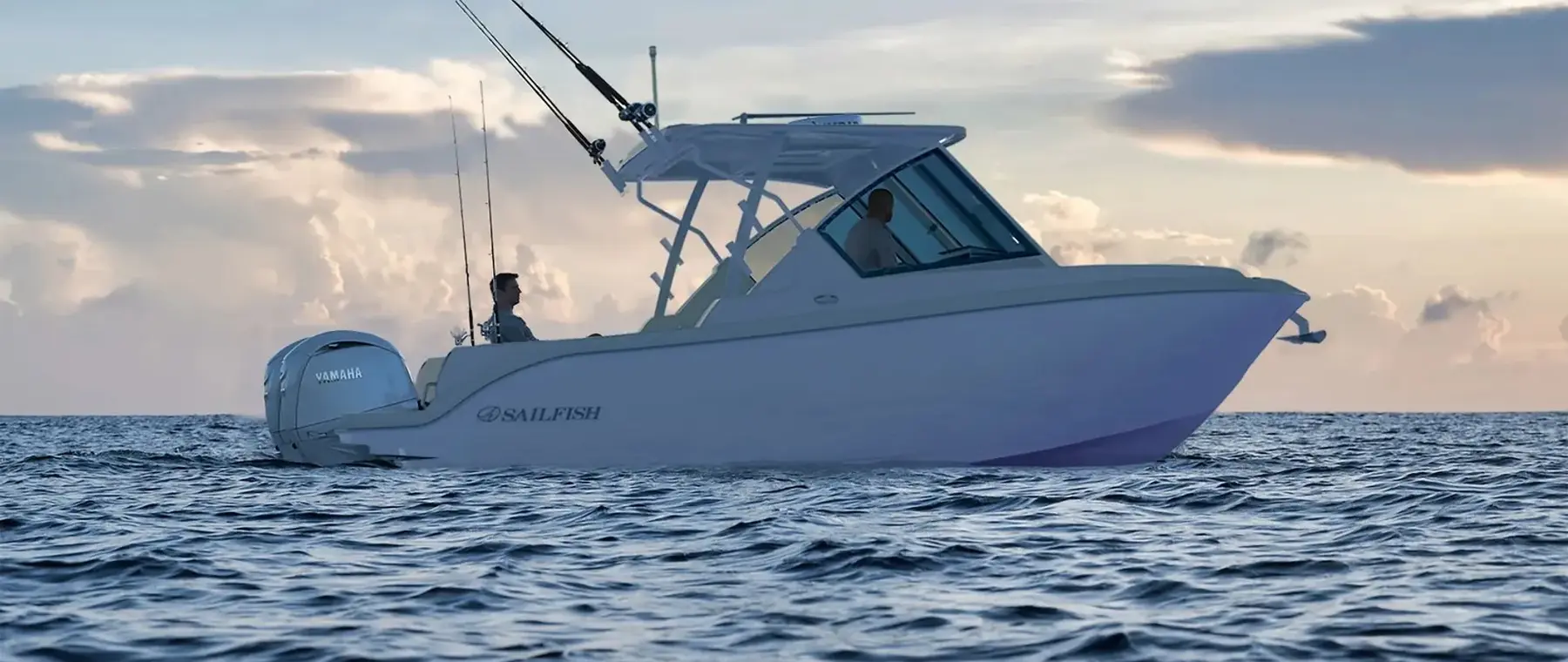
A new 25-foot dual console enters the range
Sailfish Boats has presented the 256 Dual Console, a new 25-foot model aimed at owners who want to combine inshore and offshore fishing with general family use. The Georgia boatbuilder's official announcement identifies an adaptable cockpit, protected helm positions and its established hull construction as the main ingredients. Unlike a dedicated fishing-only layout, a dual console must allow passengers and anglers to use the same space in different ways across a day.
The new craft measures 7.62 metres overall and is therefore within the small-boat scope of Leisure Boat Guide. Sailfish describes the model as suitable for owners who might fish early, cruise with family later and entertain at anchor. Those are intended uses rather than independently measured outcomes, and the layout should be considered alongside local sea conditions, passenger loads and the practicalities of storing equipment.
A cockpit designed for changing activities
The builder offers a choice between a standard cockpit configuration and an optional entertainment-centre arrangement. That flexibility is intended to let buyers prioritise fishing activity or more social seating without requiring an entirely different model. On any relatively compact boat, decisions about fixed furniture and working deck area have a noticeable effect on how easily people can move and how much gear can be carried.
A serious inspection should explore where tackle, fenders and safety equipment can be stowed when the boat is full of guests. Folding or convertible seating may allow the deck to switch between uses, but the ease of that change matters in practice. Owners will also want to consider whether the layout leaves enough clear space around the transom when fishing or boarding from a dock.
Variable Degree Stepped hull construction
Sailfish specifies its Variable Degree Stepped hull, usually shortened to VDS, as part of the 256 DC's design. The manufacturer says the hull is intended to deliver a soft and comparatively dry ride across a variety of water conditions. Its Sailtech construction process also uses materials including Kevlar and carbon fibre in parts of the structure, reflecting the builder's established approach rather than an entirely new material system.
Those claims should not be read as a substitute for a test in representative conditions. Actual ride quality depends on speed, load distribution, trim, wind and wave direction. Prospective buyers comparing similar boats may learn more from a careful demonstration with a normal passenger complement than from a hull description alone. The relevant question is how comfortably and predictably the 256 DC operates on the waters where it will be used.
Helm screens and protection
The helm provides space for a pair of 12-inch displays, allowing navigation and boat-system information to be positioned within easy view of the operator. A sport windshield is standard, while a taller windshield can be specified for additional weather protection. The dual-console configuration creates a defined passenger-side position as well as the helm, helping separate the main seating and forward access routes.
The presence of space for displays does not mean that every unit is supplied as standard. Buyers should review the actual electronics inventory, installation options and compatibility with any chosen engine package. Windshield height also involves a trade-off between a sheltered position and an open-air feel. Testing sightlines when seated and standing can reveal whether the arrangement suits the intended operator.
Propulsion choices and fuel capacity
The preliminary specification lists a maximum of 400 horsepower, available through single or twin outboard configurations. Sailfish gives the fuel capacity as 150 US gallons, equivalent to approximately 568 litres. These figures describe the boat's design envelope and tank size, not a guaranteed cruising range. Consumption can vary substantially with engine choice, speed, conditions and the weight carried aboard.
A buyer should establish the recommended propulsion specification for their normal boating rather than choosing solely on the highest permitted power. Single-engine and twin-engine installations can differ in purchase cost, servicing, weight and handling characteristics. Fuel planning should be based on expected conditions and verified consumption, retaining an appropriate reserve for the return passage. The precise engine package should be confirmed with the supplying dealer.
Dimensions and practical ownership
The manufacturer lists a beam of 8 feet 10 inches, or 2.69 metres, and a preliminary draft of 19 inches, approximately 48 centimetres. Sailfish also provides a published weight figure of 5,800 pounds, with the final loaded weight dependent on specification and equipment. These dimensions matter for marina berths, storage and transport arrangements as much as they do for deck space.
Owners planning to trailer a boat should verify the complete road-going dimensions, tow weight and local legal requirements with the dealer and trailer supplier. A nominal boat weight may not include fuel, gear or every installed option. Similarly, a shallow draft specification should not encourage an operator to enter unfamiliar water without allowing clearance for engines and underwater equipment. Practical measurements determine whether a boat fits an owner's routine.
Comfort provisions for longer outings
Sailfish includes an enclosed, lockable head compartment with a portable toilet and pump-out arrangement, while an electric upgrade is offered. The water capacity is listed at 12 gallons, about 45 litres. Such facilities can make a full day on the water more convenient for families who might otherwise need to return to shore more frequently. They also affect how the boat must be maintained and provisioned.
The usefulness of the accommodation depends on the size of the party and the journey being planned. Passengers may prioritise seating, shade, accessible storage or access to the bow over fishing-specific fixtures. The head compartment adds privacy but does not transform the 256 DC into an overnight cruising yacht. The right assessment compares facilities with the length of trips realistically expected from a seven-and-a-half-metre open boat.
What buyers should check
The 256 Dual Console broadens Sailfish's offer to boaters who want a dedicated offshore-capable hull combined with a more versatile recreational deck. The company's official announcement and preliminary specifications provide a basis for comparison, but final equipment packages, dealer pricing and delivery arrangements should be confirmed separately. Optional features can alter the final specification and the total cost of ownership.
Before ordering, a buyer should ask to see the exact configuration, engine installation, helm electronics and safety equipment, preferably during a representative sea trial. Maintenance access and the ability to move around the boat with passengers aboard are equally important. The 256 DC illustrates a growing demand for flexible dayboats, but its value to an individual owner will depend on how well its particular choices fit their intended boating.