
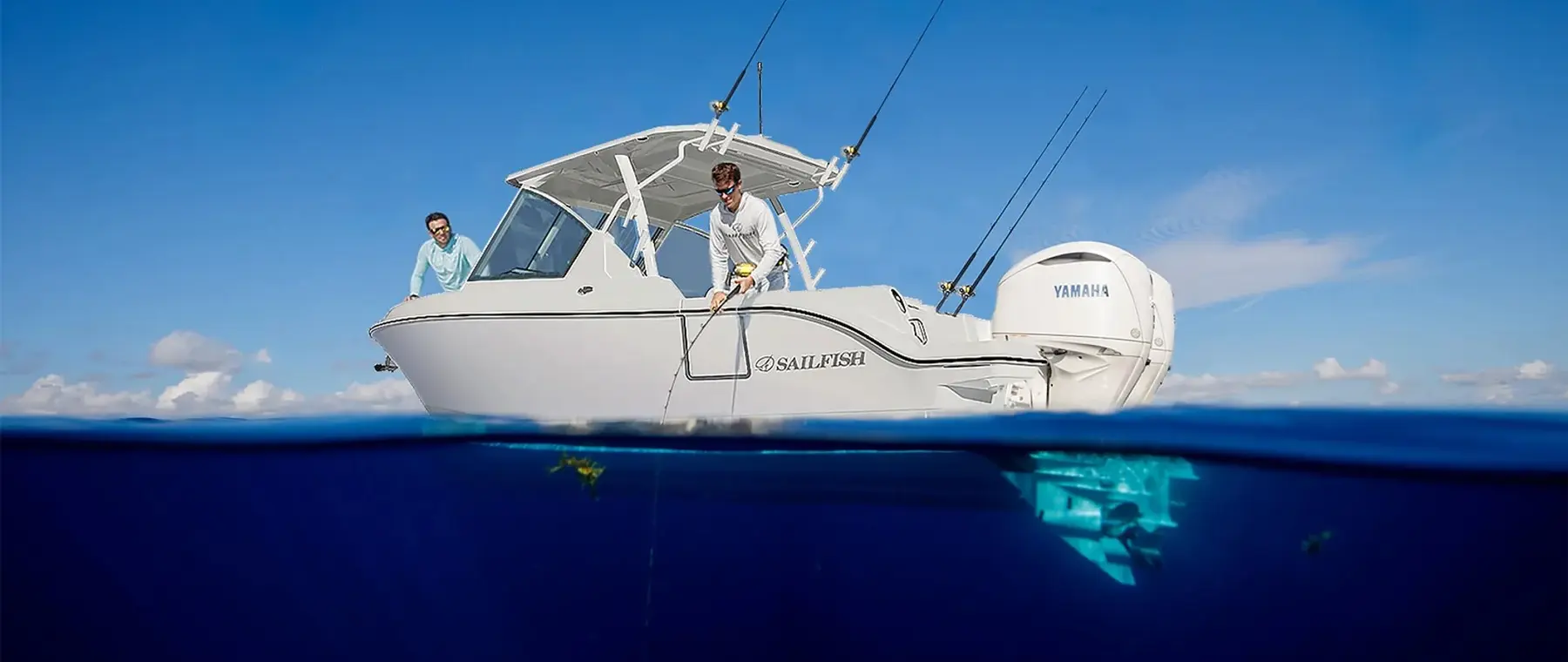
A new size in Sailfish's family boating lineup
Sailfish Boats has introduced the 256 Dual Console, a new design that aims to combine fishing capability with a comfortable, easily adapted family cockpit. The manufacturer announced the model in August 2026 and has since included it in the current 2027-model offering. Positioned around the 25-foot hull class, the 256 DC is intended for owners whose plans might move from an early fishing departure to afternoon swimming and then a relaxed coastal cruise.
That range of activities is an increasingly important design brief for dual consoles. Rather than organising the entire deck around a central fishing station, the arrangement gives passengers distinct areas while keeping useful equipment within reach. Sailfish's own introduction focuses on changes to the seating and boarding layout, indicating that everyday movement through the boat was as important to the design as engine horsepower.
How large is the 256 DC in practice?
The official specification gives a hull-only length of 25 feet and a rigged length of 26 feet 5 inches, with an 8-foot-10-inch beam. This distinction between hull and rigged length is essential when assessing marina slots, storage and lift dimensions. Some headline measurements omit fittings or outboards, while the space required at a particular berth depends on the final configuration.
An approximate 19-inch hull draft is listed alongside a dry rigged weight of about 5,800 pounds. Actual operating weight will be greater with a full tank, equipment and people aboard. The manufacturer lists a maximum capacity of twelve passengers, but that is not a promise of equal comfort with twelve adults carrying bulky fishing or watersports gear. Buyers should consider normal crew size and available places to sit and move.
The portside boarding door expands everyday uses
An important standard feature in the new layout is a portside boarding door. Sailfish emphasises the opening as useful not only for people joining from a dock, but also for swimmers returning to the boat and anglers handling larger catches. In a dual-console configuration, a side door can also help reduce congestion around the transom when several guests board at once.
The practical details deserve inspection. Owners should test how the door latches, where a reboarding ladder is stored and whether the opening lines up well with their home berth. Boarding is a dynamic activity, especially where tides and floating docks change the relative height of boat and pontoon. A useful feature is only safe when guests know the correct route aboard and have appropriate handholds.
One seat with four different roles
Sailfish's announcement identifies a four-position portside seat as a defining part of the 256 DC. It can face forward during a passage, face aft for socialising or extend into a lounging arrangement. That adaptability has obvious value when the same boat spends part of the day in motion and part at anchor, allowing furniture to support the day's activities without demanding a permanent change to the deck.
Reconfigurable seats need to work smoothly under real use. A walkthrough should check the latches, clearances and cushion storage associated with every position. The owner's priorities may differ from those shown in promotional photographs: anglers may want unobstructed space for rods, while a family with children may care more about secure facing-forward seats and a table. Seeing the transitions firsthand is therefore worthwhile.
A cockpit that can host or fish
The manufacturer offers an optional entertainment centre with a sink, cutting board and sliding cooler, bringing everyday catering functions close to the main social area. That can simplify lunches at anchor or keeping drinks readily accessible on a longer outing. However, it is an option, so the buyer should not assume it is included simply because it appears in a well-equipped demonstration boat.
Fishing remains part of the design's purpose. Sailfish lists fourteen standard rod holders in its model information and provides space to work around the aft cockpit. The exact suitability for trolling, bottom fishing or casual casting will depend on the tackle used and the chosen furniture configuration. Serious anglers should bring their requirements to the dealership and confirm how well the seats, storage and holders function together.
Power choices for different operating patterns
The 256 DC can be specified with a single or twin outboard setup within a maximum rating of 400 horsepower. This gives prospective owners alternatives in power, cost and maintenance complexity. A single-engine arrangement may appeal to a family focused on local day boating, while a twin setup changes the layout and service considerations and should be evaluated on its own merits.
Published power limits do not establish cruising speed or endurance. Engine brand, propeller choice, loading and sea state will all influence the outcome. The maker specifies a 150-US-gallon fuel tank, a meaningful capacity for this length bracket, but it should still be paired with representative consumption measurements and a reasonable return reserve when planning longer trips offshore or between coastal stops.
Windshield choices and helm technology
The standard sport windscreen is designed to preserve an open connection to the water, while Sailfish offers a taller windscreen for owners who prioritise additional protection. The helm is arranged to accommodate two twelve-inch displays, allowing navigation, sonar and essential systems to be separated across the driver's view. The exact equipment supplied will depend on the purchased electronics package.
Boaters who travel in cooler months should give the windscreen decision particular thought. A taller screen may provide welcome shelter, but visibility, ventilation and the ability to reach controls remain just as important. An informed comparison should involve sitting and standing at the helm with the boat configured as intended. A dashboard that looks impressive in a photograph still has to be intuitive when moving through traffic.
The VDS hull and construction method
Sailfish builds the 256 DC on its Variable Degree Stepped hull, which the company uses across its product range. The manufacturer pairs the hull with its SailTech construction approach and references materials including carbon fibre and Kevlar in the deck and hull. These are intended to contribute to durability and efficient structure, but a responsible comparison also requires attention to build execution and ongoing care.
The published deadrise range for the model is 22 to 24 degrees. That describes aspects of the hull geometry but cannot guarantee a particular ride in every sea. A proper demonstration should include turns, transitions on and off plane and typical cruising speeds with a normal passenger load. Practical handling and comfort matter far more than comparing an isolated hull-angle number across brochures.
Comfort for a full day on the water
The 256 DC includes an enclosed and lockable marine head compartment, with the maker describing a standard portable toilet arrangement with pump-out and an available electric upgrade. On family outings, this can be a major convenience, particularly where shore facilities are not close at hand. A freshwater capacity of twelve gallons is listed, although individual equipment choices determine how quickly that reserve is used.
Owners should inspect how the compartment is accessed and maintained and ensure its waste-handling arrangement complies with local marine regulations. Similarly, optional systems such as Seakeeper Ride are intended to reduce unwanted boat motion but will add complexity and cost. It is better to choose such equipment after considering normal weather and cruising patterns than to regard it as a universal requirement for the model.
What the new model offers buyers
The Sailfish 256 DC is most convincing as a balanced leisure boat, one designed to handle a changing day rather than excel at just one activity. Its versatile seat, side boarding door, range of engine choices and substantial fuel capacity all contribute to that flexibility. The presence of a more technical fishing specification means owners can still pursue offshore interests without abandoning family-oriented comfort.
The authoritative source is the official 256 DC model page, supported by the manufacturer's launch announcement. Buyers should obtain the current standard-versus-optional equipment sheet, ask for exact as-rigged weights and arrange a sea trial with the intended group. That is the most reliable way to judge whether this new dual console truly fits the family's preferred boating life.