
Training and access come together
The Royal Yachting Association has highlighted new opportunities for organisations involved in its Sailability programme to strengthen disability awareness, safe lifting procedures and the leadership of inclusive sailing sessions. Its 12 November 2026 announcement focuses on the people who run activities rather than the launch of a new boat. The training options include disability-awareness resources, courses involving hoists and moving people safely, and a one-day Session Lead programme intended to support a positive safety culture.
The development is relevant to Leisure Boat Guide because much of Sailability takes place in small sailing craft and support boats. A club providing access to the water needs equipment that suits its participants, but it also requires staff and volunteers who know how to use that equipment. A new ramp or adapted dinghy cannot create a safe programme on its own. The RYA's November update places the emphasis on knowledge, practical preparation and the ability of clubs to respond to different needs.
Disability awareness as a foundation
The RYA describes disability-awareness sessions that organisations can deliver in person using association resources. The programme is designed to help staff and volunteers make participants feel welcome, safe and confident, with flexibility over the duration and local content. That approach recognises that a small village club and a large training centre may have different facilities, volunteers and participant groups. It also acknowledges that inclusive boating is not simply a matter of purchasing a particular piece of equipment.
Effective disability awareness starts with speaking to sailors about their own needs and expectations rather than making assumptions. A person who uses a wheelchair ashore may have very different requirements once aboard a small keelboat, while an impairment that is not immediately visible may influence balance or communication. Staff should consider the participant's expertise and choices alongside the requirements of the craft. Respectful communication and a realistic assessment of the local sailing area are both part of a good introduction to the sport.
Hoist competency and practical handling
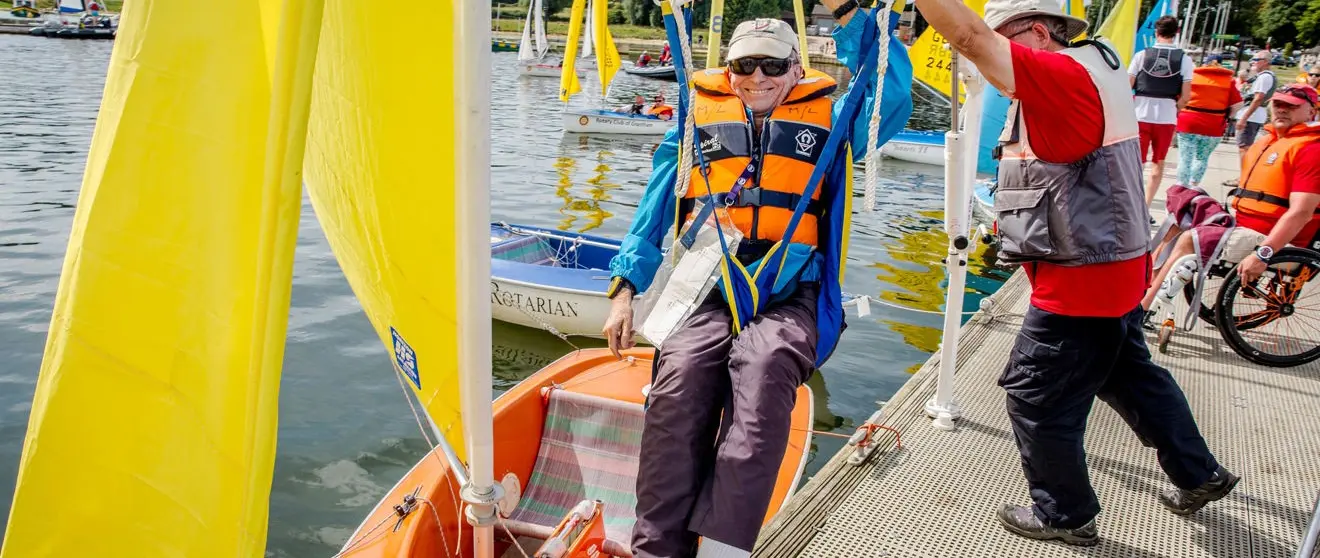
Some centres use hoists to transfer sailors between shore equipment and boats. The RYA identifies a one-day hoist-competency course covering general operating principles, intended to help attendees share the knowledge with others at their venues. It also offers a three-day moving-and-handling programme for people who will run in-house inductions and training. These courses address different levels of responsibility, and clubs should not assume that attendance at one automatically qualifies a volunteer to operate every lifting device.
A hoist installation involves engineering, maintenance and the individual needs of the sailor. Capacity, sling selection, inspection records, access routes and the competence of the operator all require attention. A club must also decide what happens if a device is unavailable or develops a fault during a session. The announcement encourages formal learning precisely because the task is too important to leave to informal instruction passed between volunteers without documented procedures.
The role of a session lead
The RYA's one-day Session Lead course is a classroom programme intended to help organisations organise safe and positive activity on the water. It considers people, working practices and documentation, rather than teaching only a single technical manoeuvre. That broader view matters on a busy dinghy day, when instructors, shore helpers, sailors and safety-boat crews are coordinating several activities at once. A session can be well intentioned and still encounter avoidable confusion if responsibility is unclear.
A session lead should understand who can make decisions about the weather, launch order, equipment checks and emergency response. The exact arrangements will depend on the club's operating procedures and the number of people afloat. Formalising these tasks makes it easier to brief volunteers and new participants, and helps ensure information is not lost when experienced people are absent. A positive safety culture is practical: participants know whom to approach, and staff feel able to report concerns without hesitation.
Safety boats need their own preparation
Inclusive dinghy sailing relies on appropriate safety cover. An instructor or safety-boat crew may need to assist with a boat that has capsized or recover a participant who cannot climb back aboard without help. The RYA's existing Sailability guidance encourages a systematic approach to risk assessment, checks of recovery equipment and practical drills. Safety-boat crews should be familiar with the craft used by the club, the likely recovery techniques and the limitations of their own equipment.
No single recovery method works for all sailors. The decision may be affected by the participant's mobility, sea conditions, boat design and whether an assisted return to shore is safer than recovering the person into the rescue boat. Staff need procedures that have been discussed with the participant and tested appropriately. Documentation is important, but its value lies in preparing the people on the water to make sound decisions when an unexpected event occurs.
Flotation and the need for individual decisions
Choosing personal flotation equipment can be more complicated when a participant has reduced mobility or may be unable to assist with self-righting in the water. The RYA's supporting safety material stresses that the characteristics of the individual device and the person's own needs should inform the decision. It also warns that self-righting behaviour cannot be guaranteed in every circumstance. An apparently standard lifejacket arrangement should not be adopted without checking how it actually fits and performs for the intended user.
The club should consider whether a participant can release straps or other securing equipment if the boat overturns. Any adaptation that affects posture, seating or the ability to escape requires careful assessment. The person going afloat should be involved in decisions wherever possible, rather than having assumptions imposed on them. Good preparation includes a clear explanation of procedures and the availability of competent support, not simply a statement that flotation equipment has been issued.
Adapted controls and small-boat design
Accessible sailing may involve boats with modified steering, powered winches or switch-operated controls. Such adaptations can give participants more independence, but they may also change the operating characteristics of the vessel. The RYA's guidance recommends checking modifications with the original manufacturer and ensuring the crew retains appropriate access to controls. An adaptation that is useful in ordinary conditions must also be assessed for equipment failure, capsize and recovery.
On a small boat, limited space makes the layout particularly important. Seating position, personal support, tiller reach and the movement of sheets all interact with one another. A club should avoid assuming that equipment designed for another boat can be transferred without further assessment. The objective is to create genuine participation while retaining a level of safety appropriate to the craft and the local sailing environment.
Making familiarisation meaningful
A new volunteer might know how to operate a boat but not how to assist someone using a lifting sling. Conversely, a carer may have excellent experience of moving a particular person yet little knowledge of sailing hazards. The RYA's education options provide a way to bring those different skills together. Clubs should create opportunities for staff to practise the equipment they are expected to use, ideally before a full programme begins and without the pressure of a live emergency.
Familiarisation is useful for participants as well. A sailor may need time to understand how a boat moves, how to control sails and what assistance is available. Confidence develops through respectful instruction and repeated positive experiences. Clubs should set realistic expectations for conditions and duration, particularly during a first outing. Inclusion is not measured by the number of people launched in a day if the activity leaves them uncomfortable or uncertain about their safety.
Learning from near misses
The RYA's longer-standing Sailability guidance encourages clubs to record and review accidents, incidents and near misses. A near miss can expose an unclear procedure or a piece of equipment that was not checked properly, even when nobody was hurt. Good safety culture treats that information as an opportunity for improvement rather than an embarrassment to conceal. Reviewing incidents can also reveal where refresher training is needed for a volunteer team.
Small clubs often depend on people who contribute in their spare time, making the transfer of knowledge especially important. Procedures should be concise, accessible and realistic, with responsibilities identified clearly. Practical drills can show whether those documents work when participants are already afloat. The November training announcement reinforces the need for ongoing learning rather than assuming a qualification earned years ago remains sufficient for every new activity.
Why clubs should review the off-season
The RYA published the update as many organisations enter a quieter part of their sailing calendar. That can be a useful time to inspect lifting equipment, update risk assessments, review the condition of small boats and discuss courses with staff and volunteers. Waiting until the busiest summer weekend makes training harder to organise and reduces opportunities to correct problems found during practice. A club's annual plan should include both equipment maintenance and the continued development of the people delivering activities.
The specific courses and resources will be most valuable when matched to the club's actual responsibilities. A centre without a hoist may still benefit greatly from disability awareness and session leadership. A venue that uses complex lifting equipment should ensure its operators have suitable training and regular competence checks. The aim is not to collect course certificates as an administrative exercise, but to make safe, enjoyable boating possible for a wider range of people.
A wider community benefit
An inclusive small-boat programme can bring families and communities together, giving participants opportunities to develop skills, make decisions and enjoy time on the water. Such programmes depend on patient instruction and reliable teamwork as much as on the design of the craft. The RYA's updated learning resources recognise that the experience of the sailor is the central measure of success. A technically sophisticated boat has limited value if the participant does not feel comfortable or welcomed.
Clubs and training centres can also benefit from exchanging lessons with other organisations. One venue may have useful experience of hoist maintenance, another of adapting controls or running sailing sessions in confined inland waters. Sharing knowledge can help avoid repeated mistakes and support volunteers who are taking on a demanding role for the first time. The RYA's programme offers a framework for that development without pretending every venue is identical.
What the announcement establishes
The confirmed 12 November news is the RYA's renewed emphasis on Sailability learning opportunities, including disability-awareness resources, a one-day hoist-competency course, a three-day moving-and-handling programme and one-day Session Lead training. It does not announce a new class of adapted boat or prove that participation has increased by a particular percentage. The association directs organisations towards its course information and existing safety-practice guidance for more detail.
For Leisure Boat Guide readers, the message is a practical one: access to sailing depends on trained people, properly prepared small boats and systems that recognise individual needs. Clubs can use the quieter season to assess where their programmes would benefit from new knowledge or a review of existing procedures. The strongest result will be sessions in which sailors enjoy the same sense of challenge and freedom as anyone else, with thoughtful support available when they need it.
Official source: www.rya.org.uk. RYA official Sailability programme photograph of participants and volunteers launching an adapted small sailboat at a waterside training centre, supplied with the association's 12 November 2026 announcement.