
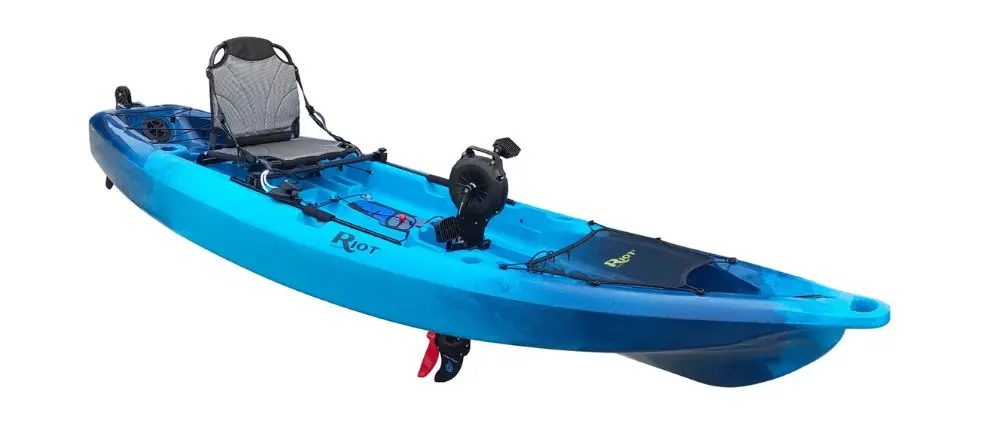
A fishing kayak built around the pedals
Riot Kayaks has presented its Mako 10.5 Impulse Drive for the Paddle Sports Show's 2027 kayak-fishing product selection. The model combines a 3.20-metre hull with a pedal-driven propeller intended to let anglers move and adjust position without putting down their fishing rods for a paddle. Riot positions the package as an accessible compact alternative to larger specialist fishing kayaks, although the suitability of any propulsion arrangement must be tested on the water.
Pedal propulsion is particularly attractive when a person needs both hands to cast, manage a lure or work a fish in changing current. A well-positioned pedal unit can reduce interruptions and allow more continuous movement. It does not remove the need to carry an appropriate paddle, practise manoeuvring without the drive or understand how the kayak behaves when it encounters shallow water.
The reversible Impulse Drive
The manufacturer's Impulse Drive uses a reversible propeller, giving the operator forward movement and genuine reverse through the pedal system. That can make fine positioning easier near a fishing location, especially when the skipper wants to avoid drifting across a chosen line. Unlike designs that require a person to use a hand-operated mechanism before changing direction, Riot presents its arrangement as readily reversible.
The simplicity of the concept should not be confused with an absence of maintenance. Propeller damage, drive alignment and contact with sand or weeds can all affect performance. Anglers should learn how the unit is removed or protected at a landing, and check whether spare components and service advice are available in their region.
A broad, compact platform
The Mako measures 10 feet 6 inches, about 320 centimetres, and is 34.5 inches, around 88 centimetres, wide. Riot specifies a weight of approximately 35.4 kilograms and a maximum capacity of 213 kilograms. These figures describe a compact but relatively substantial fishing platform, with a beam intended to support reassuring stability and space for equipment.
The stated capacity includes the angler and everything carried aboard. Tackle boxes, a cooler, extra batteries and electronic displays may contribute more weight than expected. A maximum rating does not guarantee comfortable operation at the limit, so owners should check trim and movement with realistic equipment rather than evaluate the hull only when it is empty.
A raised seat with useful adjustment
The Mako has a mesh-framed raised seat intended to offer comfort and airflow during longer sessions. A slide-track system allows the seating position to be adjusted for different heights without tools. Good adjustment is important for a pedal-drive craft because the legs need to work through a natural range of movement without straining or leaving the paddler too close to the controls.
Comfort should be assessed with a test fitting, particularly if a customer has knee or hip limitations. A raised position may make casting and viewing the surroundings easier, but it also alters how weight is distributed. Owners should understand how to move safely when leaving or returning to the seat, and avoid standing unless the manufacturer and conditions support it.
Hand-controlled rudder positioning
Riot specifies a Pilot Rudder System that can be controlled by hand and mounted on either side of the cockpit. This arrangement allows the owner to choose a configuration that feels natural while preserving the hands-free benefit of pedal propulsion for much of the trip. A rudder can help the angler hold a chosen course while the feet provide thrust.
It still requires basic technique. A rudder responds differently at low speeds and can be vulnerable near a launch where rocks, weeds or shallow sand are present. Buyers should practise controlling direction on sheltered water before assuming that the system will manage strong current or heavy wind by itself.
Bow shape and water conditions
The company's submission highlights an upswept bow, intended to help the Mako manage chop and the wakes of passing boats. This is a useful attribute for a fishing kayak that may travel across busier inland waters rather than remain in a sheltered pond. However, a wave-resistant bow does not turn a compact kayak into an offshore boat.
Weather, vessel traffic and water temperature still define where it can be used safely. The angler needs appropriate flotation equipment, an awareness of navigation rules and the ability to return under their own power if the drive becomes unusable. An early return should be planned if wind builds or the intended fishing location becomes exposed.
Trade-offs in transporting pedal kayaks
A 35-kilogram fishing kayak may feel manageable when afloat but require planning to move from storage to the launch. The pedal unit, seat and other detachable accessories can add to the total package and should be secured before transport. Roof racks, trailers or a suitable trolley may be appropriate depending on the owner's vehicle and physical ability.
A compact hull does help with storage compared with a much longer fishing kayak, yet the width and fittings still need room. Owners should measure the actual equipment and loading arrangement before buying. A boat that fits on a trailer but cannot pass into a home storage area may become inconvenient long after the novelty of the new drive has passed.
What the 2027 selection means
The Mako 10.5's inclusion in the kayak-fishing product selection shows Riot is presenting the combination of compact hull, reversible propulsion and adjustable steering to the trade. The listing does not establish that the boat won the overall award. Its official product photograph depicts the actual fishing kayak, allowing readers to inspect the cockpit and pedal arrangement.
For anglers, the decisive question is how well the kayak works during their usual fishing activity. A demonstration with tackle aboard can reveal whether the pedals feel natural, whether reverse is useful and how the boat responds to wind or current. The model's strongest potential lies in making controlled, hands-free movement available in a craft that remains practical to own.