
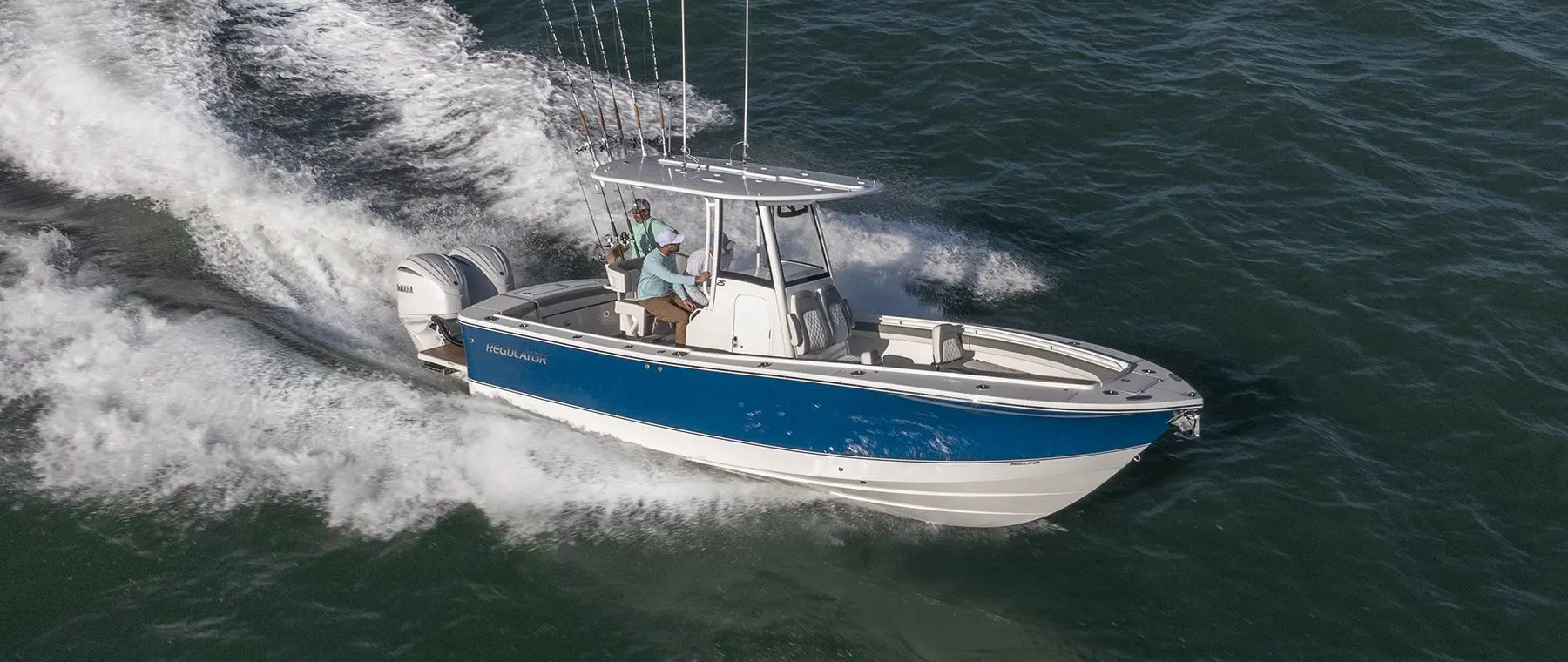
Why a 25-foot name does not tell the whole story
Regulator's 25 is a centre-console fishing boat whose identifying number understates the overall space required once the propulsion arrangement is counted. The manufacturer quotes a hull length of 25 feet 2 inches, but a length of 30 feet with the bracket and engines. That difference is material when an owner books a marina berth, measures a lift or plans winter storage, and it deserves to be checked early.
The listed beam is 8 feet 10 inches, while the standard dry weight with engines is given as 8,330 pounds. Those figures put the boat in a class that warrants a proper towing and lifting assessment rather than a casual assumption based on the 25 designation. A boat's transport dimensions, fuel, batteries, trailer and additional equipment determine the actual demands placed on a vehicle or hoist.
Regulator describes its current 25 as a revived offering with updated helm and fishing provisions. The most useful approach is to assess the vessel as a working platform and family dayboat, not simply to accept comparisons with smaller centre consoles. Layout, structural access, finish quality and the character of a sea trial will decide how successfully the boat manages both tasks.
Hull form, draft and offshore expectations
The manufacturer specifies 24 degrees of deadrise at the transom, a feature often associated with a deep-V approach to cutting through chop. It does not make any hull immune to slamming or spray, and ride quality remains dependent on how a skipper handles speed, trim and the sea state. On this model, the deadrise is one element of a broader package rather than a substitute for operating judgement.
Regulator gives a draft of 22 inches with the engines raised and 34.5 inches with them lowered. Those two numbers should appear together whenever a buyer plans shallow-water access. A sandbar anchorage may be approachable at idle with engines lifted under controlled conditions, yet the boat's normal powered draft is greater and bottom clearance changes with loading and trim.
Published bridge height is 110 inches, another useful figure for owners travelling beneath fixed structures or storing the boat under cover. Buyers should confirm the precise height of the chosen hardtop, antennas and accessories because an advertised figure can omit later additions. Local tide ranges and the accuracy of a charted bridge clearance matter more than a theoretical few inches of margin.
Fishing volume is clearly prioritised
Regulator lists a combined fishbox and storage capacity of 1,058 quarts and a 46-gallon transom livewell or fishbox arrangement. Within that total are two 178-quart forward seat compartments, a 408-quart in-deck compartment and a 230-quart centre-forward area. The separation is useful for handling different kinds of gear, but the meaning of every compartment depends on drainage and whether it is intended to remain wet or dry.
The in-deck fishbox can also serve as locking rod storage, illustrating the trade-offs common to a versatile centre console. Using a large compartment for rods may reduce the chilled storage available for the catch, while fitting it for fish requires a rigorous cleaning routine. Buyers should ask the dealer to show lid supports, insulation, drains and the route by which water leaves the vessel.
The manufacturer's latest presentation emphasises additional rod holders and an improved leaning post. This is welcome attention to the working positions of anglers, who spend long periods bracing against movement and reaching for equipment. However, the effectiveness of the arrangement should be tested with the intended number of crew, actual rods and tackle, rather than inferred from an uncluttered showroom boat.
How much family comfort is included?
Regulator places cushioned seating forward of the console and offers removable backrests and a table or sun-bed arrangement. The insulated forward console seat adds another location where a guest can sit without occupying the stern working area. The benefit is a genuine second use for a boat that will not fish every time it leaves the berth, although exposed bow seating requires sound weather judgement.
An optional head with holding tank is listed, together with a 20-gallon freshwater tank. As with any centre-console enclosure, the height inside and the ease of access may determine how useful the facility is to older passengers or families with children. The manufacturer's published head height is 74 inches, which should still be checked physically because usable space is not defined by height alone.
Comfort also includes movement around the console, places to store towels and food, and a route back to the cockpit when the boat is rolling. Handholds, nonslip decks and the side-deck width deserve close inspection. They are unlikely to stand out in a specification headline but can become the features owners notice most during ordinary weekends afloat.
Fuel planning and equipment selection
The Regulator 25 carries a stated 160-US-gallon fuel capacity. That tells a potential owner how much fuel the system can hold, not how much distance can safely be covered at a chosen speed. Range planning must account for actual engine burn, usable fuel, weather and a reserve; the manufacturer's published performance information should be read in the context of the engine package tested.
With a large centre-console hull and substantial engine weight, careful trimming and balance matter under load. Passengers, anchor gear, fishing tackle and a full fuel tank can change the feel of the boat. A competent sea trial should include several speeds, a turn in both directions and docking manoeuvres, with the skipper explaining how the vessel responds rather than merely demonstrating maximum performance.
Modern electronics can create a superb helm, but buyers should review which navigation displays, transducers and communications devices are installed as opposed to shown in marketing material. Redundancy is an especially important consideration for offshore use. An accessible switch panel, labelled circuits and practical service routes have more long-term value than a screen arrangement that looks impressive only while everything is new.
A focused checklist for the Regulator 25 buyer
The 25's strongest measured points are its deep-V specification, large dedicated storage compartments, substantial tankage and the clear distinction between hull length and overall length including engines. Those are concrete characteristics, not claims about how all owners will feel aboard. They suggest a boat aimed at anglers who want offshore credibility without giving up forward seating and other dayboating conveniences.
A serious buyer should measure the actual vessel for berth fit, operate every fishbox and hatch, examine the transom livewell plumbing and confirm the head specification. It is also worth comparing insurance, annual servicing and mooring charges with those for a nominally longer boat. The 30-foot overall figure is particularly important when marinas or storage providers charge by measured length.
All figures quoted here are drawn from Regulator's current official 25 model information and remain subject to model-year variation and optional equipment. The final decision should rest on an inspection and sea trial of the exact build under consideration. For owners whose primary interest is fishing but who value a comfortable family outing, the Regulator 25 offers a meaningful balance to investigate.