
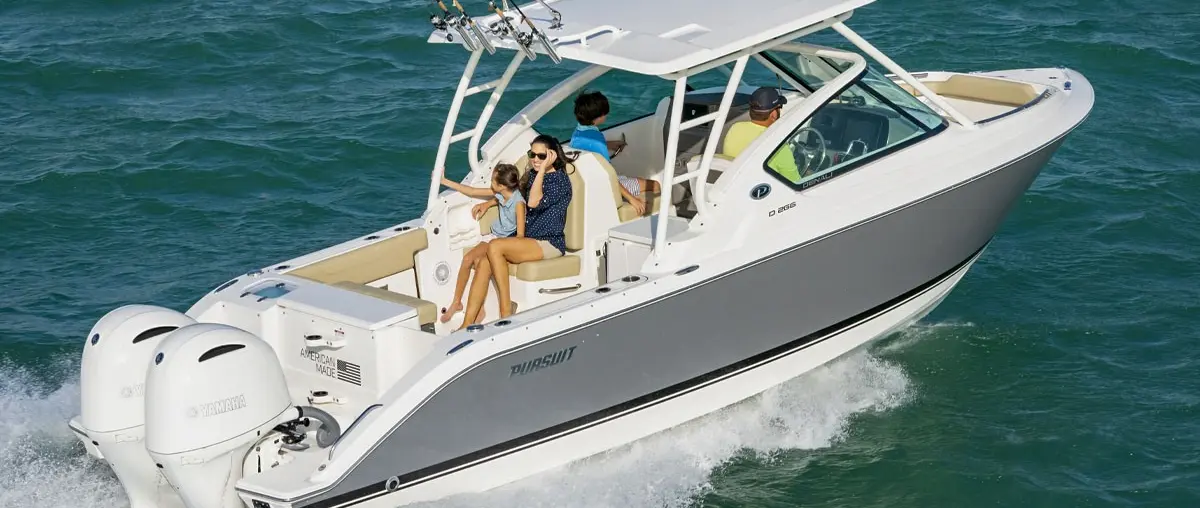
A different answer to the family-boat question
Small powerboats often force a clear decision between fishing equipment and comfortable family seating. Pursuit's D 266 Denali challenges that separation by applying a dual-console arrangement to a boat measuring 8.33 metres overall. The owner can take a group to a beach in the morning, fish offshore when conditions allow and entertain aboard in the afternoon without starting from a hull whose entire layout is optimised for only one activity.
The two consoles define the boat's character. A sheltered helm to starboard and a companion side to port create an open central walkthrough, making the bow seating easier to reach while preserving a protected area around the crew. The fibreglass hardtop and tempered-glass windscreen add real utility when running into spray, although an open-bow vessel still requires judgement about when and where exposed passengers should be seated.
The beam is 2.67 metres, broad enough to support flexible seating but not so generous that the boat becomes an unwieldy floating lounge. Buyers considering towing, storage or restricted slips will want to compare that number with local regulations and available transport equipment. Pursuit's approach is to make each metre work hard, with an interior that can change from social to task-focused as the day progresses.
What changes when the rods come out
With guests aboard, the cockpit can function as a casual conversation area; for fishing, foldaway seats release working deck space. This is a useful distinction because loose chairs and cushions can obstruct a fishing crew at precisely the wrong time. Integrated seating reduces the conversion process to an intentional rearrangement rather than a lengthy operation that persuades the owner to leave gear unused.
The boat's equipment list includes a 20-US-gallon livewell and a 31-US-gallon fishbox, supported by rod holders positioned where a working crew can reach them. These figures provide a better indication of the model's actual fishing intent than a photograph of someone holding a rod. An owner primarily interested in serious tournament fishing may still prefer a purpose-built centre console, but this layout preserves enough utility for frequent recreational trips.
The bow is configured differently, with wraparound seating that makes it a natural place for passengers to enjoy a harbour cruise at moderate speed. An available sunpad transforms the area into an informal lounging space at anchor. Parents should assess the comfort and safety of younger passengers in varying conditions, since a pleasant bow lounge in sheltered water should not be assumed to be the right place for every part of a passage.
Propulsion, capacity and real-world range
Pursuit specifies twin Yamaha F200 outboards for the D 266, with a published maximum combined horsepower of 400. Engine separation can make low-speed control more intuitive for an experienced helmsman, but manoeuvring technique still matters, particularly around crosswinds or close-quarters docks. The manufacturer's listed 21-degree transom deadrise is one element of the ride characteristics, not a universal promise of softness in difficult chop.
The fuel tank holds 139 US gallons, approximately 526 litres, while freshwater capacity is given as 20 US gallons. Rather than converting those numbers into a universal cruising range, prospective owners should look for engine-specific performance data at realistic passenger and gear loads. Fuel use changes with sea state, speed, propeller specification and hull condition, making a quoted best-case range an unsuitable basis for every family trip.
The published draft is about 0.53 metres with the motors raised and 0.84 metres with them lowered. That shallow-water ability can suit exploring inshore channels and sandy islands, but the numbers do not account for every local hazard or wave condition. A hardtop air-clearance figure of approximately 2.41 metres is also relevant to covered storage and some bridge passages, especially once optional antennae or equipment are fitted.
Ownership questions before placing an order
The manufacturer's current material describes an approximate dry weight of 3,184 kilograms with twin F200 outboards, before fully loaded cruising stores. That is not a figure to use unadjusted when selecting a trailer or tow vehicle. A boat delivered with a full tank, safety gear, accessories and watersports equipment may impose very different demands on launching facilities and marina lifts.
The combination of a sink, a private head area and multiple storage spaces makes day use more comfortable than the dimensions alone suggest. Nevertheless, the D 266 is a dayboat rather than a dedicated overnight cruiser with standing cabins. Owners planning repeated late returns should prioritise good navigation equipment, lighting, suitable clothing storage and the practicalities of cleaning fishing equipment after a family outing.
What makes the D 266 distinctive is the speed with which it can change purpose. The foldaway cockpit, sheltered forward consoles, open bow and genuine fishing systems combine to make a broad-use vessel rather than a compromised imitation of several types. The most useful sea trial would include a realistic load and a mixture of cruising and manoeuvring, allowing the buyer to assess whether that versatility works as well on the water as it does on the specification sheet.