
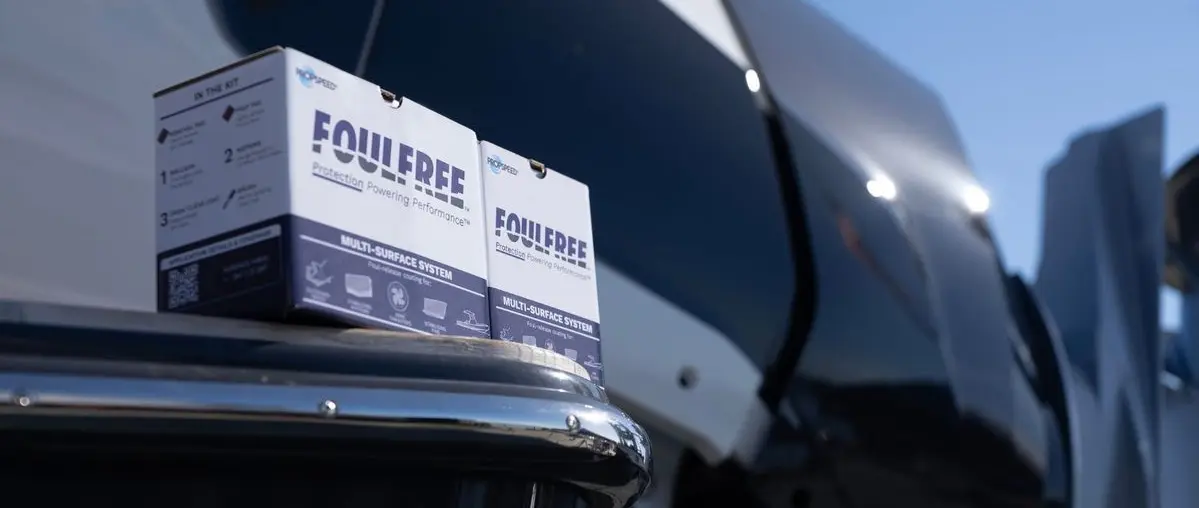
An IBEX award for protecting underwater components
Propspeed's Foulfree Multi-Surface System was one of the winners of the 2026 IBEX Innovation Awards, announced in Tampa on 6 October. The award in the boat care and maintenance category recognises a coating intended for submerged components that are often awkward to protect because they are made from plastics, composites or coated metals rather than traditional underwater hull materials.
The product is relevant to smaller leisure craft with outboard engines, RIB tubes, transducers and associated fittings. Biofouling can build up in these exposed areas and complicate cleaning or affect the movement of components. The manufacturer describes its clear coating as a way to make attachment more difficult without using a biocidal antifouling ingredient.
A different approach from conventional bottom paint
Foulfree is a foul-release system, meaning it aims to create a surface that makes it harder for marine growth to remain attached. It should not be confused with coatings that rely on chemical biocides to suppress organisms. Propspeed says the transparent finish is designed to preserve the appearance of the components to which it is correctly applied.
For owners, this distinction matters when selecting an appropriate protection method. A product that releases fouling may still require inspection and periodic cleaning, particularly when a boat remains stationary for long periods. Results can vary with water conditions, vessel usage, surface preparation and maintenance, and the manufacturer's description is not a substitute for local operating experience.
The manufacturer says the system can be applied to outboard lower-unit paint and brackets, stabilising systems, fins, certain thrusters and RIB tubes. It is not presented as an all-purpose coating for every material under the waterline. Using the right product on a bronze propeller is a different problem from treating a painted outboard lower unit or a composite part.
Which substrates are on the compatibility list
Propspeed's published compatibility table includes fibreglass, carbon fibre, ABS, POM or Delrin, polypropylene, nylon, acrylic, polycarbonate and HDPE. It also lists Hypalon or CSPE, PVC and OEM outboard paint. The variety is a significant part of the product's appeal because a modern small boat can combine many such materials within a relatively compact space.
The same table specifically rules out bronze, stainless steel and uncoated aluminium for this system, directing owners to the company's separate Propspeed treatment instead. The distinction is easy to overlook when evaluating a single kit for a boat with mixed underwater hardware. Coating the wrong substrate could compromise adhesion or protection, so the compatibility instructions should guide the job.
The company reports adhesion testing against ISO and ASTM criteria across more than twenty substrate classes and factory coatings. That is the manufacturer's reported test programme, not an independent statement that every installation will deliver identical results. Owners should check whether a particular factory finish, previously applied paint or repaired area needs extra preparation before attempting the coating.
Application follows a sequence rather than a quick wipe
The product's maintenance process has separate cleaning, priming and clear-coat stages. Propspeed markets it as a four-step application and specifies a ten-minute primer overcoat window at 20 degrees Celsius, followed by approximately twelve hours' cure time before returning the boat to the water. Timing and temperature limits mean the actual work area and weather conditions need to be planned.
On a trailerable boat, the accessible engine leg and appendages may make the application easier than the same job on a vessel afloat. Nevertheless, correct preparation is essential, especially where the original coating is damaged or contaminated. Applying a clear layer over an unsuitable old surface does not resolve defects that should have been addressed first.
Owners should follow the product's current technical and safety documents, including any specified surface-conditioning process, protective equipment and ventilation. The quoted twelve-hour interval is a manufacturer condition at 20 degrees Celsius, not a promise that every coating will cure at the same rate in colder, wetter conditions.
Small and medium kits serve different areas
Propspeed offers separate small and medium Multi-Surface kits. The small kit has a stated coverage of 0.5 square metres and contains 60 millilitres each of cleaner, primer and clear coat, together with preparation materials and brushes. That format is intended for smaller boats or selected areas rather than a large collection of fittings.
The medium kit is designed for approximately 2 square metres of coverage and supplies 240 millilitres each of the cleaning, priming and finish components. Propspeed specifically associates this larger format with RIBs and yacht stabilising fins, where there may be a larger surface area to protect. Quantity planning needs to consider the full area, number of components and the permitted coating thickness.
The published dry-film thickness is 97 microns for the Multi-Surface coating. Owners should not assume that adding extra layers improves protection; the system is intended to be applied within the manufacturer's specified procedure. A successful application is primarily a preparation and process task rather than a question of using as much product as possible.
Why smaller boats can benefit from attention to appendages
A small outboard boat may spend part of the season afloat, leaving the lower unit, brackets and sensors continuously exposed to fouling organisms. Even when the hull is cleaned, these less visible components can accumulate deposits in places that are difficult to reach. Reducing adhesion could make seasonal maintenance more manageable, particularly for boats kept in saltwater.
RIB owners face a different set of materials around the tube and its attachments. Some fabric surfaces may be listed as compatible, but not every section of an inflatable structure is necessarily appropriate to coat without following the builder's care guidance. Boat manufacturers and coating suppliers should be consulted if there is uncertainty about warranties, adhesives or the tube's original finish.
Performance claims also deserve careful interpretation. The manufacturer says clean submerged components can help avoid drag and other problems associated with growth, but it has not published an independent speed or fuel-saving figure that can be applied to every boat. A customer comparing maintenance products should focus first on compatibility, correct application and the expected inspection schedule.
The award and the buying decision
IBEX says its 2026 programme selected twelve innovation award winners from one hundred entries, with judging undertaken by Boating Writers International for the marine trade show. Propspeed was recognised alongside Spectrum Color in the boat care and maintenance category. The honour is evidence of industry judging, but it does not exempt an owner from checking the product instructions for a specific application.
Propspeed's technical product information sets out the compatible surfaces, kit coverage, timing and excluded metals. The formal IBEX award announcement confirms the 6 October result. Together they give a useful basis for evaluating the coating without assuming its suitability for every underwater surface.
For the owner of a compact cruiser or RIB, the decision is practical: identify the actual substrates, inspect their condition, estimate the area to treat and confirm the work can be carried out under suitable curing conditions. That preparation will matter more to the result than the award itself, even as the honour places the product among the notable maintenance introductions of the 2026 show.