
A new explanation layer for passage planning
PredictWind has announced an AI Weather Router that turns completed weather-routing and departure-planning results into written briefings. Presented in October 2026, the feature is intended to help crews interpret competing route and departure options without having to examine every chart, forecast model and numerical table separately.
The distinction is important: the AI does not simply invent a route from a conversational prompt. PredictWind says the feature works with its existing routing calculations, forecast information and vessel-performance inputs. It then explains those results in ordinary language, adding a review layer to a planning process that still depends on the quality of the underlying data.
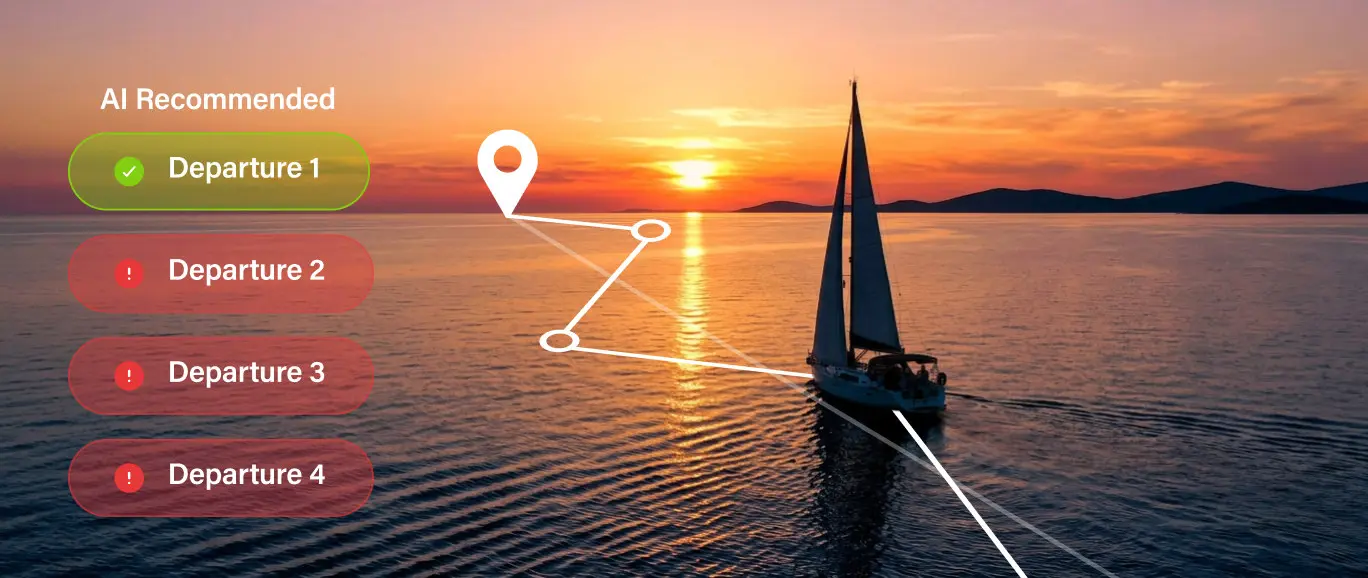
Comparing possible departure days
Departure Planning ordinarily compares the conditions that a boat would encounter by leaving on different dates. PredictWind's new AI summary reviews the completed comparison and can identify a preferable day with an explanation of why. It can also advise caution, advise against departure or conclude that none of the examined choices is fully recommended.
This could help a leisure skipper who sees several plausible coloured route lines but is uncertain how to weigh wind direction, sea state, time at sea and forecast confidence. The written briefing makes a recommendation easier to discuss with a crew. It remains advice based on modelled conditions, not a promise of safe weather.
From weather numbers to crew instructions
PredictWind says the passage briefing is organised around key time periods and the conditions expected along a route. Rather than presenting only a maximum wind speed or an arrival estimate, it is designed to describe where a passage may become demanding and when conditions are expected to ease.
That approach has practical value for a small crew. Watchkeeping, meals, sleep and movement around the boat become harder when motion increases. A briefing that identifies a difficult overnight stretch can prompt a conversation about departure timing, watch rotations or an alternative destination before everyone leaves the marina.
The role of boat performance data
The AI Router is linked to the weather-routing engine and uses information including boat polars, which describe expected performance in different wind conditions. This matters because two boats on the same passage may experience different elapsed times, apparent wind angles and exposure to changing weather systems.
Owners should ensure their boat-performance assumptions are realistic. A theoretical performance curve, a heavily loaded boat and a crew reluctant to carry full sail can produce markedly different outcomes. An articulate AI summary cannot compensate for an inaccurate starting model, so the skipper still needs to validate speed and capability inputs.
Forecast confidence is part of the story
PredictWind highlights the ability to point out where forecast confidence falls as a passage extends beyond the more reliable part of the prediction horizon. This is especially useful for longer journeys, where a neat-looking route can conceal considerable uncertainty late in the trip.
For practical planning, such warnings should encourage flexible decisions. A departure that looks favourable today may need reassessment after the next forecast update; a small boat may also require a conservative weather window. The feature should be read as another input to seamanship, alongside official forecasts, actual observations and local navigational notices.
Designed for the existing apps
The manufacturer says the AI Weather Router is available within its PredictWind app and Offshore app as part of the Weather Routing and Departure Planning functions. It requires a Standard or Professional subscription. The company presents the model as developed with experienced sailors, routing professionals and delivery captains.
Subscribers should check their own plan entitlements, device compatibility and connection requirements before depending on the feature during a trip. A passage plan should also be saved in formats the crew can access if connectivity or a screen fails. The company's description does not remove the need for backup navigation methods.
What an AI route briefing can and cannot do
A readable explanation may expose considerations that a busy skipper could miss when scanning graphs quickly. It could also make collaborative decisions easier, because less experienced crew members can follow the reasoning behind an early departure, a later start or a planned diversion.
However, automated recommendations should not be treated as an independent authority for navigation. The feature cannot see every unreported obstruction, mechanical weakness, human limitation or rapidly developing local squall. It does not assume legal responsibility for the voyage. The captain must still decide whether the boat and crew can undertake the proposed passage.
A broader shift in boating software
PredictWind's launch illustrates how marine software developers are moving beyond displaying increasingly detailed data towards explaining its meaning. The underlying forecast and routing calculations remain indispensable, but the interface increasingly tries to translate them into decisions a crew can act on.
For recreational boaters, that is a promising direction if implemented transparently and checked against real conditions. The safest use is to compare the AI briefing with the route plots and official weather sources, question anything surprising and update the plan as new information arrives. The technology should support judgement rather than displace it.