
Portimão brings together an international inclusive fleet
The 2026 World Sailing Inclusion Championships concluded on 10 October in Portimão, Portugal, after six days of racing across keelboat, multihull, visually impaired and other inclusive disciplines. The second edition attracted 222 athletes from 40 nations, reflecting growing demand for international competition in accessible sailing. The final day delivered close medal decisions alongside a particularly notable performance from Poland's Piotr Cichocki.
The championship should be understood as a collection of different events rather than one race with a single winner. Each discipline uses equipment and competition formats suited to its participants, and results in one category do not automatically transfer to another. That diversity is central to the event's ambitions: to provide serious sporting opportunities for sailors with varying needs and experience.
Cichocki wins two Hansa 303 gold medals
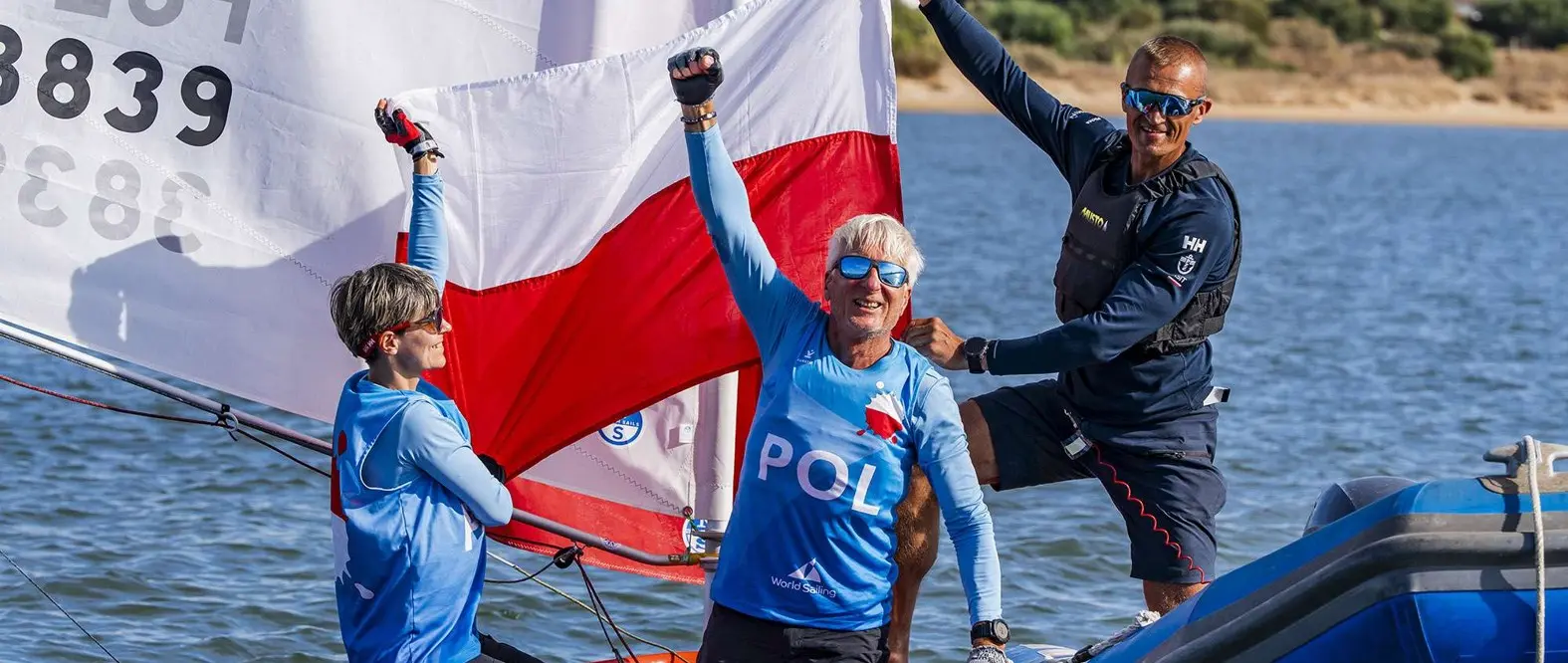
Piotr Cichocki won the Para Inclusive One Person Keelboat event in a Hansa 303, defeating Germany's Jens Kroker after entering the final day with only two points separating them. Two further race wins helped the Polish skipper complete his campaign, while Portugal's João Pinto finished with bronze. The result showed the importance of handling pressure after a week in which the leading sailors had exchanged strong performances.
Cichocki also won the Inclusive Two Person Keelboat event alongside his wife Joanna Cichocka, giving Poland a memorable double success. The pair had established a substantial advantage before the final races and extended it with two additional victories. Portugal's Carlos Santos and João Pinto took silver, while Korea's Mun Sungwon and Dongjin Yun completed that podium.
Sweden survives a final-race turnaround
The Para Inclusive Two Person Keelboat category, sailed in RS Venture Connect boats, provided one of the closest conclusions. Sweden's Fia Fjelddahl and Patric Rosenberg began the final day ten points ahead, but a difficult opening race allowed Spain's Pau Toni Homar and Ramón Gutiérrez to reduce the difference to two points. The last race then became a position-by-position contest involving boats from several nations.
An Austrian team ultimately moved ahead of the Spanish challengers, helping the Swedish crew secure gold on countback. The outcome demonstrates how fleet racing differs from a direct match between two competitors. Even when one rival is the principal championship threat, the positions of every other boat can determine whether a team wins or loses a medal.
Other disciplines produce a wide range of champions
Britain's James Coxon won the Challenger multihull title following his return to sailing, while the British team led by Lucy Hodges retained the Vision Impairment championship. Finland's Marko Dahlberg led a complete Finnish podium in the 2.4mR technical keelboat class, ahead of his son Otto Dahlberg and Rikard Bjurström. Hong Kong, China's Tsz Hin Cheung secured the Para Intellectual Impairment competition in the ILCA 6.
Portugal's José Campos won gold in the Inclusive Cognitive Impairment category. These results show why the championship cannot be summarised through one kind of sailing or one equipment platform. Some competitors race alone and make every decision themselves; others depend on teamwork and communication across several crew members. The organisers must coordinate those different requirements within one international programme.
Seated wingfoiling appears on the programme
The 2026 championship also introduced Inclusive Wingfoil as a demonstration discipline, with seated riders participating in an emerging form of the sport. Light winds prevented final-day racing, leaving Britain's Charlie Wolf at the top of the standings, with fellow Briton Jazz Turner second and Vietnam's Truc Diep third. The demonstration is a step towards exploring what accessible foiling competition might become.
A demonstration event is not the same as a fully established championship class with years of standardised international competition. Equipment development, training, accessible launching facilities and consistent rules will be essential if the discipline grows. The wider significance is that sailing organisations are testing new approaches instead of assuming accessibility can only be achieved through traditional keelboat formats.
Wind and currents test the competitors
Portimão presented a varied range of racing conditions, from challenging seas and stronger winds to lighter tactical sessions. Competitors also had to account for local currents, which can change the relationship between apparent wind, boat speed and progress towards a mark. Cichocki specifically noted the challenges of racing on the ocean as he reflected on his wins.
Weather is an important consideration for every sailor, but equipment suitability and support arrangements can become especially relevant at an inclusive event. Organisers need reliable launching facilities, course management and rescue cover appropriate to different craft. Weather-related adjustments to the racing schedule should be assessed in that practical context rather than assumed to indicate a weakness in any particular competitor.
Accessibility involves more than adapted boats
World Sailing's Inclusive Development Programme aims to extend training and international participation to nations that are still developing relevant coaching and equipment networks. That effort involves sailors, race officials, classifiers, volunteers and national sailing organisations. It is supported in part by funding associated with the America's Cup, while the Portimão edition was delivered with local partners including Vela Solidária.
An accessible event requires more than fitting a boat with a modified seat. Transfer arrangements, shore access, transport, communication, changing facilities and the ability to service specialist equipment can determine whether a sailor can participate. Yacht clubs seeking to broaden membership may find these practical questions as important as the purchase of any single training boat.
The next championship moves to Poland
Organisers have indicated that the 2027 World Sailing Inclusion Championships will take place in Gdynia, Poland. The move will give Cichocki and his fellow Polish sailors an opportunity to compete on home waters, where different wind and current conditions will create new tactical challenges. It will also provide another opportunity for the participating nations to improve programmes established during the first two championships.
Great Britain received the 2026 Nations Trophy as the leading country overall, a separate recognition from the medals in individual disciplines. The combined results demonstrate the growth of inclusive sailing as a competitive international sport, not merely a series of exhibition races. For the wider boating community, the lasting value will depend on translating this level of participation into accessible facilities and regular sailing opportunities throughout the year.