
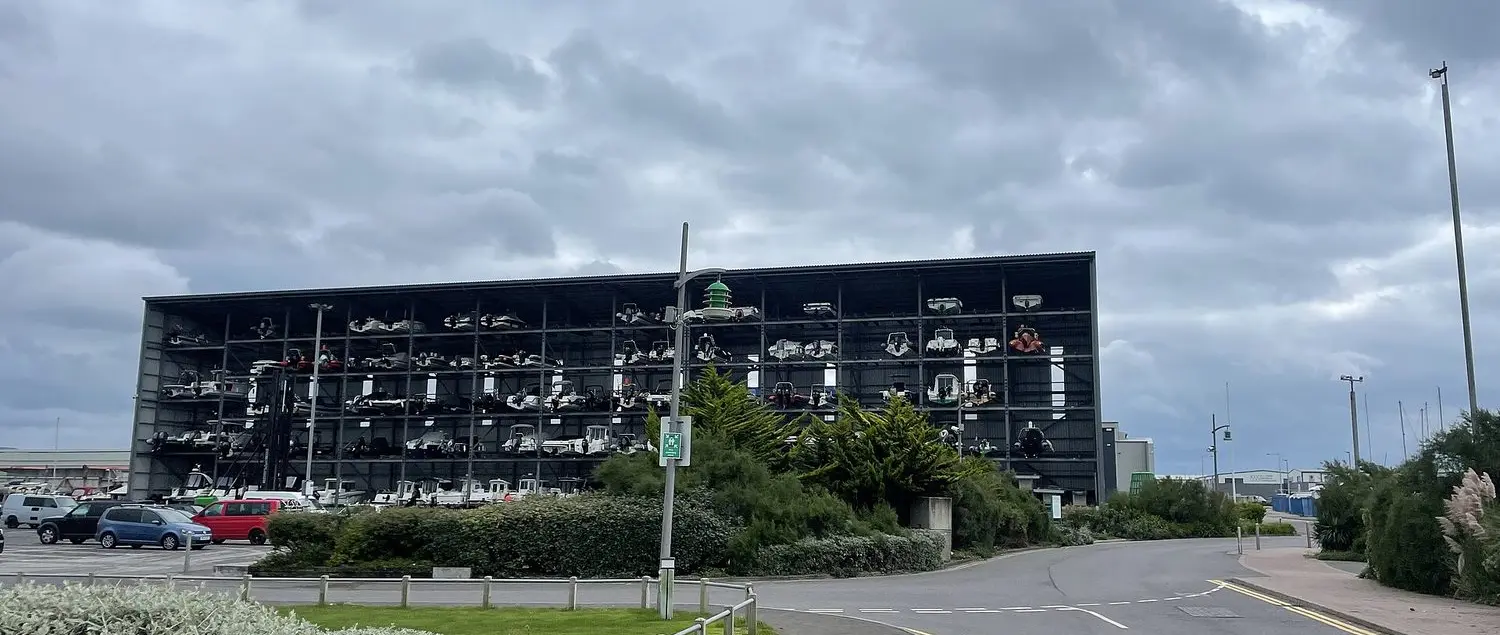
Palm Beach Gardens prepares a large dry-stack marina
PORT 32 Marinas has appointed Matt Domke as general manager and Linda Pfeifer as member adviser and leasing specialist at its redeveloped Palm Beach Gardens facility in Florida. The appointments were announced on 3 November 2026 as the project enters its final preparation phase, with an opening planned for December 2026. The development is directly relevant to owners of smaller motorboats because its capacity is dominated by enclosed dry storage rather than conventional wet berths. The company says advance leasing is already under way.
The precise opening date has not been confirmed in the announcement. A facility expected to open in December should not be described as operational in early November, even if the management team has been appointed and construction is advanced. Potential customers must check whether storage contracts can be signed, whether a particular boat can be accommodated and when launching services will actually begin. Publicity about a forthcoming marina is not the same as permission to arrive with a boat for immediate storage.
Four hundred and fifty-one dry-storage spaces
The operator plans a total of 471 slips, including 451 fully enclosed dry-storage spaces and 20 wet berths. This balance makes the development especially significant to owners who keep a recreational boat out of the water between trips. PORT 32 says its dry-stack facility will accommodate vessels ranging from small tenders to boats as long as 60 feet, subject to a published maximum height of 22 feet. Those upper limits extend beyond Leisure Boat Guide's under-twelve-metre scope, but a large share of potential users may operate more compact craft.
Not every boat below the quoted maximum length will automatically fit. Beam, weight, engine height and structural details matter, as do any restrictions on equipment that remains attached to the boat. Owners should request written confirmation for their exact vessel before committing to storage. An advertised capacity of 451 spaces describes the planned facility, not the number of spaces available to book on a particular date or guaranteed after all membership allocations are made.
The location offers two inlet choices
PORT 32 Palm Beach Gardens is being developed at 2385 PGA Boulevard, with access to the Intracoastal Waterway and routes towards the Atlantic Ocean through the Jupiter and Palm Beach inlets. Those waterways are used by a broad mixture of recreational and professional craft. A smaller dayboat owner might value a storage location that offers sheltered local cruising as well as the possibility of coastal trips when conditions allow. The best route still depends on vessel capability, tide, current and the latest navigation information.
The distance to an inlet is not a guarantee of quick access in all conditions. Bridges, traffic, speed restrictions and weather can make journeys slower or more demanding than a promotional map suggests. Inlet conditions can deteriorate when wind and tide oppose each other, particularly for open boats with limited freeboard. A marina's geographical advantages should be assessed alongside the skipper's experience and the realistic conditions in which the boat will be used.
Enclosed storage changes the ownership routine
Dry-stack arrangements can reduce the amount of time a hull spends in the water, potentially limiting some fouling and exposure to waves at a berth. They also change how an owner launches and recovers the boat. Instead of walking directly onto a wet slip, customers generally ask the marina team to retrieve their craft, place it in the water and return it to storage after use. The precise procedure for the new PORT 32 site is not fully detailed in the announcement.
Prospective members should ask how far in advance a launch must be booked, whether same-day requests are possible and what happens if weather delays a return. They should also clarify the policy for batteries, fuel, loose equipment and any maintenance performed while the vessel is in storage. Dry stacking can make small-boat ownership convenient, but that convenience depends on service reliability and a schedule suited to the customer's normal boating habits.
A 75,000-pound lift rating is a facility claim
PORT 32 says the new marina will use large forklifts with lifting capacity of 75,000 pounds and elevated operator cabins intended to improve visibility and handling. This is a manufacturer or operator statement about the proposed infrastructure, not a demonstration witnessed by Leisure Boat Guide. A substantial lifting system can allow a facility to handle boats larger than those normally associated with traditional small-boat dry stacking. For compact craft, lifting precision and staff training are at least as important as the maximum rated capacity.
Large lifting machinery requires procedures appropriate to the hull and its supporting points. An owner should not assume a boat can be lifted anywhere along the keel or chines. The marina and boatbuilder may need to agree on suitable support arrangements for particular designs. Safe lifting also depends on operator competence, equipment inspection and local working conditions. A high capacity rating gives context but does not remove those engineering requirements.
Hurricane-rated design draws attention
The marina is described by its operator as a Category 5 hurricane-rated facility, engineered for wind speeds up to 180 miles per hour. That is an ambitious resilience claim and may be attractive to boaters in a region exposed to major tropical storms. It must be understood as a statement about design standards rather than a promise that every stored vessel will remain undamaged during any hurricane. Storm behaviour involves wind, flying debris, water and other hazards that are not captured by a single speed figure.
Owners should review the storage agreement, insurance requirements and hurricane plan before relying on a facility for severe-weather protection. They need to know what the marina requires when a storm threatens, how access is restricted and who is responsible for preparing the boat. The operator's published structural rating does not replace a suitable insurance policy or the need to follow official emergency instructions. No marina should be described as completely storm-proof.
The twenty wet slips serve a different market
The proposed 20 wet slips are described as suitable for boats between 50 and 100 feet, placing them mainly outside Leisure Boat Guide's target audience. By contrast, the much larger dry-stack allocation is relevant to compact motorboats and small recreational craft. Distinguishing these facilities is important: an owner of a seven-metre runabout should not expect a conventional small wet berth to be available merely because the promotional release announces 471 total slips.
The split also illustrates how the marina intends to serve different ownership patterns. Larger vessels may require permanent afloat access and additional dockside services, while many smaller boats can be stored in enclosed racks. Customers should enquire about the correct product before comparing prices. A dry-storage membership and a wet-berth agreement may involve very different access arrangements, responsibilities and costs.
A new management team has been named
Matt Domke brings a marine-industry career beginning in 1989 and previously held a leadership role at PORT 32 Fort Lauderdale. Linda Pfeifer has been appointed member adviser and leasing specialist, with a background in customer-facing roles. The company says the appointments are intended to help build the new marina's operational and membership services before opening. Those are confirmed personnel developments rather than evidence that the entire site has already completed all operational testing.
Service can be a decisive factor for a small-boat owner using a rack-storage marina. Customers need clear information about launching, access, fuel, cleaning and emergency arrangements. An experienced management team may help shape those procedures, but its reputation must be tested in day-to-day operation after the facility opens. Members should still obtain written details rather than rely solely on statements about an enhanced concierge experience.
The business case depends on more than capacity
A facility with hundreds of enclosed spaces may support convenient small-boat access in a busy coastal region, but its success will depend on affordability, staffing, service reliability and demand. The November release does not provide a complete tariff, occupancy figure or financial projection. It would be speculative to claim that every space will be leased quickly or that the project will lower storage prices at competing marinas. The appointment of leasing staff shows preparations are advancing, not the outcome of the leasing programme.
Owners weighing dry storage against a marina slip, trailer storage or a private driveway should compare full annual costs. Those may include launch fees, membership charges, service restrictions, transportation and insurance. A compact boat that is used only occasionally may have different financial priorities from one launched several times a week. The planned PORT 32 facility offers another potential choice, but a realistic comparison requires confirmed operating rules and prices.
What small-boat owners should take from the news
The verified November development is a new management and leasing team for PORT 32 Palm Beach Gardens ahead of its planned December opening. The project is expected to provide 451 enclosed dry-storage spaces and 20 larger wet slips, with access to the Intracoastal Waterway. It has drawn attention through its substantial lifting machinery and claimed hurricane-resilient construction. Most importantly for LBG, it illustrates continued investment in services designed to store and launch smaller recreational boats.
Until the facility opens, the most responsible approach is to treat capacity, design and timing as the operator's announced plans. Owners should confirm their vessel's eligibility, the signed membership terms, the actual opening date and the launch arrangements before making changes to an existing berth or storage contract. The project's future importance will depend on how safely and reliably it handles boats when daily operations begin.
Sources: PORT 32 management appointments and marina specifications, 3 November 2026 and PORT 32 official company site. Photograph: illustrative dry-stack boat storage by Eirian Evans, Wikimedia Commons, CC BY-SA 2.0; this photograph is not of the proposed Palm Beach Gardens site.
