
A new arrangement for a compact Polish powerboat
Pegazus Boats has introduced a Bow Rider variant of its 500 family, giving the compact Polish-built motorboat a dual-console arrangement and an open forward seating area. The manufacturer describes the boat as suitable for recreation and fishing, a combination that makes sense in a hull intended for short outings rather than extended accommodation. Official published specifications give a length of 4.98 metres and a beam of 2.32 metres, putting it squarely within Leisure Boat Guide's under-12-metre editorial remit. This is an announced model configuration, not a reported delivery to a named owner. The builder has not supplied an independently verified sales tally or market forecast, and no such figures are needed to appreciate the new layout.
How the bow-rider concept works
The defining feature is an accessible bow cockpit ahead of the windscreen rather than a completely enclosed foredeck. Pegazus says the forward space is arranged as U-shaped seating, which can be developed into a sun pad or a fishing platform depending on the owner's needs. That adaptability is significant on a boat below five metres because there is relatively little deck area to allocate between leisure passengers and equipment. A family may prefer a comfortable place to sit at anchor, while anglers may want more uncluttered working room. Prospective owners should establish whether each arrangement is standard, optional or a dealer-fitted choice. Changing an advertised seating plan is not necessarily a simple alteration after delivery.
Two consoles divide the working spaces
The 500 Bow Rider uses two consoles, with the manufacturer's description specifying an aluminium windscreen arrangement intended to protect the helm and passenger. Such a layout provides a central route towards the bow and can give occupants a degree of shelter when the boat moves at moderate speed. Its effectiveness depends on the actual screen height, seating position and exposure to waves; a windscreen does not make an open boat weatherproof. On an inspection, try the passage between the consoles, locate secure handholds and check whether a person can move forward without stepping on loose cushions. These practical details count far more than how spacious the cockpit appears in an isolated promotional photograph.
The dimensions in the official specification
Pegazus publishes a 4.98-metre overall length, 2.32-metre beam, 2.05-metre height and 0.35-metre draft for the 500 Bow Rider. The technical page also lists a weight of 670 kilograms. Buyers must clarify what that weight includes, since the final trailering and towing mass normally rises with an engine, fuel, battery, safety equipment and trailer. Draft can also vary with loading and how the propulsion unit is positioned. All four figures are useful starting points for assessing a berth, driveway or launch ramp, but none substitutes for dimensions and mass measured on the actual purchased package. A dealer should confirm the precise configuration in writing before a towing or storage decision.
Maximum engine and passenger figures
The published upper engine rating is 112 kilowatts, equivalent to about 150 metric horsepower, and the maker specifies space for up to seven persons. A maximum engine rating is not a recommendation to use that output for every owner, and passenger capacity must be read alongside loading limits. More people, equipment and fuel can alter handling and trim even when the nominal number of seats is sufficient. The builder additionally lists maximum load as 820 kilograms. Customers should ask how the stated capacity is defined and how fuel, engine mass and other items count towards it under the relevant documentation. A boat being permitted to carry a number of people does not mean that every seat is comfortable for a rough-water passage.
What design category C conveys
The manufacturer identifies the model's design category as C under the recreational-craft framework. This classification describes a design standard associated with specified environmental conditions; it is not a promise that any individual trip will be safe whenever the wind reaches a particular speed. Weather, waves, visibility, crew experience, loading and access to shelter still determine whether to go out. Some small open boats spend most of their lives on calm inland water despite a higher published design classification. For the 500 Bow Rider, the CE declaration and owner's manual should be examined together so a buyer understands the vessel's intended service conditions and equipment requirements rather than relying on a single letter in a brochure.
Fishing and family boating ask different things
The builder's idea of configurable forward space recognises a familiar compromise. Passengers appreciate padded seating, cupholders and comfortable resting areas; anglers generally want clear casting positions, gear storage and surfaces that are easy to wash. Neither arrangement is universally better. On a boat of this size, an installed sun pad can make the bow inviting for relaxed stops but may occupy space that would otherwise carry tackle or allow movement. A raised fishing platform must be assessed for safe footing and stability, particularly when the boat is moving. Buyers should describe a realistic day's use, including how many people will be aboard, before choosing optional modules or accessories from photographs.
Planning propulsion without overspending
The 150-metric-horsepower maximum does not establish the optimum engine for a particular route. A lightly loaded boat used for short, sheltered-water journeys may have quite different priorities from one that regularly carries several people and fishing equipment. Operating cost, weight, fuel capacity, acceleration and maintenance provision all affect the choice. Official performance curves for the hull with a named engine would be more useful than a generic promise of speed, but none should be invented where the manufacturer has not supplied them. When comparing quotations, require the engine model, propeller specification, controls, battery and charging arrangements to be clear. A demonstration using a similar load can help assess comfort and handling.
A small craft is often a trailer boat
At just under five metres, the Pegazus could appeal to owners who move between lakes and coastal launching areas, provided the complete trailer combination meets local limits. The key figure for towing is the laden assembly, not merely the 670-kilogram published boat weight. A safe setup needs a correctly rated trailer, suitable vehicle, secure winch and straps, working lighting, and appropriate braking where required. Launch ramps also vary in width, gradient and the amount of water available at low tide. An owner who plans regular self-launching should practise an efficient routine with the engine and trailer configuration actually supplied. Ease of ownership comes from these mundane details as much as the attractive bow seating.
The Polish manufacturer and the market
Pegazus Boats gives its business address in Sztabin, Poland and offers boats, engines and trailer arrangements through its sales channels. The 500 Bow Rider appears alongside the builder's other smaller recreational models. No independently verified retail price, dealer stock level or waiting time is available from the principal technical page, so it would be premature to publish an invented starting price. Nor does a new model alone demonstrate that the entire European small-boat market is expanding. It is evidence of one manufacturer presenting another way to configure a modest hull. Buyers outside Poland should confirm local import, warranty, service and registration arrangements before ordering from a distant dealer.
Inspection points before ordering
Inspectors should sit at both consoles, stand in the central walkway and test the movement between the stern and bow. Ask to see the seat cushions removed and installed, and check where they are stored when the forward space becomes a fishing deck. Examine drainage, battery access, fuel filling, deck hardware and the location of emergency equipment. If optional electronics are fitted, verify they do not obstruct lines of sight or essential controls. A hull may look suitable in a video but reveal inconvenient reaches or narrow passages in person. Such observations need not disqualify a boat; they simply help match it to the owner's size, mobility and typical crew.
A specification is not the complete ownership cost
A new 4.98-metre boat may be simpler to maintain than a large cruiser, but insurance, launch fees, winter storage, batteries, engine service and trailer upkeep still matter. Where electrical accessories and entertainment equipment are added, charging arrangements and available battery capacity deserve attention. If the boat will be kept afloat, antifouling and marina charges may apply instead of some trailer costs. Buyers comparing the 500 Bow Rider with similar models should evaluate annual use and running costs alongside the initial sale price. There is no reason to assume that a higher maximum engine rating automatically makes a configuration more economical. The best package is the one that suits actual use and remains manageable.
What is confirmed and what remains open
The verified facts are a 4.98-metre Pegazus 500 Bow Rider with 2.32-metre beam, dual consoles, configurable bow seating, published category C, 670-kilogram quoted weight, seven-person maximum and an engine ceiling of 112 kilowatts. The builder has not published every optional-equipment price, real-world fuel consumption figure or delivery date on the cited model page. A buyer should seek those details directly, together with the exact loading definition and a written package quotation. The model's appeal is its ability to combine family seating and angling space on a genuinely compact platform. That claim can be judged by inspecting the real boat rather than borrowing specifications from other 500-series variants.
Sources and photograph credit
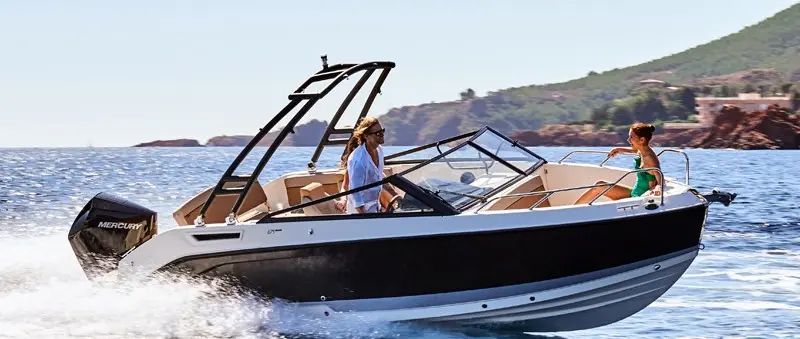
Source: Pegazus Boats official 500 Bow Rider model and specifications. Photograph: Quicksilver Activ 675 Bowrider.jpg by Quicksilver Boats, Wikimedia Commons, CC BY-SA 4.0. This archival illustrative photograph shows a Quicksilver bow-rider, NOT the Pegazus 500 Bow Rider. The photograph was resized for web use.
