
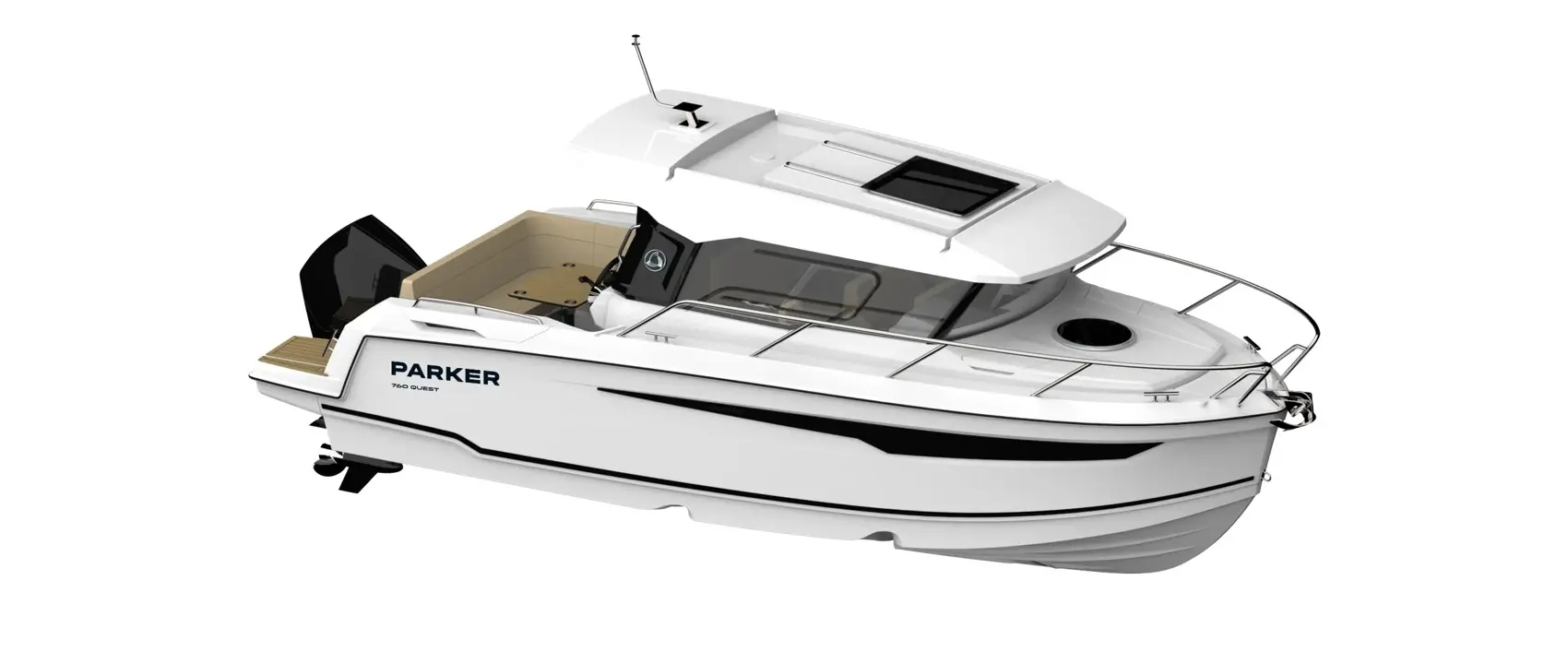
A hull designed for varied coastal work
Parker gives the 760 Quest an overall length of 8.1 metres and a beam of 2.54 metres, with a stated weight of 2,270kg without the engine. It sits between the builder's smaller 660 Weekend and larger 790 Explorer. The dimensions suggest a compromise aimed at couples and families who need genuine cabin comfort without moving into much higher operating costs.
The twin-stepped hull is central to the design story. Parker says the arrangement aims to reduce friction and improve fuel efficiency as well as top-end performance, while its construction uses vacuum infusion and composite reinforcement. Owners should ask for performance figures for their own engine and load rather than assuming every hull achieves the most favourable result.
The builder cites an independent test in which a 200hp configuration achieved 35.6 knots in the reported conditions. That is a useful indication of capability, not a promise for a fully loaded boat in rough water. For weekend cruising, predictable motion and visibility at moderate speeds may matter considerably more.
The cabin changes what is possible
The interior includes a galley, forward berth area and a separate toilet compartment, with a saloon table that can convert into an additional sleeping space. It is a configuration that can support an unplanned night away or a carefully organised short trip. Families should inspect headroom, ventilation and the practicality of converting the seating before treating the nominal berth count as comfortable capacity.
A hinged seat back lets passengers orient towards the dining area when stopped or face forward while travelling. That is a small but useful mechanical solution to an age-old cabin-boat problem: seated guests need different support underway and at the table. The idea reduces the need for separate pieces of furniture.
Three-part sliding doors provide access to an aft cockpit with L-shaped seating. This helps connect the main cabin to outside activity and simplifies circulation on fine days. Owners who fish frequently should consider how cushions, tables and lines can be managed so that leisure furniture does not interfere with the working deck.
Engine, tanks and practical equipment
The official model description lists 230 litres of fuel, a 40-litre freshwater tank and 40 litres of waste holding capacity. Those figures can support simple overnight routines, but they are not a substitute for planning realistic fuel reserves and fresh-water use. A busy family day involving showers or cooking can consume supplies more quickly than expected.
Parker's current technical listing permits a maximum of 300hp, while the builder's model comparison distinguishes passenger limits by CE operating category. Owners need to observe the appropriate rating for their conditions and registration. Adding larger engines and equipment also changes the loading and balance that matter on a relatively compact boat.
An extended roof with a panoramic window is among the model's customisation possibilities. This may appeal to owners in variable climates who prioritise protected seating and cabin light. The trade-off involves added height, ventilation and potential storage considerations under fixed bridges or covers.
A genuine multipurpose weekender
The 760 Quest is interesting because its design does not insist the owner choose permanently between fishing and family cruising. The cockpit can support a rod-and-tackle outing one day and a relaxed coastal stop the next. That adaptability has financial value if the owner would otherwise be tempted to keep two specialised boats.
Before ordering, it is worth considering the boat's complete displacement with engine, passengers, stores and trailer if relevant. Realistic launching and retrieval arrangements may determine how often the family gets afloat. A prospective buyer should also inspect how safely everyone can move around the deck when the boat is rolling at rest.
The Parker 760 Quest's strongest case is that it offers enclosed accommodation, reasonable performance and a useful working area in 8.1 metres. It is not without compromises, but those compromises are visible and can be evaluated during a proper sea trial. The best buyer is someone who genuinely expects to use both sides of its personality.