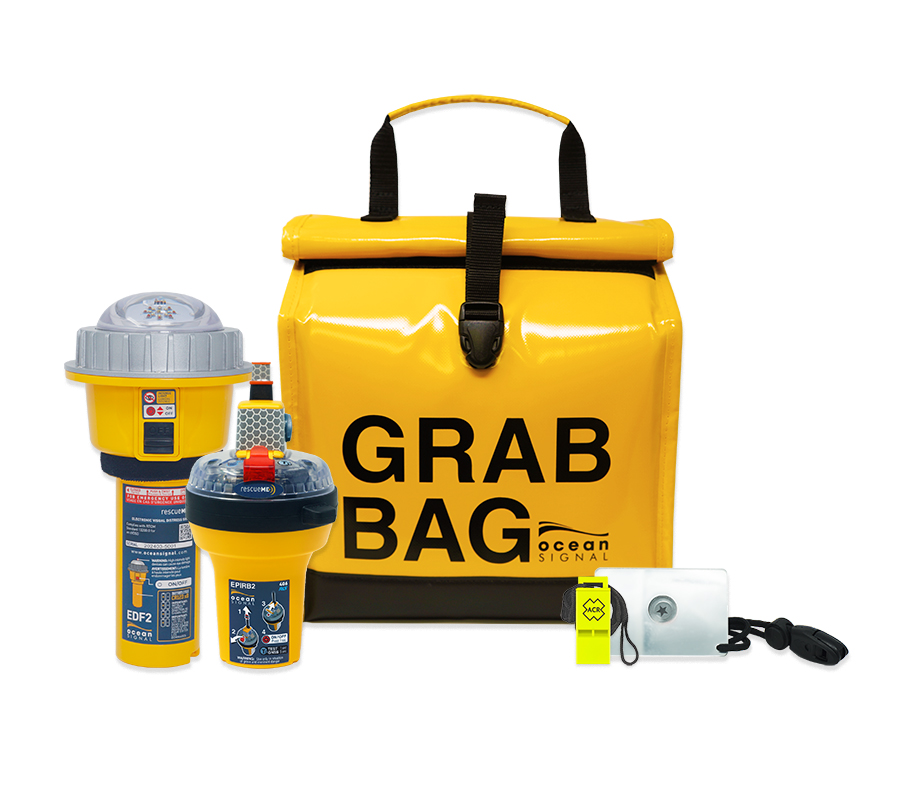
Marine safety specialist Ocean Signal has introduced its purpose-designed emergency Grab Bag to the METSTRADE 2026 audience, highlighting the value of organising essential equipment before a leisure-boat emergency develops. The manufacturer describes a brightly coloured, water-resistant bag with nine litres of internal storage, external compartments for communications and rescue devices, reflective detailing, tether points and space for vessel identification. The product is a piece of emergency organisation equipment, not an electronic distress beacon and not a replacement for one. For small-boat owners, its appeal lies less in a dramatic technology claim than in a simple question: when something goes wrong, can the crew find and carry the equipment they will need?
A recent show introduction with a practical purpose
Ocean Signal's latest product has been presented publicly around the November 2026 METSTRADE exhibition in Amsterdam. The timing makes the equipment relevant to owners reviewing their winter safety preparations and operators evaluating next-season inventories. The idea of carrying emergency supplies together is not new; sailors have used dedicated grab bags for decades. The development reported here is a manufacturer-specific product that combines an identifiable carrying format with compartments and fittings intended for modern marine safety devices. A product launch alone does not establish that it has been tested in every emergency scenario. The useful questions are what it holds, how it is stored and how the crew will use it.
Nine litres is internal capacity, not a universal packing list
Ocean Signal specifies a nine-litre main compartment. That is a guide to available space, not a promise that every recommended survival item will fit with equal ease. Food rations, spare batteries, first-aid material, a handheld light, thermal protection and a personal locator beacon all compete for space and weight. A coastal dayboat needs a different equipment selection from a boat contemplating a longer offshore passage. The right approach is to begin with a risk assessment and a checklist suited to the vessel, then confirm the bag can be closed and carried without obstructing access to important items. Overfilling a bag may make its quick-release purpose harder to achieve.
External pockets keep key devices identifiable
The manufacturer lists two large outside pockets intended for EPIRBs, VHF radios or similar equipment. These external positions can reduce rummaging when a crew needs a communications device, but the arrangement must be checked against each unit's size, antenna and protective casing. A handheld VHF and an emergency position-indicating radio beacon have different functions; neither should be assumed interchangeable. The most important item may be a beacon that can automatically alert search-and-rescue authorities, while a working VHF supports local communication. A bag that keeps them visible and immediately accessible may help, provided every crew member knows what each device does and how to operate it.
The bag does not replace the beacon
An emergency grab bag is essentially storage and transport equipment. It cannot create satellite coverage, guarantee a distress transmission or locate a casualty by itself. EPIRBs, personal locator beacons and marine VHF radios must be selected, registered where required, maintained and tested according to their own manufacturers' guidance and applicable rules. A useful safety audit checks battery expiry dates, registration details, identification numbers and the availability of operating instructions. Keeping a beacon in a distinctive yellow bag could help during an evacuation, but the owner should consider whether the device also requires a separate mounting or release arrangement. Those decisions depend on the actual boat and its safety plan.
Water-resistant is not the same as watertight
The product description calls the Ocean Signal Grab Bag water-resistant and buoyant. Neither term should be casually rewritten as waterproof in every condition. Water-resistant materials can slow wetting and protect equipment during spray or brief exposure, whereas a watertight container involves a different level of sealing and may be subject to its own performance limits. Owners should put vulnerable papers, medications, batteries and other moisture-sensitive supplies in suitable additional protection. The maker's buoyancy claim also needs to be understood with a realistic load: a container that floats empty may behave differently when full. Follow the manufacturer's stated limits rather than inventing a guaranteed flotation weight.
Bright colouring and reflective tape aid identification
Ocean Signal uses an intensely visible exterior and what it identifies as SOLAS-approved reflective tape. That detailing can help crew locate a bag in a dim locker or provide contrast during a search, but it should not be treated as proof that a rescue will be swift or successful. Reflective material needs an appropriate light source to return a signal and must remain exposed rather than buried beneath other luggage. The bag has a wipe-clean surface that may simplify maintaining visibility after use. During a vessel inspection, ask whether the chosen storage location remains accessible in darkness or a sudden list, and whether passengers can recognise the emergency bag immediately.
Internal tethering helps control small essentials
A feature easily overlooked in product photography is the internal tethering arrangement. Ocean Signal lists points intended to attach equipment using lanyards or carabiners. In an evacuation, small items may be lost when a bag is opened, passed between people or moved into a liferaft. Tethering reduces some of that risk if the attachments are correctly sized and do not create a tangle. Owners should distinguish items that need rapid independent deployment from items that should remain secured to the bag. A signal mirror, whistle or compact torch may deserve retention, while some equipment must be free for immediate operation. A rehearsal reveals whether the arrangement is helpful or simply complicated.
Vessel identification should be prepared in advance
The manufacturer's large rear identification panel is designed for a vessel name, call sign and MMSI details. Such information may be valuable if equipment becomes separated from the crew, but it is only useful if it remains current and legible. The precise information needed depends on the boat's registration and its carried communication systems. Owners should check a newly acquired vessel's paperwork before copying numbers from outdated equipment or an earlier owner. The bag should also contain a waterproof contact sheet with relevant medical and emergency information where lawful and appropriate. Security and privacy considerations argue against displaying unnecessary personal information to everyone who can see the bag.
Nine litres and two exterior pockets shape stowage
The company's current product listing gives closed external dimensions of 42 centimetres wide, 29 centimetres high and 17 centimetres deep. Those figures should be checked against the actual product and the intended locker before installation. A bag that fits perfectly at the back of a deep berth compartment may be almost impossible to remove when the boat is moving. Position is therefore as important as nominal volume. Owners should seek a location protected from ordinary damage but not obstructed by other cargo, with an obvious route to the boarding point. The bag may need a dedicated strap or bracket, but any restraint must release without tools when time is short.
Abandonment drills reveal the weak points
Emergency preparation is most useful when everyone aboard can perform it. A simple rehearsal can assign one person to alert authorities, another to bring flotation and another to collect the prepared bag, provided the skipper's immediate responsibilities and vessel configuration permit it. The aim is not to rehearse a dramatic rescue but to discover whether crew members know where items are and how they function. Include children and inexperienced passengers at an appropriate level, and make clear that no one should enter danger to retrieve a bag. The central rule remains preservation of life. A neat storage solution cannot compensate for delayed judgment about fire, flooding or other hazards.
Coastal and inland users have different requirements
A short inshore trip close to help may call for communications, a waterproof torch, first aid and basic emergency supplies. A longer offshore programme may require very different survival equipment, independent power sources and provisions. Local navigation rules, the boat's operating area, the presence of a liferaft and the crew's experience all matter. Ocean Signal's grab bag is designed to accommodate a range of essential items, but its contents should never be presented as one universal standard. A safety adviser or competent instructor can help owners determine suitable equipment without relying on a consumer product description to make regulatory decisions.
Price and stock information need care
Ocean Signal's own online listing displays a price of £129.99 for the bag and showed a stock status that should be checked at the point of purchase. Retail offers change, and local taxes or shipping may alter the amount paid outside the manufacturer's market. Some boaters will already have a suitable emergency container and may prefer to improve its organisation instead of replacing it immediately. Others may value a distinctively marked case with exterior device pockets and an adjustable shoulder strap. The best purchase depends on compatibility with the actual carried equipment, the quality of its access arrangements and the durability of the chosen storage solution.
Photo and source documentation
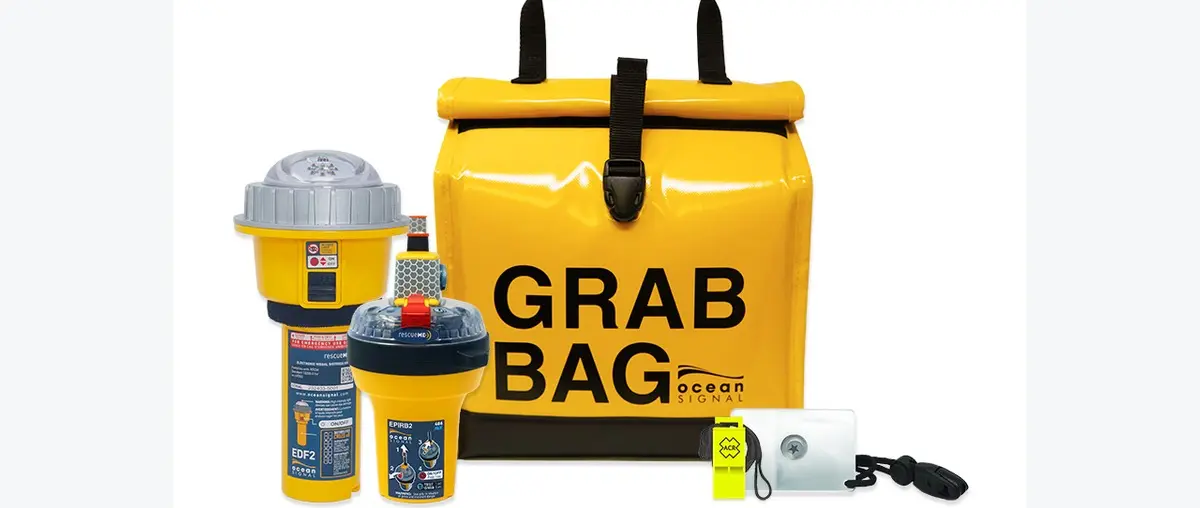
The accompanying official studio photograph shows Ocean Signal's real branded grab bag with components from a separately sold EPIRB2 safety kit, rather than a photograph of an emergency or rescue event. The file appears in the company's earlier media library, so it should not be described as a new November 2026 photograph. The current news relates to the product's METSTRADE presentation, while the first-party product listing provides its capacity, construction and features. This distinction matters when an existing product image accompanies a newly publicised launch. The pictured beacon and signalling equipment belong to the illustrated kit; they are not represented as standard contents of a bag purchased on its own.
What responsible owners should do next
The new Ocean Signal offering is a prompt to review the wider emergency plan, not simply to buy another bag. Check the location of every distress device, verify registration and battery status, inspect personal flotation equipment, refresh any perishable supplies and practise reaching the essentials from a realistic onboard position. Decide how the bag will be secured and who will carry it if abandonment becomes necessary. The practical benefit of a purpose-designed container is that it can make preparation visible and repeatable. Whether that promise is realised depends on what goes inside, how often the contents are checked and how confidently the crew can act.
Original industry sources and image credits
Reporting based on Ocean Signal official Grab Bag product specifications, nine-litre size, water-resistant construction and manufacturer-specified dimensions, Ocean Signal official EPIRB2 kit catalogue that includes the Grab Bag and hosts the official illustrative studio photograph (not the standalone bag's included contents), Marine Industry News 23 November 2026 independent report on Ocean Signal's METSTRADE 2026 presentation.
Lead image: Ocean Signal Grab Bag Makes Emergency Gear Easier to Find — genuine manufacturer press or product photograph. © Ocean Signal. Original supplier image.