
A familiar maintenance job gets new ingredients
Marine maintenance rarely attracts the attention given to a new engine or hull, yet a bottle of lubricant or degreaser can determine whether everyday fittings continue to work reliably. Barcelona-based NZERO is extending its plant-derived product business into boating, with a Marine range presented around METSTRADE 2026 and described in the company's own November product announcement. Its catalogue includes a marine grease, wet lubricant, dry wax and cleaning formulations intended for common maintenance tasks. This is relevant to owners of dinghies, trailer boats and compact cruisers, who frequently perform work themselves and operate close to beaches, estuaries or other sensitive waters. The word plant-based, however, must not be treated as proof that any lubricant is suitable for every bearing, winch, engine or underwater fitting. The interesting news is the expansion of the product choices; the purchasing decision still requires proper mechanical and environmental evidence.
What the manufacturer's range contains
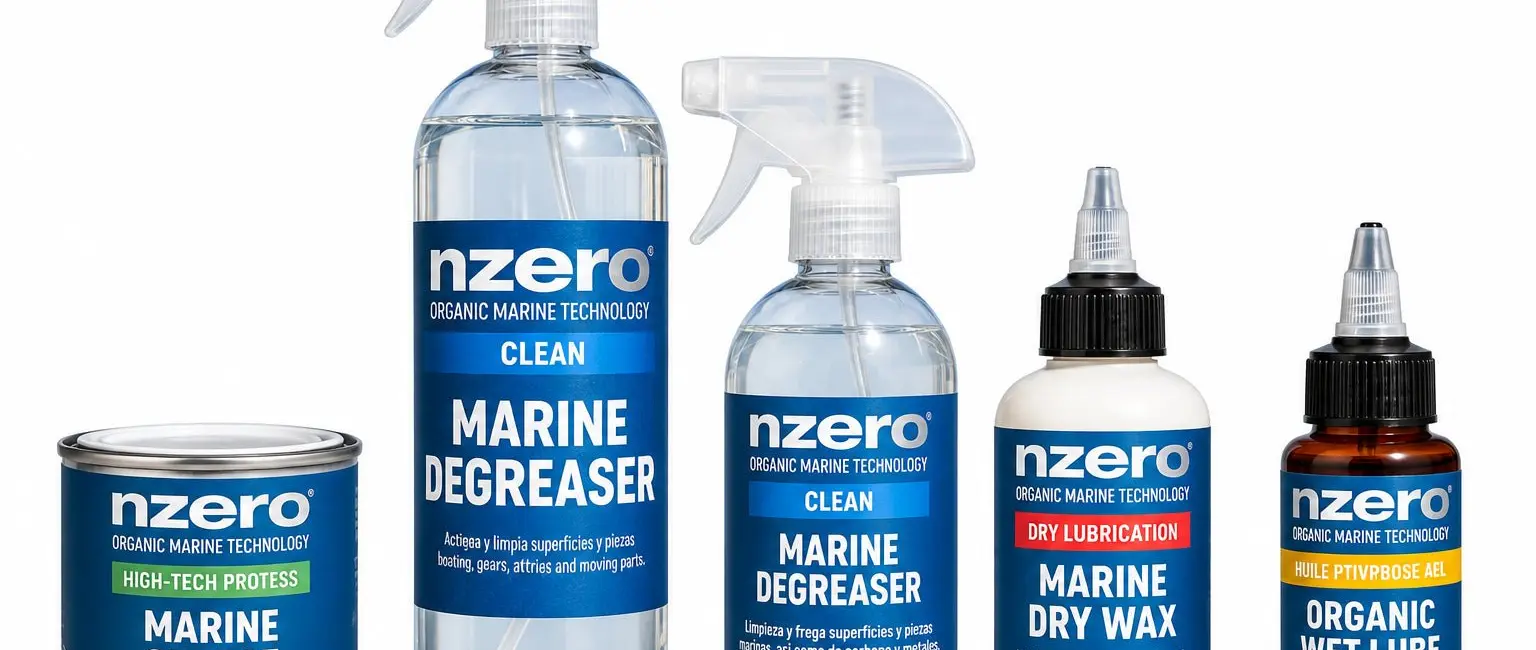
NZERO's official marine pages identify a group of products for cleaning, lubricating and protecting equipment. Its displayed bottles include labelled marine degreaser, dry lubrication formulations and conventional-looking liquid products in small containers. The maker describes a move away from mineral-derived inputs, building on earlier experience with cycling and winter-sports formulas. A marine environment presents different demands from a bicycle or ski. Salt water, humidity, ultraviolet exposure and continuous movement can accelerate wear and corrosion. Lubricants may be washed off repeatedly, and some components must survive very high contact loads while others merely need protection against sticking. Owners should therefore examine the purpose stated for each product rather than assuming that all of the liquids and greases are interchangeable. Packaging that looks similar can disguise important differences in viscosity, water resistance, temperature limits and material compatibility.
Wet lubricants have a specific job
A liquid lubricant can reach a small hinge, linkage or control mechanism that would be awkward to grease heavily. In a small boat, likely maintenance points include accessible hinges, moving deck fittings and hardware explicitly approved by its manufacturer for oil-based lubrication. But not every rope clutch, block or winch part should receive the same treatment. Some bearings are designed to operate without added oil, and lubricant can attract grit or interfere with friction surfaces. NZERO's range invites owners to review which components actually need a liquid product and how often. A marine-compatible wet lubricant should be assessed for adhesion, resistance to salt spray and performance after prolonged exposure. The company makes its own claims about composition and suitability, but those should be supplemented by the equipment maker's service instructions. Lubricating the wrong surface can create a safety problem despite the apparent good intention.
Where dry wax may be useful
Dry lubricants are often selected where a user wants low friction without a persistent oily film that collects dust or dirt. A small-boat owner might be interested in such a product for specific exposed hardware, provided the maker of the hardware allows it. The effect depends on how the coating is deposited and how well it adheres after repeated wetting. Marine dry wax should not be assumed to replace protective grease inside a loaded bearing or to provide corrosion resistance in every saltwater environment. The NZERO product adds an alternative for an owner to investigate, not a universal maintenance shortcut. A sensible test would identify the exact application, prepare the surface according to instructions and monitor whether the result remains satisfactory over a defined period. An owner should avoid applying a new formulation to safety-critical parts during a passage without knowing its behaviour.
Grease requires much more than a green label
Marine grease is frequently used in areas where a fluid film needs to remain between loaded surfaces and resist washing away. The correct consistency, base-oil characteristics, thickener chemistry and compatibility with existing grease can be vital. Two products both sold as marine grease may not mix safely, and introducing one into a component packed with another type can change how the lubricating system performs. On a trailer, bearings can be exposed to water during launching and carry significant loads during road travel. A failure there is a transport safety issue, not just a minor inconvenience. On a steering linkage, poor lubrication can affect boat control. Before changing to a plant-derived marine grease, owners should confirm any relevant load ratings, operating temperatures, waterproofing performance and approvals required by the component manufacturer. A manufacturer supplying a greener alternative should make it straightforward to establish whether it meets the same specification as the product being replaced.
Degreasing can transfer pollution rather than eliminate it
The range also includes cleaners intended to remove oil and grease. A degreaser may be valuable when servicing an outboard cowling, cleaning a workshop bench or preparing a component for inspection. Yet cleaning an oily surface does not make the removed contamination disappear. Oil, dirt, solvents and residues can be carried into bilges, drains or surrounding water if wash-off is uncontrolled. The environmental benefit of a cleaning product must therefore be considered alongside how the waste is collected and disposed of. Owners should use appropriate containment, absorbents and disposal methods even when the bottle describes ingredients of plant origin. Product handling should also follow the safety data sheet, including ventilation and skin or eye protection when specified. A formulation may reduce reliance on certain petrochemical feedstocks and still require careful storage and waste management. That is a distinction useful for everyone maintaining a boat near water.
Composition and biodegradability are different measures
The expression organic can have several meanings in marketing and chemistry. Plant-derived ingredients describe the origin of some raw materials, while biodegradability describes how a substance breaks down under specific test conditions. A product could contain renewable carbon without degrading rapidly in a cold marine environment. Likewise, biodegradable does not mean harmless to fish or invertebrates at every concentration. The manufacturer presents its Marine line as an environmentally focused alternative, but owners should ask for test methods, substance information and relevant certifications before treating broad claims as independently proven. It would be inappropriate to infer an exact carbon saving or a universal absence of aquatic toxicity merely because some ingredients came from plants. An honest product comparison requires evidence appropriate to the particular formulation and application, not a general impression created by the company name or packaging.
Saltwater is a demanding test environment
Boats expose maintenance products to a combination of moisture, salt crystals, temperature changes and mechanical stress. A lubricant performing well in an indoor workshop may behave differently on a frequently splashed deck fitting. Some coatings can become sticky, others wash away, and still others may affect certain plastics or seals over time. For owners of small RIBs and powerboats, particular attention is needed around steering components, cables and exposed engine fittings where failure could have consequences underway. A product trial should use a noncritical, manufacturer-approved application first, with records of when it was applied and how the surface behaved. Laboratory tests remain important for comparing water resistance and material compatibility. Owners should not conduct their own unsafe experiments on loaded steering mechanisms or trailer wheel bearings. Proper engineering evidence is much more useful than a quick demonstration of water beading off a shiny surface.
Compatibility with plastics and elastomers matters
Modern recreational boats contain nylon, acetal, polycarbonate, rubber seals, composite bushings and various coatings. Chemicals that are harmless to one material can damage another. Even natural oils and plant-derived solvents can be incompatible with certain plastics or sealing compounds. This is particularly relevant where a product may reach inflatable-boat fabric, synthetic running rigging or transparent instrument covers. The correct procedure is to consult the equipment manufacturer's recommendations and the formulation's current technical documentation. If compatibility is uncertain, avoid applying the chemical to the component until there is a suitable answer. A small-boat owner often works without the dedicated stores and technical department available to a commercial ship, which makes clear instructions and accurate labels especially valuable. One benefit of a well-designed consumer marine range should be that an ordinary user can identify safe applications without guessing.
What would count as credible independent testing
A useful comparison between NZERO Marine products and conventional alternatives would specify identical test conditions. For lubricants, the assessment could consider friction, wear, wash-off, corrosion resistance and performance at stated temperatures. For cleaners, it might compare the amount of product needed to remove a defined contaminant, the nature of any residue and the handling requirements for the resulting waste. Environmental evaluation would need separate methods appropriate to biodegradability and aquatic toxicity, rather than assuming that mechanical performance proves ecological benefit. Such testing should be carried out by a suitably qualified laboratory or independent technical reviewer and should report methods, sample sizes and limits. This article does not claim to have performed those tests. The company's participation in a recognised trade show provides evidence that the range is being promoted to the industry, but it does not itself validate every product claim.
The practical value for do-it-yourself owners
Owners of modest boats often undertake routine cleaning and lubrication because yard visits can cost a significant share of the value of a small vessel. A clear family of marine products may make it easier to organise those jobs, provided the range is supported by usable documentation. The right approach is to maintain a service log that identifies the fittings, materials, lubricant selected and next inspection date. This helps prevent incompatible products being mixed later and assists future owners or technicians. A kit should also include gloves, absorbent material and suitable waste containers rather than only bottles of lubricant. For a trailer boat, the service programme should cover both onboard hardware and the road trailer, each with its own requirements. No lubricant, however innovative, can compensate for corroded components or parts that have already exceeded their safe service life.
Distribution and price will influence adoption
The November 2026 announcement positions the Marine range as a product development that NZERO hopes to distribute more widely through the leisure marine sector. Small-boat owners will judge whether the idea is practical partly by the ability to obtain replacements and reliable advice. A formulation that performs well but can be purchased only through a complicated overseas order may be inconvenient for routine maintenance. Actual prices, packaging sizes and availability should be checked at the point of purchase rather than treated as fixed by an exhibition news item. The overall cost comparison should consider how much product is needed and how often it is applied, not just the label price per bottle. A more concentrated or longer-lasting formulation could be economical despite a higher initial price, but that possibility requires observed performance. Strong dealer support and useful technical data will make the product more credible than an attractive promotional slogan.
Why the boat industry is exploring alternatives
The boating industry is under pressure to examine the materials used in construction and service, including those consumed repeatedly after a boat is sold. Unlike a one-time hull choice, cleaners and lubricants are purchased throughout the life of a vessel and may enter waste streams during routine work. This provides a reason to investigate alternative raw materials, refill arrangements and improved disposal practices. It also creates an opportunity for marketing claims to get ahead of evidence. An innovative manufacturer should welcome clear questions about chemical specifications, materials testing and long-term performance. Consumers can encourage better products by selecting formulations with reliable documentation and by managing maintenance waste responsibly. This approach is more valuable than condemning all conventional products or assuming every renewable-material substitute is inherently superior. Marine safety and environmental responsibility should be evaluated together.
What the company has confirmed
NZERO's own company announcement about METSTRADE 2026 describes its entry into marine maintenance products, and its official current product catalogue identifies the range and shows genuine product packaging. The original first-party product photograph in this report comes directly from that catalogue, not from an unrelated stock gallery. The maker's emphasis on plant-derived ingredients is reported as a company position. This article does not assert that each item has passed a particular certification, that a named boatbuilder has approved it for a safety-critical component or that every conventional lubricant can be replaced. Readers should also distinguish product categories: a dry wax is not a substitute for bearing grease merely because both are grouped under one brand. The verified news is the addition of a marine range to the manufacturer's offering, not a completed independent test programme.
A measured purchasing checklist
Before adding a new product to the service box, a boat owner should identify the component and consult its prescribed maintenance materials. The next questions are whether the NZERO item meets those requirements, what storage conditions apply and how leftover product and used cleaning materials should be handled. Keep records of compatibility advice and use one product at a time in a noncritical application when a change is permitted. Where the manufacturer specifies a particular grease or oil, do not substitute on the basis of environmental marketing alone. If reliable technical evidence demonstrates adequate performance and lower impact, plant-based formulations could become a worthwhile part of routine boat care. In the meantime, careful maintenance, avoiding leaks and responsible disposal remain the foundations of keeping a small boat both dependable and considerate of the waterways it uses.
Primary reporting and image credit
Primary manufacturer and organiser source(s): https://shop.nzerowax.com/es/blogs/noticias/nzero-sets-sail-for-metstrade-2026-with-its-new-organic-marine-range. © NZERO Organic Formulas / original manufacturer photographer. Genuine 2026 NZERO Marine product packaging photograph; no endorsement or independent test result is implied. Image is used only for correctly attributed factual editorial coverage and never represented as open-licence stock photography.