
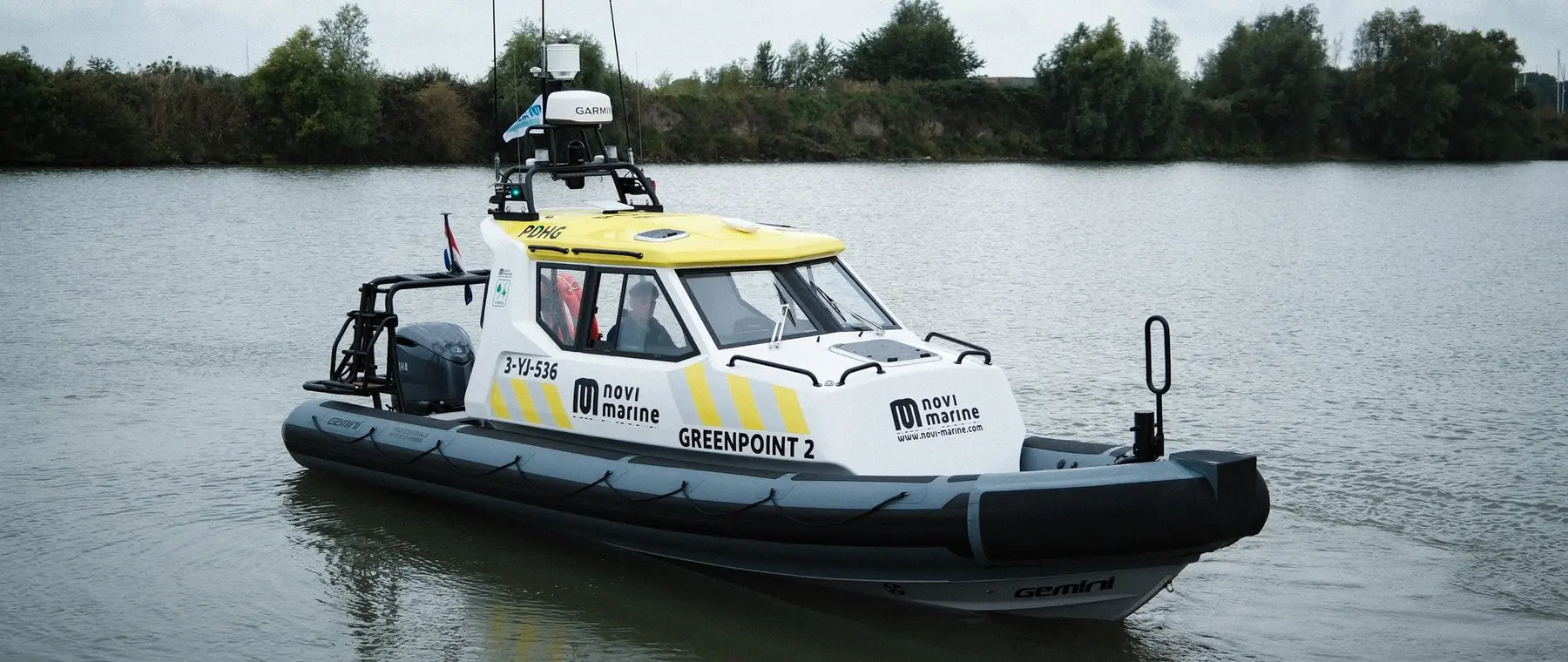
A hybrid cabin RIB joins the working fleet
Novi Marine has introduced the Gemini WR880 Hybrid Cabin RIB, a nine-metre professional workboat designed to switch between a conventional outboard and dedicated electric propulsion. The Dutch company presented the vessel at the Workboat Show in Hoorn on 28 September 2026 and described it as both a charter asset and a working demonstration platform. Its importance lies less in a headline speed figure than in the ability to use different propulsion methods during different portions of a professional assignment.
The boat, identified in the manufacturer's imagery as Greenpoint 2, is intended for operations where crews may need to transit quickly before spending extended periods working close to shore, quays, structures or wildlife-sensitive waters. Novi Marine says the hybrid arrangement allows electric operation without local exhaust emissions, while retaining a separate Yamaha outboard for conventional travel. It is a specialist workboat, not a claim that all nine-metre pleasure RIBs require this machinery.
Why a protected wheelhouse matters
The enclosed cabin is an important departure from the open arrangement familiar on many high-speed rigid inflatable boats. Surveyors, patrol crews and offshore technicians may have to remain on station in rain or wind, often with electronic equipment operating throughout the shift. The wheelhouse helps protect people and instruments while preserving the compact footprint that makes a nine-metre vessel useful in restricted waterways and alongside marine infrastructure.
Novi Marine specifically identifies survey, inspection, surveillance and law-enforcement assignments among the vessel's intended roles. These activities have different working patterns and will not all benefit equally from the same propulsion setting. A long transit to an offshore site, for example, presents a different power demand from a slow inspection under a bridge. That contrast helps explain why the builder has combined a conventional power source with a second, electrically driven system.
Conventional propulsion for transit work
The main outboard is a Yamaha F350NSBU four-stroke unit with steer-by-wire controls, according to Novi Marine's specification. The engine is connected to Yamaha's HelmMaster system, which the company describes as integrated to Level 5+. This equipment forms the conventional propulsion side of the design, intended to support longer runs and rapid redeployment when a crew needs to cover distance before beginning a task.
That does not establish a maximum speed, cruise consumption or range for this particular vessel. Those outcomes depend on loading, sea conditions and how the hybrid equipment affects the overall displacement of the boat. Buyers comparing the WR880 with a traditional patrol RIB should request trial data at the weight of their actual crew and equipment. A high-output outboard provides options, but mission planning still needs verified endurance and fuel capacity.
Twin HARMO electric drives provide another mode
For electric-only work, the WR880 carries two Yamaha HARMO 2.0 drive units. Novi Marine says the units can rotate through 140 degrees and are operated through joystick control, giving the crew fine control of direction during low-speed work. A separate VETUS Bow Pro bow thruster adds another manoeuvring aid. Together, these systems are aimed at precise positioning rather than claiming that electricity is automatically the best solution at every speed.
Electric operation can be particularly attractive around harbour structures, close to survey targets and in locations where local emissions or propeller noise are sensitive concerns. The distinction between no exhaust at the boat and zero environmental impact overall is important: batteries still need to be charged from an energy source. Equally, an electric operating mode does not remove the need for safe watchkeeping, careful propeller clearance or a competent helm when working near people.
Battery storage and electrical integration
Novi Marine identifies a Victron LiFePO4 Next Generation 48-volt battery system as the energy supply for the electric installation, coupled to a Victron MultiPlus II inverter and charger. This offers a recognisable architecture for the secondary drive system rather than an unspecified experimental battery arrangement. The source announcement, however, does not state a total pack capacity, charging rate or measured continuous runtime for Greenpoint 2.
For commercial operators, those missing figures will be central to a deployment decision. A useful specification should show how much electric endurance is available while the boat is carrying its normal electronics load, how quickly the batteries can be replenished and what the response is when the state of charge is low. The best configuration for an inspection contractor may differ from one required by a harbour authority undertaking repeated short movements.
Navigation instruments for demanding assignments
The reported wheelhouse installation includes Garmin GPSMAP 8416 chartplotters with radar, a Garmin Panoptix LiveScope sonar system and a Garmin MSC 10 GPS compass. Novi Marine also lists a SIONYX Nightwave D1 camera and Starlink satellite communications. Those elements are a reminder that the workboat carries a substantial information and communications requirement in addition to its dual forms of propulsion.
Instrument choice matters differently across the intended roles. A survey crew may prioritise repeatable positioning and detailed observations, while a security patrol may concentrate on target awareness and reliable communications. The maker's list establishes what has been fitted, but it does not by itself certify a specific surveillance detection range, communications availability offshore or classification capability for every task. Operators should validate those elements against their contractual requirements.
An offshore wind assignment provides a test
Novi Marine said in its September announcement that the WR880 was due to enter service on an offshore wind project in early November. That offers a useful operational context for the design: support vessels near wind infrastructure must combine safe passages, controlled approaches and periods of relatively slow movement. It would be premature, however, to describe a completed deployment without a follow-up confirmation from the operator or manufacturer.
Offshore conditions will test the installation differently from sheltered canal or harbour work. Wind, waves and the need to maintain position can increase propulsion demand, while a cabin protects the crew but adds weight and windage. The practical question is not whether a hybrid RIB can perform every mission electrically, but whether it can reserve the appropriate propulsion system for each part of the assignment without complicating crew procedures.
A development from Novi Marine's earlier hybrid boat
The WR880 follows the Gemini WR650 Hybrid Patrol RIB previously supplied by Novi Marine to Antwerp City Harbour. The manufacturer presents the larger cabin boat as a further step in its development of professional hybrid craft. The comparison is useful because it indicates a line of work with similar operating aims, though the two vessels should not be assumed to share identical batteries, hull performance or control installations.
Novi Marine supplies boats for port authorities, emergency services and offshore users and says the WR880 can also be chartered. That rental role may allow prospective operators to gain experience with an unfamiliar propulsion arrangement before specifying a new boat. It can also provide an opportunity to compare electric manoeuvring with conventional outboard operation in real duties, provided the trial records its loading, duration and weather rather than relying only on first impressions.
Operating procedures become as important as hardware
A dual-propulsion boat can give its crew useful flexibility, but it also introduces more system states to understand. Training should cover selecting modes, monitoring battery charge, coordinating the bow thruster with the main drives and responding to faults. The manufacturer describes the equipment as integrated, yet each professional operator will still need a documented procedure appropriate to its crew, waters and emergency responsibilities.
Maintenance planning should consider the outboard, electric-drive units, controls, lithium batteries and connected navigation equipment as one operational platform. Inspectors will want access to components and evidence that isolation and charging can be carried out safely. Crew members also need to know how a loss of one power system changes handling and how to end a mission without using assumptions about the remaining range.
What buyers should ask before specifying one
The initial statement is rich in equipment detail but does not supply every metric required for a procurement comparison. Operators should request measured electric speed, working endurance, recharging time, conventional range and payload under their intended configuration. It would also help to know the vessel's verified dimensions and weights with the full mission equipment package and the standards under which it has been built.
The result is an interesting nine-metre workboat that addresses a real operating split between reaching a site and working carefully once there. The Gemini WR880 is more persuasive as a practical hybrid platform than as a simple demonstration of green technology, because its maker has specified real drive components, control systems and anticipated assignments. Its longer-term significance will depend on how those systems perform under the varied conditions faced by working crews.
Source: Novi Marine – Gemini WR880 Hybrid Cabin RIB presentation, 28 September 2026.