
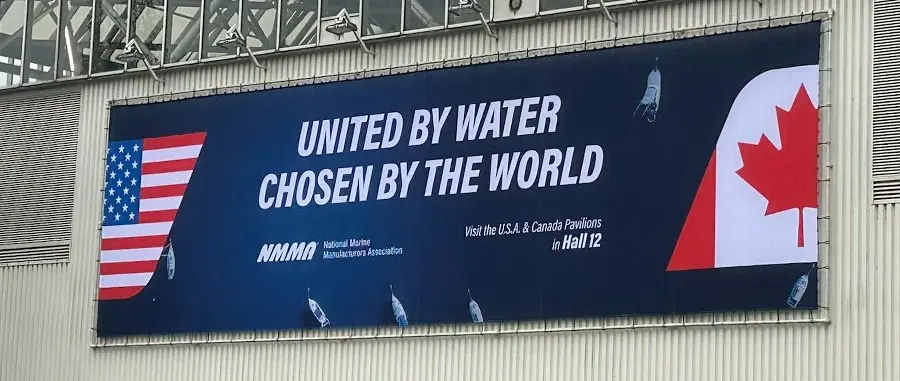
North American marine businesses had a substantial organised presence at METSTRADE 2026 in Amsterdam, with the National Marine Manufacturers Association reporting 57 member exhibitors across the combined United States and Canada pavilions. The exhibition ran at RAI Amsterdam from 17 to 19 November, while the NMMA announcement was issued immediately before opening. The trade association also set out a programme of nine talks under the North American Stage banner in Hall 12. For owners of smaller leisure boats, this is a supply-chain and industry development rather than a single new vessel launch: equipment, components, technical standards and distributor relationships can influence what eventually reaches local boatyards and chandlers. The published figures describe the announced exhibitor programme, not an independently audited attendance or sales result.
An international meeting for equipment businesses
METSTRADE brings together marine equipment manufacturers, distributors, boatbuilders and technical specialists in a business-to-business setting. NMMA's statement described participation from more than 140 countries and more than 1,700 exhibitors across the wider event. Those numbers refer to the show as a whole rather than the combined North American pavilions, where 57 exhibiting member companies were named as part of the association-supported presence. A business-oriented exhibition differs from a consumer boat show: visitors are often assessing products and negotiating supply rather than comparing the price of a finished dinghy or family powerboat. Nevertheless, decisions made between suppliers and distributors can eventually affect which equipment options are offered to retail buyers, where spare parts are stocked and which businesses can service the products.
Why the Hall 12 arrangement matters
Grouping the U.S. and Canadian exhibitors in Hall 12 was intended to give international buyers a defined place to find North American products and business contacts. A concentrated pavilion can make a complex show easier to navigate, especially when someone wants to compare suppliers in a particular geographic market or discuss distribution opportunities. That practical advantage should not be translated into a claim that all 57 exhibitors launched new equipment. Some companies attend to maintain relationships, discuss established systems or seek new customers for products already on sale. Others may be presenting developments. The announcement does not establish a complete list of launches or verified transactions. What it confirms is the scale of the organised pavilion presence and the accompanying opportunities for technical and commercial discussion.
Nine sessions with different purposes
The North American Stage was scheduled to offer nine sessions covering market trends, manufacturing, marine marketing and regulatory requirements. NMMA, IBEX and Soundings Trade Only were named as joint hosts. Talks of this kind can be useful when they explain a challenge shared by companies on different sides of the Atlantic, such as product certification or methods of constructing boats with new production technologies. The planned programme is distinct from a formal training qualification or an announcement that all recommendations became industry standards. Session descriptions establish the subjects organisers intended to explore. Unless recordings, proceedings or independently verified summaries are available, reporting should not put specific conclusions into the mouths of speakers or describe proposed solutions as already adopted by participating firms.
Certification and market entry
For a small-boat equipment maker, selling internationally can involve more than finding an interested distributor. Electrical products, navigation systems, safety gear and other marine equipment may need to meet applicable rules in the destination market. Technical documents, testing and clear installation instructions can all influence whether a product is suitable for a particular vessel. The programme included discussion of import compliance, certification and market entry, reflecting the need for businesses to understand differences between operating regions. This is not a declaration that one generic international certificate makes equipment universally approved. The actual requirements depend on product class, intended use and jurisdiction. Boatbuilders and owners should check relevant technical standards and current regulator guidance rather than assume that a product's presence at a major trade show confers certification.
Additive manufacturing and boatbuilding
The programme also included a discussion of three-dimensional printing for boatbuilding. Additive manufacturing can offer ways to produce parts, moulds or tooling with different design and lead-time considerations from conventional fabrication. But the environmental and commercial results are not automatic: material choice, energy consumption, durability, repairability and testing remain essential. A part intended for a structurally critical application has very different requirements from a prototype or a cosmetic fitting. The NMMA programme placed the technology on its stage, but did not present proof that printed hulls or components would replace established methods across the industry. The relevant development is an opportunity for industry participants to examine manufacturing processes that may affect future recreational craft and their components.
Marketing changes around marine products
The stage agenda also addressed the changing ways marine equipment reaches prospective buyers, including a session on marketing and artificial intelligence. For an independent dealer or a manufacturer of a specialised fitting, correct and discoverable information can help a buyer identify the right product. However, promotional claims about safety, engine compatibility or loading limits must remain accurate regardless of how they are distributed online. AI-powered search and digital advertising do not eliminate the obligation to provide clear specifications and technical support. The association's inclusion of this subject shows that commercial communications are part of the industry discussion. It does not prove that any particular marketing platform is more effective or that automated content should replace manufacturer documentation.
Opportunities for component suppliers
Small recreational boats often use parts sourced from companies far beyond the country in which the hull was built. Steering, propulsion, electrical distribution, ropes, deck fittings, seating, ventilation and navigation electronics may all come from different manufacturers. An international trade meeting can therefore support the commercial relationships needed to keep equipment available across regions. For owners, an important result of well-managed supply chains is the ability to locate correct replacement parts and obtain qualified service. That outcome is not guaranteed by an exhibition. Distribution contracts, inventory decisions and after-sales arrangements still determine local availability. The relevant question for companies attending METSTRADE is how new connections can be translated into dependable product support once a vessel is in everyday use.
The networking element
NMMA also advertised a North American Networking Reception on 18 November near the pavilion's stage, along with meeting and lounge areas for industry visitors. Such arrangements make it easier to follow up discussions without relying only on brief stand visits. However, a reception programme is not evidence of contracts signed, sales made or financial performance. The association's publication preceded the meeting, and any assessment of actual results would require later confirmation. The distinction helps readers understand the role of a trade-show announcement: it can establish that an initiative was organised and offered to participants, while the economic results are a separate story. The same principle applies when manufacturers describe planned collaborations without naming confirmed orders or production schedules.
Why the small-boat owner should care
Someone operating a modest RIB or trailerable motorboat may never attend METSTRADE in person, yet marine equipment decisions can influence the cost and convenience of ownership. Buyers need products that fit, can be installed correctly and have parts support in their home market. An electronics unit may be impressive on a demonstration stand but of limited value if local service or software support is unavailable. A clever fitting can simplify routine tasks only when it works in the actual installation. The concentration of North American suppliers in Amsterdam is relevant as a way of connecting manufacturers with the distribution and boatbuilding businesses that ultimately serve consumers. It is not a reason to assume that every newly advertised feature is immediately available in every country.
Trading across international markets
The U.S. and Canadian pavilions also point to a broader reality: recreational boatbuilding is international even when a manufacturer promotes national craftsmanship. Imported components, shared technical expertise and relationships with overseas distributors are ordinary parts of the sector. A supplier entering a new market may need to adapt packaging, units of measurement, installation guidance or service arrangements. A boatbuilder considering a new part must assess compatibility and long-term support, not merely introductory pricing. These considerations help explain why an industry trade fair includes sessions about standards and commerce as well as new materials. The show offers a venue for those discussions but does not itself determine the terms under which a product can be sold or used.
Interpreting the announced scale
NMMA's figures of 57 North American pavilion exhibitors and nine stage sessions are concrete, attributed claims. The more than 1,700 exhibitors and participation from over 140 countries describe the wider METSTRADE event as presented in the association's pre-opening statement. Those measures should not be treated as final visitor counts, nor should they imply that all exhibitors operate in small recreational craft. Some suppliers serve commercial vessels or much larger yachts. Leisure Boat Guide's interest lies in the equipment, manufacturing and distribution implications for owners of smaller vessels. A responsible report also avoids declaring the event a commercial success without post-show figures and independently attributable results.
What comes after the 2026 show
METSTRADE ran from 17 to 19 November 2026, and the official NMMA source used here was published just before the exhibition opened. Subsequent reporting can examine confirmed product launches, supplier agreements and technical developments that emerge from the event, provided the companies involved release verifiable information. The accompanying official NMMA photograph shows a genuine METSTRADE trade-show setting and is used as event context, not proof of any individual deal or an exhaustive display of the 57 exhibitors. For leisure boating, the important underlying story is that component supply, manufacturing knowledge and access to international markets are shaped through the same professional networks that gather at the industry's leading equipment exhibitions.
Sources and image attribution
Primary reported announcement: https://www.nmma.org/press/article/25700.
Official photographic provenance: https://www.nmma.org/press/article/25700. Image supplied by the originating organisation, credited in the photograph title; original copyright remains with the rights holder. Official image file. The photographs are documentary or clearly labelled archival illustrations, not evidence of events that have yet to happen.
