
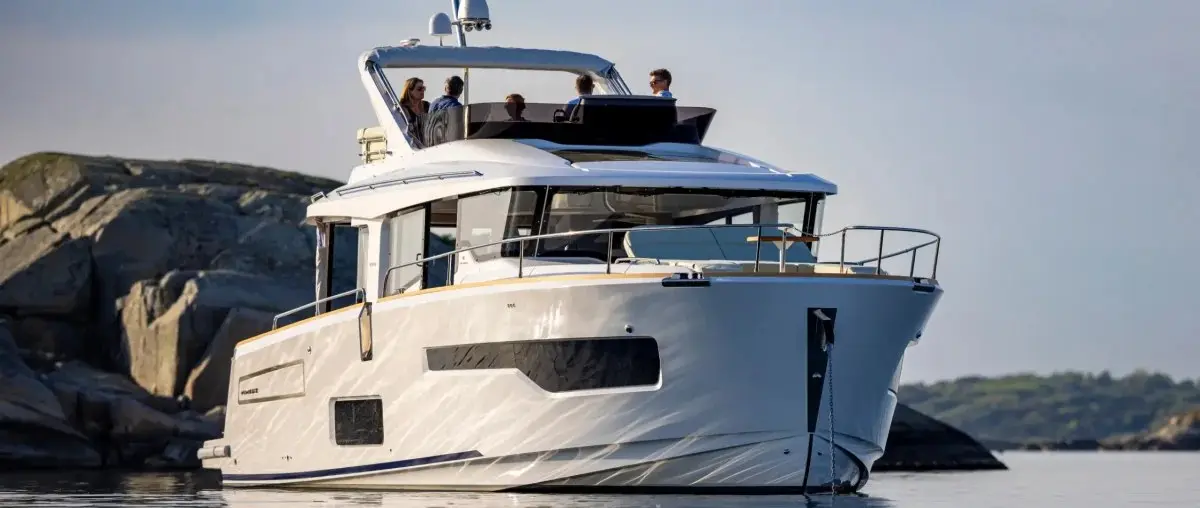
Nimbus's 495 Flybridge is among the Nordic cruising models represented in the Fort Lauderdale boat-show market this year, giving US buyers an opportunity to consider a distinctly Scandinavian alternative to more conventional Mediterranean-style motor yachts. Its character is defined less by display speed than by planning for time aboard.
The builder's official specification gives an overall length of approximately 14.9 to 15 metres and a beam around 4.6 metres. The 495 is therefore large enough for a proper flybridge and meaningful interior volume, yet still sized for an owner who wants to run the boat with a small regular crew.
Nimbus describes the concept as an island of its own, a phrase reflecting the goal of staying comfortably in natural harbours without constantly returning to shore. It is a marketing description, but the tankage and equipment options show that the project takes extended cruising requirements seriously.
Changing the main-deck experience
The main deck combines the sheltered pilothouse tradition of the Nimbus range with an upper flybridge for enjoying better weather and an elevated outlook. These two distinct environments let passengers travel protected in poor conditions and then use the open deck when arriving in a calm bay.
A hydraulic bathing platform and substantial rear deck connect the interior spaces to the water. Owners intending to carry a tender should check the platform's working load, the access to storage and the launch sequence, because a longer trip often needs more equipment than can remain permanently on the aft deck.
The flybridge is also a second navigation position rather than merely an extra seating area. Its value will depend on wind exposure, instrument visibility, ease of communication with crew below and the skipper's ability to move between stations without losing awareness of nearby traffic.
Systems for the passage
The standard propulsion configuration is twin Volvo Penta IPS650 units, based on Volvo Penta D6 diesels rated at 480 horsepower each. The model's documented normal cruising band is around 20 to 24 knots, while the listed top speed is about 30 knots, figures that should be confirmed in representative loaded conditions.
Nimbus lists a diesel capacity of 1,700 litres and a fresh-water tank of about 520 litres, alongside separate grey-water and black-water storage. Those capacities are important when a family spends several days in an anchorage, although real endurance depends on the number of people aboard and how generously the systems are used.
The product documentation identifies a Volvo Penta glass-cockpit arrangement at both the enclosed helm and the flybridge. Owner choices can also include additional battery capacity, stabilisation, a generator and advanced navigation equipment, so comparing two 495s requires more than matching model names.
Accommodation and extended cruising
Interior choices are aimed at a family that wants to live aboard, with separate sleeping spaces and the possibility of tailoring systems for longer passages. A dedicated heating or cooling installation is likely to matter much more in an exposed Nordic anchorage than during a mild summer afternoon, but buyers should verify the energy demand and service access.
The builder provides for optional equipment such as a watermaker, washer, additional refrigeration-related amenities and extended battery provision. These are not luxuries in every cruising context: on a long itinerary, the ability to wash clothes and manage freshwater can change the number of marina stops required.
Yet no amount of equipment makes a boat self-sufficient without a maintenance routine. Owners should understand filter access, charging behaviour, emergency power arrangements and how the vessel handles accumulated waste before relying on extended periods away from serviced berths.
Ownership questions
At this length, berthing and travel planning extend beyond simple overall length. Beam, draft, the height of the flybridge and any optional aerials can restrict marina choices, while insurance and lifting facilities vary widely between a sheltered inland harbour and an exposed coastal location.
An owner comparing the 495 with a faster open cruiser should consider the number of nights aboard, expected weather and likely crew. The Nimbus makes its strongest case where sheltered living, storage and good movement around the boat contribute more to enjoyment than an occasional top-speed run.
The 495 Flybridge's appeal is ultimately a form of independence rather than isolation: a place where a family can spend time together without a complicated daily return to land. Its detailed official specification gives buyers a practical basis for a full walk-through and sea trial, including checks on every major optional system.