
The national requirement is already in force
New Zealand’s lifejacket-wearing requirement for recreational craft six metres and under took effect on 9 October 2026. Maritime New Zealand says everyone aboard those craft must wear an appropriately sized, properly secured lifejacket while underway, subject to specified exclusions. The threshold includes a craft measuring exactly six metres, as well as smaller vessels.
The change applies throughout New Zealand, covering inland waterways and coastal waters. It reaches beyond conventional motorboats to dinghies, yacht tenders, small sailing boats, kayaks, paddleboards and personal watercraft. For a recreational crew, the starting point is therefore the craft’s measured length and the activity being undertaken, rather than whether it carries an engine.
Underway does not require forward movement
Maritime NZ defines underway by what the vessel is not doing: it is not anchored, attached to a dock, aground or attached to the shore. A boat drifting without making forward progress can still be underway. Turning off an engine or pausing the paddle stroke does not itself satisfy one of those conditions.
That definition matters during the quiet portions of a trip as well as during powered travel. A fishing pause, a drifting rest or a stop to reorganise equipment should not automatically be treated as permission to remove lifejackets. The regulator’s published definition, rather than an everyday interpretation of “moving”, determines the scope of the new requirement.
Measure the structure rather than the model badge
The regulator’s guidance explains length overall as a measurement from bow to stern that includes the vessel’s permanent structure. Its examples include bulbous bows, fixed bait tanks and the buoyancy tubes of inflatable boats and rigid inflatables. Those tubes are part of the craft, rather than accessories that can simply be ignored.
The same guidance excludes listed fittings and equipment extending beyond the bow or stern, including outboard engines, jet-drive units, bowsprits, boarding platforms and trim tabs. Owners should use the full published measuring guidance when close to the six-metre threshold. A marketing model number can provide a clue, but it should not replace establishing the applicable measurement.
Carriage and wearing remain different obligations
Carrying enough lifejackets is still an existing requirement for recreational craft, subject to the applicable exclusions. A jacket stored in a locker is nevertheless different from one worn and properly secured. On a craft within the new size threshold, carrying a suitable jacket does not by itself meet the underway wearing requirement.
For boats longer than six metres, the previous requirements remain important. Maritime NZ identifies wearing during heightened danger or risk and during towing activities such as water skiing and wakeboarding, alongside the skipper’s responsibility for everyone aboard. The new size-based rule adds to those requirements; it does not declare larger recreational boats exempt from lifejacket obligations.
An approved standard and a suitable fit
Maritime NZ describes a lifejacket as a buoyancy aid meeting an approved standard. Its guidance identifies New Zealand Standard NZS 5823:2005 or an accepted international standard, with types and markings helping identify the activity and wearer weight range for which the equipment was designed. The change in terminology does not make every flotation product an approved lifejacket.
Proper fit is part of compliance rather than an optional comfort consideration. The regulator explains that an incorrectly fitting jacket cannot be properly secured, and notes weight restrictions for certain types, including inflatables. A skipper preparing for a different group of passengers should check the available sizes against those people, rather than relying on the total number of jackets.
Activity-specific exclusions need their conditions
The official FAQ lists existing exclusions in Maritime Rule 91.4, including a surfboard or similar unpowered craft and a sailboarder or windsurfer wearing a wetsuit. Other provisions concern particular diving, supervised sporting, training and ceremonial situations. Their conditions matter, so the list should not be read as a general exemption for all sport or all unpowered recreation.
Stand-up paddleboard surfing receives a specific explanation. An existing exemption granted in 2022 has been brought into Part 91, but Maritime NZ says it applies to SUP surfing rather than every use of a stand-up paddleboard. A flat-water paddling excursion should therefore not be treated as SUP surfing simply because it uses the same board.
Swimming has a narrow transition provision
The regulator distinguishes recreational swimming from activities aboard a vessel. Its FAQ explains that maritime rules do not regulate a person’s recreational swimming itself, and that the new provision allows a lifejacket to be removed immediately before entering the water or immediately after returning aboard. The practical transition is tied directly to active swimming.
That explanation also addresses repeated jumping or diving from a craft. It should not be expanded into a general exception for remaining aboard without a lifejacket between unrelated activities. Anyone relying on an exclusion should read the exact current rule and the regulator’s examples, particularly where several people are using a small craft differently.
Education does not postpone the rule
Maritime NZ’s 9 October announcement describes an educational approach to compliance over the coming months, supported by co-regulators including harbourmasters and police. That approach helps explain how the change is being introduced. It does not change the commencement date or turn the national requirement into a rule that starts only after an awareness campaign.
The regulator’s published FAQ says dedicated national offences and penalties for the new wearing requirement had not yet been created. It also identifies existing offences and consistent local bylaws that may apply in some situations. An absence of a newly specified fine should therefore not be reported as an absence of obligations or enforcement powers.
Prepare the people as well as the boat
Maritime NZ asks crews to put on correctly fitted lifejackets before heading out, check the marine forecast and carry two waterproof ways to call for help. Those are separate preparations serving different purposes. Wearing a jacket provides flotation, while communications and a weather check address other parts of planning and response.
The guidance also keeps responsibility with the skipper for the safety of people aboard. For a tender trip or family paddling outing, establishing fit before departure avoids discovering a size mismatch once the craft is underway. The appropriate jacket type still depends on the person and activity; the new rule does not prescribe one universal product.
Use the current official explanation
The Maritime NZ lifejacket FAQ provides the detailed measuring examples, exclusions and definitions behind the change. The regulator also maintains its Part 91 rules page. Those sources should be checked for updates when planning an activity whose circumstances are close to an exception.
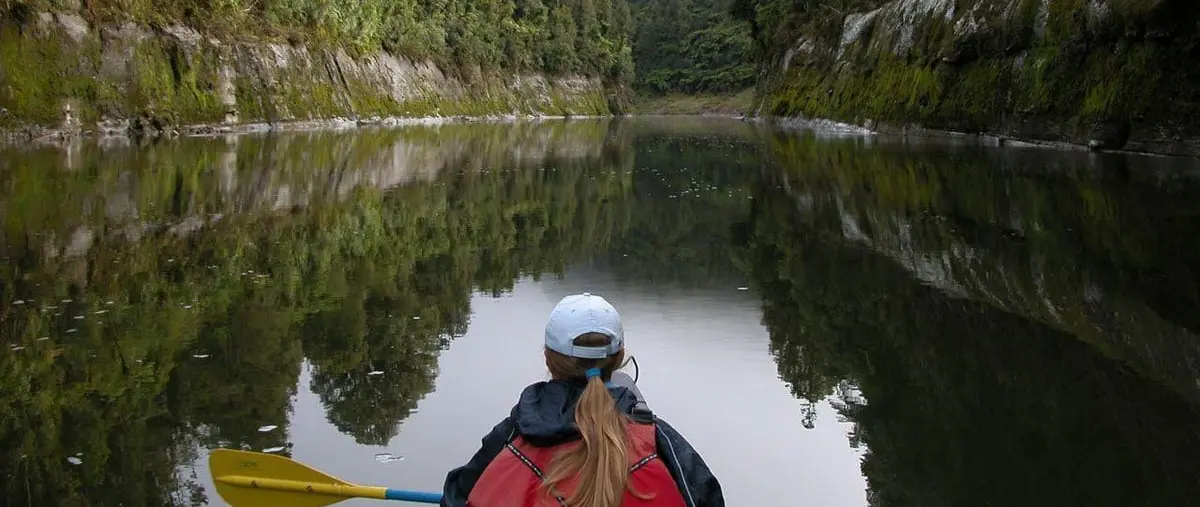
The accompanying photograph shows canoeing on the Whanganui Journey and illustrates recreational paddling in New Zealand; it is not a photograph of enforcement activity. Image: Department of Conservation (NZ), CC BY 4.0, reproduced from its Whanganui Journey gallery. No claim about the photographed trip’s date or compliance assessment is made.