
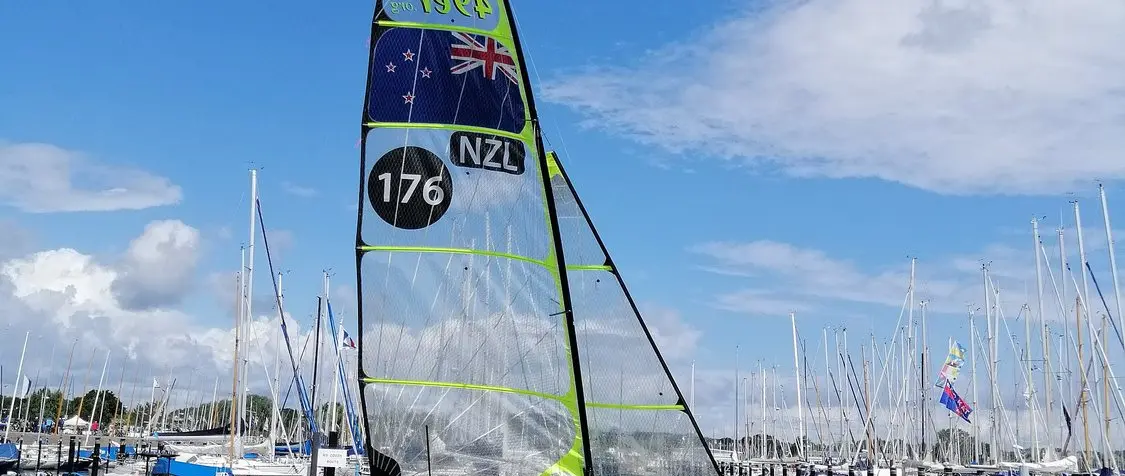
New Zealand's top sailing honour goes to a 49er crew
Seb Menzies and George Lee Rush have been named Sailors of the Year at New Zealand's 2026 Barfoot & Thompson Yachting Excellence Awards after a season of success in the 49er skiff. The prize was presented at the Royal Akarana Yacht Club in Auckland on Friday 6 November. The pair won three separate awards during the evening, reflecting their achievements on the international racing circuit. The announcement is especially relevant to Leisure Boat Guide because the 49er is a compact two-person sailing boat rather than a large racing yacht.
Yachting New Zealand's official report describes the partnership's world title at Quiberon, France, and the defence of their European championship in Germany. Those results provide the sporting basis for the recognition; the awards are not simply a popular vote on a boat or its appearance. The ceremony also celebrated younger sailors, coaches, volunteers and clubs. Taken together, the results provide a picture of a grassroots-to-elite sailing community built around many types of small craft.
The 49er is a demanding two-person skiff
The 49er is a high-performance double-handed dinghy around 4.9 metres long. Its lightweight hull, powerful sail plan and trapeze arrangements require the helm and crew to act together. Both sailors must pay close attention to boat balance, wind shifts and the speed of manoeuvres. There is little spare room for a third person to solve a problem or adjust equipment. Success at world championship level therefore reflects skill, preparation and a particularly effective working partnership.
Small dinghies are often regarded as a route into sailing, but racing a 49er at international level is far from a beginner exercise. The boats accelerate quickly, demand athletic crew movement and can capsize when mistakes combine with challenging conditions. Appropriate training and a properly managed race environment are essential. The success of Menzies and Lee Rush demonstrates how sophisticated competition can take place in a vessel far shorter than most family motorboats.
World and European titles distinguish the season
The pair's victory at the 2026 49er World Championship in Quiberon was a major achievement in a class contested by highly experienced international crews. The New Zealand governing body also credits them with successfully defending the European championship in Germany. Winning a single important regatta is difficult enough; maintaining performance across separate events adds demands involving travel, equipment preparation, recovery and adaptation to different sailing conditions.
Those title results are confirmed by the national federation's published awards report. They should not be confused with an Olympic medal or a result from a future event. Nor do the titles imply that every race during the season was won. Championship success depends on consistency across a series and on performing well enough relative to other teams under the applicable scoring rules. An accurate report recognises the overall achievement without inventing race-by-race scores or claims about every individual start.
Three awards recognise different kinds of excellence
Menzies and Lee Rush received the Sir Bernard Fergusson Trophy for Sailor of the Year, the Male Sailor of the Year award and the Radix Performance Award. The three presentations reflect separate categories of recognition within the national awards programme. Their success was the leading headline of the ceremony, but it was not the only contribution celebrated. A night of sailing awards can acknowledge results on the water while also recognising the people whose work makes future results possible.
That distinction is important for younger club sailors. International medals attract headlines, but coaches, race officers and volunteers help create opportunities to learn and compete. Strong community support can make it possible for a talented young sailor to progress from a local dinghy programme to overseas championships. The awards ceremony offers a view of that wider structure rather than treating elite sailors as isolated individuals who reached their level without support.
The 29er shows the next step for youth sailors
The Youth Female Sailor of the Year award went to Bella Jenkins and Jess Handley, a successful 29er partnership. The 29er is another compact two-person skiff, commonly used as an important developmental step towards higher-performance sailing. It shares some of the appeal and demands of fast double-handed dinghy racing while being tailored to a different stage of competition. Recognition of a youth crew reinforces the importance of keeping a strong pathway into the sport.
Progression between classes should not be automatic or rushed. A younger sailor needs the strength, technical understanding and confidence appropriate to the boat and conditions. The 29er rewards precise handling and crew communication just as a larger craft does, but its dimensions and equipment place it within a manageable training environment for suitably prepared sailors. For families thinking about youth sailing, reliable instruction and an active club matter far more than immediately selecting the fastest boat available.
Kitefoiling broadens the definition of small-craft success
The Youth Male Sailor of the Year award recognised Toby Wigglesworth for achievements in kitefoiling. This form of sailing uses a board and a kite rather than a conventional dinghy hull, but it relies on many of the same core judgments about wind, water conditions and the safety of the participant. Kitefoiling also demands specialist equipment, technical coaching and a clear understanding of when conditions exceed a sailor's ability.
The inclusion of this discipline alongside 49er and 29er racing demonstrates that New Zealand's competitive sailing landscape is broader than a single boat type. Different pathways can suit different athletes and locations. An inland club with a sheltered training area may offer opportunities very different from a coastal high-performance centre. Good programme design helps individuals gain appropriate experience without assuming that all small-craft sailors should follow the same route.
Coaches help turn potential into results
The awards programme also recognised coaching work, including contributions from Jenny Armstrong and Andrew Brown in developing sailors through classes such as the 420. The 420 is a well-established double-handed training and racing dinghy, often used to help sailors improve teamwork, sail handling and tactical awareness. Recognition of coaches reflects work that may be less visible than a podium photograph but is essential to building skills safely.
A successful coach teaches more than the fastest way around a racecourse. Sailors need to learn how to rig and inspect their boat, recognise dangerous weather, communicate clearly, follow the racing rules and manage equipment after a capsize. For young people, these skills can remain useful whether they continue competing internationally or later sail recreationally. The awards remind clubs that performance and safe participation are connected rather than competing objectives.
Inclusive sailing and environmental initiatives also feature
The national awards programme recognised contributions to inclusive sailing and sustainability, with people and projects working to widen access and improve the way sailing is organised. Such initiatives matter to owners of small dinghies because accessibility can depend on training, suitable launching facilities, adaptable equipment and knowledgeable volunteers. The size of a boat does not determine whether a person can participate; the arrangements made by a club can be decisive.
Environmental programmes likewise extend beyond major ocean races. A small-boat club uses shore facilities, consumables and equipment that will eventually need maintenance or replacement. Reducing unnecessary waste, planning responsible disposal and protecting local water quality can be practical goals without requiring new large vessels. An awards ceremony does not by itself demonstrate that every nominated project has solved all of these problems, but it gives useful recognition to people working on them.
The awards took place in Auckland
The 2026 ceremony was held at Royal Akarana Yacht Club, an established Auckland sailing venue. The event brought together competitors and people involved in the administration and support of sailing across New Zealand. It provided an occasion to recognise both international success and the health of local activity. The governing body's published report describes a substantial range of awards, illustrating that national sailing culture includes much more than one elite two-person crew.
For many members of a local yacht club, such recognition can help explain why volunteers devote time to youth programmes, race organisation and boat maintenance. Not every club will produce a world champion, and that is not the only measure of success. Helping people learn to sail, develop friendships and enjoy the water responsibly is valuable in its own right. High-profile results can inspire participation when they remain connected to those wider opportunities.
What the 2026 honours mean to small-boat sailors
The confirmed news is that Seb Menzies and George Lee Rush took New Zealand's top sailing honour and two further awards on 6 November after winning both the 2026 49er world title and the European championship. The ceremony also recognised promising sailors in small high-performance craft, including the 29er and kitefoil disciplines, and contributions made by coaches and the wider sailing community. It is a story about accomplishments already recorded, not a preview of a future championship.
For Leisure Boat Guide, the significance is that some of sailing's greatest achievements take place in boats only a few metres long. The skills behind them—preparation, communication, weather judgment and disciplined handling—are also useful to recreational sailors. An owner of a simple family dinghy may never pursue an international title, but can still benefit from the club structures and instruction that support the sport. The awards place those connections in a well-deserved spotlight.
Sources: Yachting New Zealand's official 2026 Yachting Excellence awards report, 6 November 2026 and Boating New Zealand follow-up report. Photograph: New Zealand 49er racing skiff NZL176, photographed in 2022 by Hein.Mück, Wikimedia Commons, CC BY-SA 4.0, resized. The photograph depicts the 49er class but is not a photograph of the awards ceremony or the named winning pair.
