
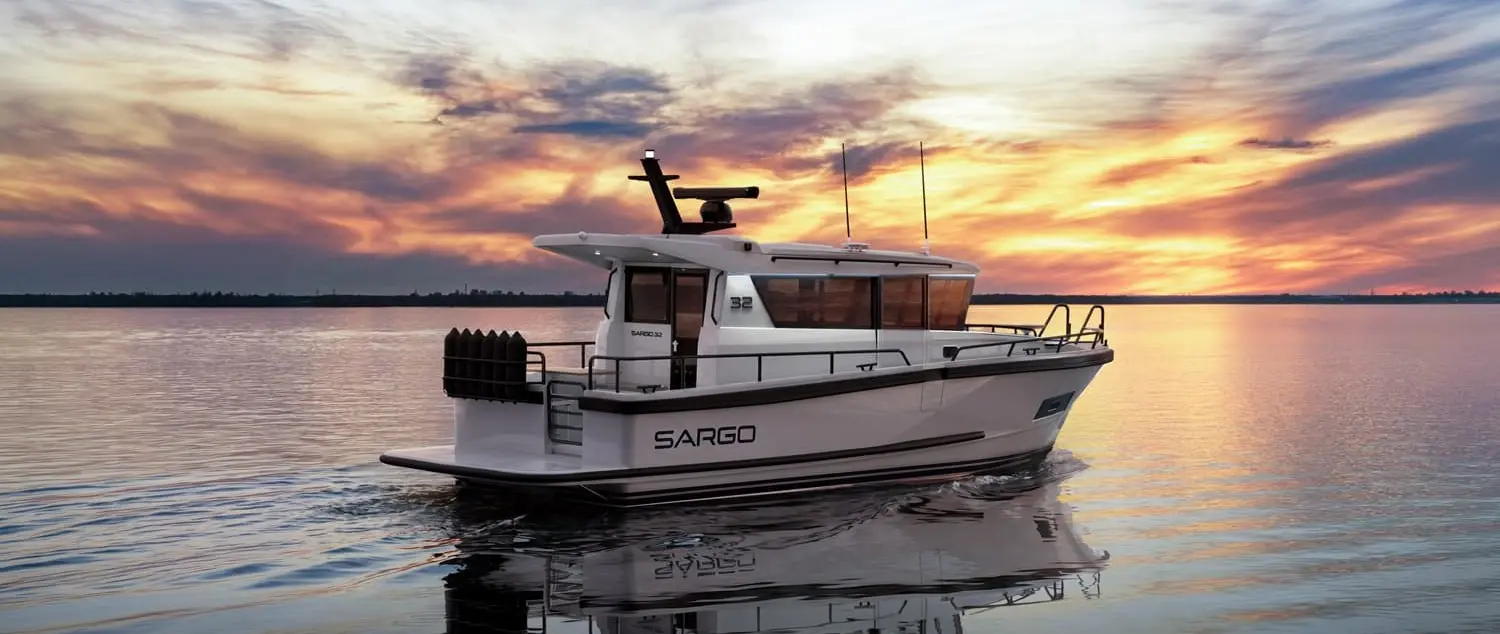
A new chapter for the Finnish all-season cruiser
Finnish boatbuilder SARGO has introduced the SARGO 32, a new enclosed-wheelhouse motorboat conceived to provide more space without requiring owners to move into a substantially heavier class. The design takes cues from the larger SARGO 45 and adds a practical choice of single- or twin-engine installations. It is intended for buyers who use their boats beyond the warmest weeks of summer and want meaningful shelter without giving up fresh air and access to the decks.
The new model is scheduled to appear at boot Düsseldorf in Germany from 23 to 31 January 2027. That will be an opportunity to inspect the actual layout, while the images currently supplied by the manufacturer should be understood as promotional renderings. It is a newly introduced model, not a report of independent sea-trial results, and published performance figures remain subject to the builder's own qualifications.
Although its name suggests a conventional 32-footer, SARGO's current model data gives a length overall of 10.40 metres, or 34.12 feet, with a beam of 3.35 metres. Owners comparing older SARGO 31 dimensions or brokerage listings should rely on the latest manufacturer's specification rather than assume that nominal model numbers are exact measurements. The new design aims to make the extra length useful in everyday movement and accommodation.
Single engine or twins: a genuine choice
One of the more interesting decisions in the SARGO 32 programme is to make a single-engine configuration central to the design. SARGO recommends 340 to 480 horsepower for a single installation, while the twin-engine recommendation is two engines of 270 to 320 horsepower each. These are alternative arrangements for different owners; the numbers are not a guarantee of a particular speed with every loading or equipment choice.
The manufacturer's guidance places the overall top-speed range between 30 and 42 knots, with the usual caveat that conditions and configuration will affect results. For long-distance cruising, range at a representative economical speed will matter at least as much as maximum speed. Published engine figures alone cannot settle that question without tank capacity, loading, propeller and independently observed consumption data for the chosen specification.
A single engine can reduce initial machinery costs, servicing requirements and the quantity of components that eventually need replacement. Twins may offer a different handling feel and a measure of propulsion redundancy, though neither arrangement removes the need for sensible passage planning. Buyers should also compare manoeuvring equipment, access around the machinery and service support at their home port before deciding which philosophy suits them.
Hull design and standard trim control
SARGO says the bow and stern have been drawn with straighter lines to lengthen the waterline and improve the boat's running attitude. The manufacturer also uses vacuum infusion for the hull and deck laminates, allowing more precise control of resin quantity during construction. It presents the result as a larger boat that avoids an increase in weight over its predecessor, a notable claim that will be worth checking against final, equipped examples.
The published dry weight for a single-engine boat is 5,400 kilograms, but it should not be confused with displacement when the boat is carrying fuel, water, passengers and cruising stores. The difference can be substantial on a compact cruiser. SARGO also specifies interceptors as standard, allowing the boat's trim to be managed across different speeds and conditions; their effectiveness will depend on the full hull and propulsion setup.
CE design category B-Offshore is listed in the manufacturer's technical data. It is a meaningful specification for an owner planning to cruise in exposed coastal waters, but it is not a substitute for interpreting the owner's manual, checking the actual certification plate or remaining within appropriate weather limits. A well-protected wheelhouse extends the usable season; it does not make severe conditions inconsequential.
Better movement around the wheelhouse
The SARGO 32 combines an enclosed helm area with large opening side doors and a substantial roof opening. Together they are intended to provide ventilation and an open-air feel during fine weather while retaining the protective structure that makes Nordic-style pilothouse boats so practical. A side boarding gate is also standard, an important detail when stepping aboard from a floating pontoon or handling lines alongside.
The helm has room for two large display screens, giving owners flexibility when configuring navigation and monitoring equipment. Screen area is useful only when the installation preserves clear sightlines, reliable physical controls and a comfortable view ahead in varying light. Prospective buyers should pay close attention to how the skipper moves from the wheel to either side deck when mooring short-handed.
There are working spaces both forward and aft, and the broader deck plan follows the practical priorities familiar to existing SARGO owners. That includes circulation and opportunities to secure equipment rather than simply maximising seating. It is an especially relevant balance for families who alternate between leisurely days at anchor, brisk passages and arrivals in exposed harbours.
Two cabins and a more useful lower deck
Below, the manufacturer lists two cabins and a total of five berths. That makes the SARGO 32 more than a dayboat and allows a small family or group to plan short cruises without requiring a much larger vessel. The specific quality of those berths will be easier to judge at the public premiere, when buyers can test headroom, access, stowage and ventilation for themselves.
The builder highlights a separate shower in the accommodation, a significant convenience on a compact pilothouse cruiser. A dry bathroom compartment makes consecutive nights aboard considerably more pleasant, particularly in cooler weather when drying clothing and towels becomes part of ordinary boat life. As always, owners should inspect water and waste capacities and the ease of keeping the compartment clean before estimating how long they can remain independent of marina facilities.
Another benefit of the revised proportions is the increase in usable outdoor space at both ends of the boat. That does not automatically make the 32 suitable for every berth: its 3.35-metre beam and 1.05-metre published draft still need to be checked against local marina dimensions and cruising grounds. Handling space around a crowded pontoon matters as much as comfort during a passage.
What to check at the Düsseldorf premiere
SARGO's official boat-show schedule lists the new 32 for boot Düsseldorf, alongside the SARGO 36 and 45. Visitors should be able to compare the new boat with its larger siblings and decide whether it delivers the same practical approach at a manageable size. Particularly worthwhile questions concern real-world single-engine economy, final available options and whether the standard equipment list varies between markets.
There is not yet a dependable basis for quoting a universal delivered price, because engines, navigation equipment, taxation, transport and dealer commissioning can change the final figure. Nor should an untested range claim be inferred from the advertised 30–42-knot top-speed bracket. The sensible comparison is a fully specified single-engine SARGO 32 against a similarly equipped twin-engine alternative and against the owner's actual annual use.
For leisure boaters seeking a sheltered, capable-feeling family cruiser, the new SARGO 32 offers a coherent set of priorities: accessible side decks, a properly enclosed helm, overnight accommodation and a propulsion choice. Its appeal rests on how well the final production boat translates those promises into easy everyday operation. January's public debut should provide the first substantial chance to judge the result aboard rather than solely from drawings.