
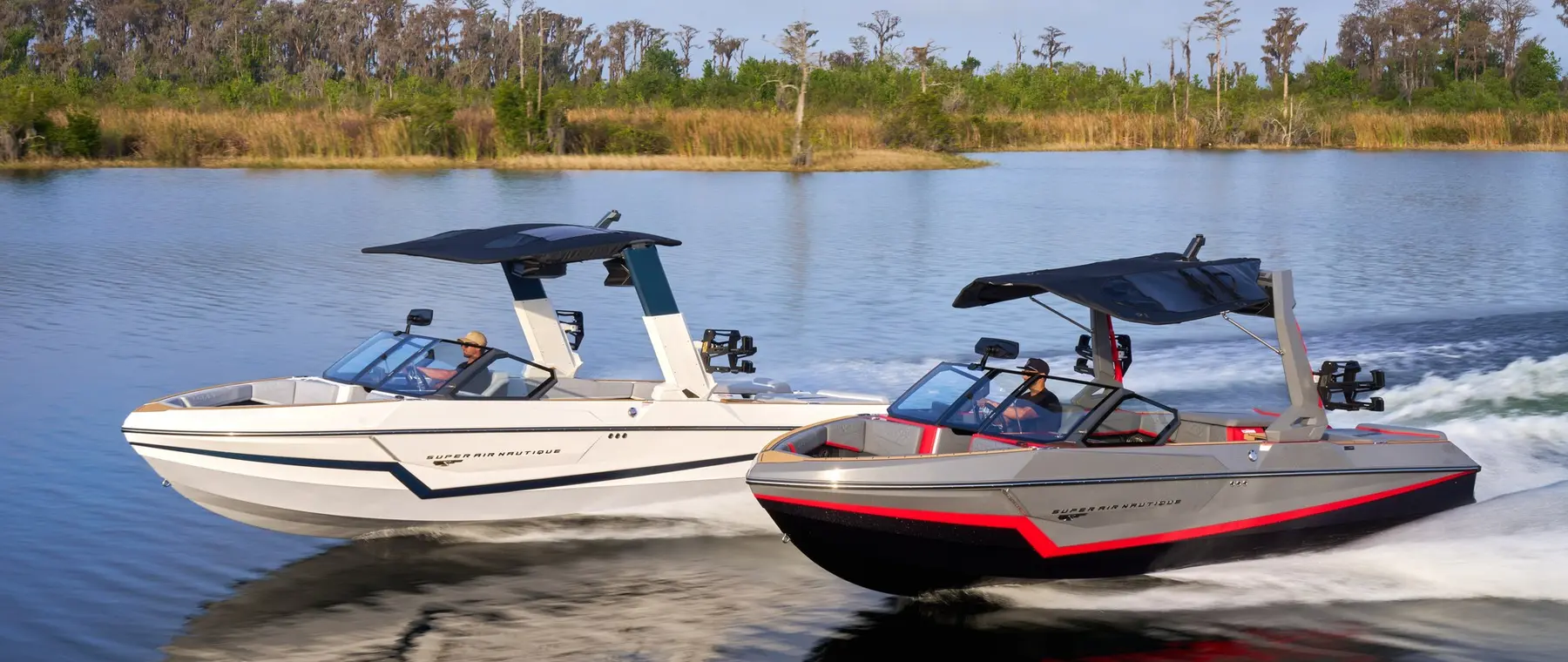
Two familiar sizes, extensively reconsidered
Nautique's redesigned Super Air S-Series for model year 2027 revolves around two boats, the 23-foot S23 and 25-foot S25. The manufacturer introduced the range in June, explaining that the new hull and interior arrangements are intended to make the boats more accommodating for a wide variety of wakeboarding and wakesurfing experiences. That approach goes beyond changing upholstery colours or adding another screen. It involves how the hull creates a tow wake and how the people aboard use their limited deck space.
For a household that alternates between different riders and quieter family outings, this is a practical proposition. A specialist wakeboat should deliver the conditions sought by experienced participants without intimidating occasional beginners. At the same time, a crew may spend more time talking, eating and swimming than actually riding. A successful redesign needs to address both halves of that routine. The S23 and S25 therefore deserve examination for their daily usefulness as much as for their technical wakesports equipment.
A revised hull needs a real-world demonstration
Nautique says the new S-Series hull produces a cleaner, more consistent wake and a broad surf wave, with a forgiving pocket intended to suit varying skill levels. Those are the builder's performance descriptions and should be kept separate from independent testing. Wake quality depends on loading, ballast configuration, speed and the water conditions during the demonstration. Buyers comparing the two sizes should ride behind both if possible instead of assuming that a larger hull will reproduce exactly the same feeling on the water.
The driver matters as much as the equipment. Reliable towing involves holding an appropriate course and speed, monitoring the rider and understanding the surrounding traffic. A sophisticated hull can help create a desirable wake, but it does not replace training or the local operating rules on narrow or crowded waterways. Families new to wakesurfing should plan a familiarisation session covering the controls, spotting duties, safe recovery procedures and the different effects of ballast and trim before inviting a large group to take turns.
Why moving ballast under the floor matters
One of the more consequential changes described in the official release is an optional supplemental ballast system housed entirely below deck. Nautique gives additional weights of 1,100 pounds for the S23 and 1,500 pounds for the S25. That installation is intended to free space in the stern lockers and distribute weight where the hull designers want it. The numbers describe optional supplemental ballast, not the total payload that can safely be carried as passengers and gear.
More useful storage space means wet equipment can be put away instead of piled under seats or left where passengers walk. The manufacturer says the revised compartments extend along the sides and communicate with other lockers, accommodating longer boards and more accessories. That needs to be assessed on the real boat because a large opening does not automatically mean every item will fit. Ask the dealer to demonstrate the filling and draining controls, maintenance access and the correct operating sequence for the specific ballast installation.
Helm controls and the driver's working position
The 2027 boats receive an updated LINC Panoray touchscreen interface, a revised Helm Command unit and a dedicated control for the stereo. Nautique also describes an optional Steering Assist Throttle Control, allowing the driver to make fine steering adjustments without removing a hand from the throttle. A wireless phone mount and redesigned dashboard storage reflect how frequently the driver needs small conveniences while handling the boat. These features are intended to reduce distraction, although they are only helpful if the operator becomes familiar with them.
There is also a redesigned helm seat with an available powered adjustment and a cleaner dashboard arrangement. Check sightlines from the seated and standing positions, especially when people are moving around the cockpit. The driver should be able to see the towline, rider and surrounding boats clearly while monitoring the essential instruments. During a dealer demonstration, rehearse the normal sequence of setting the wake, bringing the boat up to speed and returning to recover a rider. Good ergonomics become evident through repeated tasks.
The small design choices that help a family
Nautique has increased seat cushioning and revised the interior finishes, but several simpler changes may prove equally valuable. The new S-Series adopts an in-floor cooler location near the helm and passenger seating, leaving other compartments available for equipment. An optional sliding Manual Swim Terrace extends from beneath the platform to provide an additional step into the water. The builder says a sensor can warn the driver if the engine is started while the terrace remains deployed, a useful safeguard that must not replace a visual check.
Comfort on a wakeboat is about reducing small points of friction. A family may be handling ropes, boards, a cooler, lifejackets and several pairs of shoes in a relatively short space of time. If those things have predictable homes, the crew can focus on enjoying the day. Test the terrace with wet hands and investigate how it is secured for transport. A mechanism that looks elegant when clean must still be easy to use after a season of exposure to the water and ordinary wear.
S23 or S25: choose for the actual crew
The two redesigned boats share the same general engineering direction but do not offer identical space or mass. A smaller model may be more manageable to tow, store and operate with a modest crew, while the larger one can better accommodate a full group and bulky watersports equipment. Prospective buyers should request precise dimensions, transport weights, passenger limits and engine arrangements for both. The published descriptions do not establish a universal winner because marinas, road rules and typical passenger numbers vary greatly.
A useful test day involves more than a short demonstration at maximum wake setting. Include time at idle, loading from a dock, placing equipment in lockers and changing between riders. Compare the boats with the family aboard rather than with an empty showroom deck. The S-Series redesign is interesting because it addresses the relationship between performance systems and the ordinary organisation of a leisure boat, making the two essential parts of its appeal instead of competing priorities.
Read the Nautique builder profile and the official Nautique release. The 2027 model-year information was introduced 9 June 2026; current pricing, equipment and availability should be confirmed with the manufacturer.