
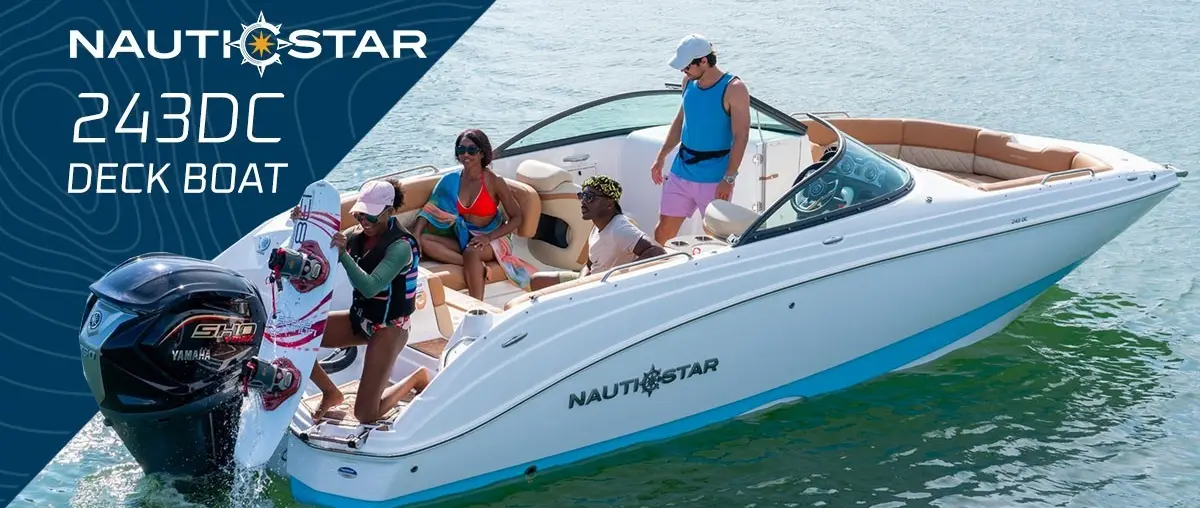
The case for an open, family-oriented deck boat
At 24 feet 3 inches in length, the NauticStar 243 DC Deck sits firmly in the practical family-boating category. Its layout is aimed at the activities that often define a successful weekend: taking friends out for an afternoon, swimming from a sheltered anchorage and carrying the bags and equipment that make a day on the water comfortable. The boat is not presented as a compact overnight cruiser, and its priorities are best evaluated on that basis.
NauticStar lists a beam of 102 inches, giving the 243 DC a substantial footprint for its length. The deck plan combines forward and cockpit lounge seating with a walk-through windshield and a defined helm position. The appeal is the ability for passengers to spread out rather than remain crowded around a single cockpit table for the entire trip.
The most useful comparison for a prospective owner is a day aboard rather than a showroom photograph. Ask where guests will board from a dock, where shoes and dry bags will go, and how someone in wet swimwear will move across the cockpit. In a boat of this size, good circulation and storage can contribute more to enjoyment than decorative details.
Twin helm seats and simple control of the day
The manufacturer describes two bucket-style helm seats with flip-up bolsters and a panoramic walk-through windshield. This gives the skipper and a companion their own forward-facing positions while preserving access to the bow. The arrangement is useful on longer trips when passengers want a view ahead and the operator needs to move between seated and standing positions.
The 243 DC specification lists a maximum power rating of 300 horsepower, but that should not be interpreted as the engine fitted to every boat. Outboard selection, propeller choice and the weight carried can alter acceleration, fuel consumption and handling. Buyers should insist on a sea trial in the actual proposed configuration rather than relying on a general performance claim.
NauticStar also lists a Simrad NSX7 display among the helm features. A screen can support chart and boat-data functions, but installed sensors, cartography, engine integration and software packages may differ by boat. The owner should check exactly what is supplied and verify that the essential navigation equipment remains accessible and legible in bright sunlight.
Space for swimmers and watersports gear
The cockpit is arranged with wraparound seating and storage compartments, with further lounge seating forward. NauticStar advertises a convertible sun pad and a variety of underseat lockers, including places suitable for day gear and watersports equipment. Thoughtful storage matters when the passenger load rises, because loose objects can quickly obstruct movement or become hazardous.
The builder shows access points at both the bow and stern for boarding and swimming. A tow pylon appears in the equipment description, but the tow-sports capability of a specific boat must always be assessed against the installed equipment, loading restrictions and manufacturer instructions. Passengers should also have a safe position clear of lines and moving equipment during a tow.
Aft access makes a difference to a family day out, especially with younger swimmers who return repeatedly to the boat. It is worth checking the height and grip of the ladder, the path to the seating and the ability to supervise someone getting back aboard. These practical elements determine whether an attractive swim platform is genuinely convenient.
A privacy compartment without a full cabin
A particularly useful detail is the enclosed, step-down dressing compartment. NauticStar describes provision for an optional portable toilet, offering a measure of privacy absent from many smaller open boats. For families planning long days away from a marina, that feature may be more valuable than an additional entertainment system.
The boat also includes a pressurised-water arrangement serving a galley sink, with an optional transom shower. Buyers should check the precise fitted configuration, tank capacity and maintenance implications before assuming that every listed option is included. A small water system needs sensible management, particularly when saltwater swims mean repeated rinsing during the day.
None of this makes the 243 DC a substitute for a cabin cruiser designed for overnight accommodation. Its strength is providing enough comfort to stay out for the day without creating the size and complexity of a larger boat. Clear expectations about weather protection, food storage and personal privacy will help an owner decide whether that balance is appropriate.
Dimensions, draft and the purchase decision
The published dimensions include a draft of approximately 16 inches and a fuel capacity of 66 US gallons. Those figures are useful planning references, but the skipper should verify draft with the selected engine and normal passenger load, and should not equate nominal shallow draft with permission to approach an uncharted beach. Tides, underwater obstructions and local access rules still govern a safe arrival.
Before ordering, buyers should compare the boat against its intended home berth or trailer, including the beam, overall transport height and any engine or tow hardware that changes the effective dimensions. It is equally important to establish what is standard, what is optional and how dealer preparation affects the delivered configuration. Manufacturer pages may show multiple equipment packages and prices that change over time.
The NauticStar 243 DC illustrates why a capable family boat is not defined only by horsepower. Forward and aft seating, a walk-through layout, a privacy compartment and useful storage all contribute to how often a boat is actually used. A careful sea trial with the normal family aboard remains the best way to decide whether these features form a convincing everyday package.