
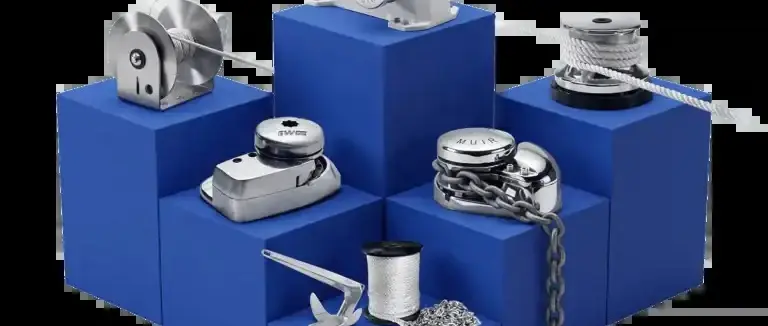
Tasmanian anchoring-equipment manufacturer Muir has launched INOX PRO, a stainless-steel drivetrain option for recreational windlasses, drum winches and capstans. Unveiled at METSTRADE in Amsterdam on 16 November 2026, the change is intended to address corrosion in the gearbox and motor housings hidden beneath an otherwise polished deck fitting. The significance for smaller leisure craft is practical rather than cosmetic: a windlass may look excellent above deck while the damp anchor locker below is steadily damaging its mechanical drive. Muir says the option can be ordered on new equipment and retrofitted to selected existing units, allowing an owner to retain serviceable top works.
What changed inside the anchoring equipment
Muir's announcement describes the change as a housing-material upgrade rather than a replacement of the windlass mechanism itself. The gearbox housing and motor housing are produced in stainless steel to match the above-deck metalwork, while the gear train, brake, clutch and sealing arrangement are unchanged from the standard build. This distinction helps explain why the company says familiar footprints, controls, wiring and chain compatibility remain applicable to the corresponding models. An owner should nevertheless request the correct drawing for a particular serial number, because an unchanged product family does not guarantee that every older installation will be identical to a contemporary replacement.
The problem of wet anchor lockers
The lower section of a windlass is often fitted in a locker where chain, rope and saltwater regularly collect. Even if a boat is cleaned carefully, the compartment can remain humid and subject to dripping gear after anchoring. The manufacturer says a recurring failure mode has involved corrosion of painted alloy motor and gearbox cases, sometimes aggravated where dissimilar metals meet at studs or flanges. Stainless steel does not mean immune to all forms of corrosion, especially in crevices and poorly ventilated saltwater environments. It does, however, represent a deliberate attempt to address the particular material combination and coating breakdown described in the company's release.
Why it matters on boats below twelve metres
A five- to eleven-metre cruiser may use its windlass frequently on holidays and weekends, especially when anchoring in coves rather than visiting marinas. Equipment reliability becomes more consequential when the crew is small and there is little room for handling a heavy chain manually. Muir says the upgrade is offered across a recreational range encompassing boats from around five metres upward, so some of the intended applications fall squarely within Leisure Boat Guide's audience. The right selection still depends on displacement, anchor and chain sizes, chain retrieval speed and the manufacturer's specified loads, not solely the length of the boat.
Which Muir models are included
The manufacturer identifies Storm vertical windlasses in VR and VRC forms, Compact HR horizontal windlasses, DW and DFF drum winches, and Sailor VC mooring capstans. These products perform related but distinct jobs, and an owner should not confuse them as interchangeable. A drum winch may be appropriate for a boat designed around rope or combined rode management, while a vertical chain windlass has different deck and locker requirements. The announcement makes INOX PRO a choice across existing families, not a claim that a single model will meet every anchoring arrangement. The selection should begin with the actual deck layout and rode rather than the finish.
The warranty changes are specific
Muir advertises a five-year warranty on the stainless gearbox housing, a three-year warranty on the motor and five-year cover on the top works for INOX PRO-equipped recreational gear. Those periods are useful headline comparisons, but warranty scope is always defined by the final written terms, including installation and maintenance requirements. Buyers should ask whether the warranty applies to a replacement motor-and-gearbox assembly fitted to an older unit and how the original top works are treated. The company's statement does not establish that consequential costs such as crane hire, yard labour or travel expenses would necessarily be reimbursed if a claim arises.
Retrofit possibilities deserve close inspection
The company says a boat owner with a corroding drivetrain may be able to replace the motor and gearbox while retaining sound deck equipment. That can be appealing where access to the windlass is awkward or the existing deck cut-out would be costly to change. It is not a reason to assume all components above deck can be reused regardless of condition. A qualified service technician should check mounting fasteners, chainwheel condition, seals, bearings, electrical terminals, deck bedding and structural support. A partial retrofit makes sense only when the retained parts are serviceable and the new assembly can be installed to the manufacturer's instructions.
Stainless steel is not a substitute for drainage
Water should still be kept away from electrical terminals and mechanical parts as far as the installation allows. An anchor locker needs suitable drainage, access for inspection and a route for wet chain or rope that does not continually soak the drivetrain. A stainless housing may tolerate an aggressive environment better than a poorly protected alloy casing, yet trapped salt deposits, crevice corrosion and electrical problems remain possible. Owners should clean the compartment, check drains and investigate standing water even after fitting a more corrosion-resistant winch. Improving the locker is a complementary task, not one rendered unnecessary by a material upgrade.
Galvanic and electrical considerations remain
Muir highlights the removal of the aluminium-to-stainless joint in the upgraded motor and gearbox housings, one of the issues raised in dealer feedback. That does not eliminate every possible source of galvanic action in a boat. Chains, fasteners, deck fittings and electrical systems may include other metals, and correct bonding or isolation depends on the complete installation. Electrical cables and connectors also need to be protected from moisture and excessive voltage drop. It would be inaccurate to claim that specifying INOX PRO removes the need to inspect the boat's corrosion-control arrangements or to follow the supplier's electrical design guidance.
The mechanical system is intentionally familiar
Retaining the established gear train, brakes and clutches helps the manufacturer present the upgrade as a change in durability rather than an unproven new retrieval mechanism. For boatbuilders and professional installers, the familiar controls and mounting arrangement may simplify specification and service planning. That does not establish an independent reliability improvement in the field yet. The new material must still demonstrate its long-term behaviour through years of immersion-related humidity, salt spray, repeated loading and ordinary owner maintenance. Prospective buyers should distinguish factory testing and design intent from published multiyear in-service failure statistics, which the announcement does not provide.
Factory tests and manufacturing claims
Muir says the INOX PRO components were developed and tested in-house at its Kingston, Tasmania, factory, including salt-spray testing under the company's ISO 9001 quality programme. Those are specific and relevant claims about production practice, but the release does not publish a full external test report for each model. Salt-spray exposure is a useful controlled method of challenging materials, not a direct conversion into an exact number of trouble-free seasons on a boat. Sea conditions, usage, maintenance and the state of the anchor locker vary enormously. Owners can treat testing information as part of the evidence without reading it as a guarantee of a particular lifespan.
Ordering and delivery dates
Orders opened at METSTRADE, with the manufacturer saying shipments would begin in November 2026 for models up to VRC1250, HR1600 and DW10. Larger versions were expected from February 2027, according to the announcement. These are planned availability dates rather than a guarantee that every distributor holds stock. A customer should confirm whether a quotation refers to an INOX PRO unit or the ordinary drivetrain, and obtain the expected delivery date in writing. When timing is critical for a winter refit, the boatyard should also check when the correct accessories and replacement parts will be available rather than schedule launch around an indicative shipping notice.
Choosing a windlass for the actual anchoring load
A new housing material does not change the fundamental requirement to size the windlass correctly. Selection depends on the full loaded boat, anchor and chain arrangement, required pull, duty cycle and how the rode enters the chain locker. The manufacturer offers a windlass selection guide and technical drawings that are a better starting point than choosing a unit because it resembles the one already on board. Smaller boats can have surprisingly demanding retrieval conditions when wind and current are adverse. Proper anchoring technique should also avoid using the windlass as the device that holds the boat against an anchoring load for which the installation was not designed.
Service access and professional installation
On a compact boat the difference between a straightforward replacement and an expensive repair may be as simple as whether a technician can reach the gearbox mounting bolts. Before specifying an upgraded assembly, inspect access panels, locker clearance and the route used to remove the old motor. A dealer should also confirm that wiring, circuit protection, controls and any chain counter or remote are compatible with the particular model. Where deck bedding or sealing must be disturbed, restoration of watertightness is essential. A visually tidy installation can still create leaks or electrical faults if the below-deck work is rushed.
Environmental benefit requires a whole-life view
The manufacturer presents longer service life as a sustainability advantage, reasoning that keeping a winch in use for more seasons avoids premature replacement. That proposition is credible as a general material-efficiency argument, but the scale of any environmental benefit would depend on manufacture, shipping, service intervals and actual lifespan. Stainless housings require their own production energy and resources, while replacing only a failed lower assembly could reduce material waste compared with buying an entirely new winch. Owners concerned about environmental performance should assess durability alongside repairability and access to spare parts, not assume that a change of metal automatically produces a quantified emissions saving.
A targeted upgrade for a common ownership frustration
INOX PRO is noteworthy because it attempts to improve a failure-prone part of established anchoring gear without demanding that every existing installation be redesigned. The appeal may be strongest for owners who keep their boats for many years or anchor frequently in saltwater. The sensible decision is still model-specific: confirm the existing winch, inspect the locker, compare the upgrade and complete replacement prices, and study the warranty. For small leisure vessels, the launch is an opportunity to improve long-term reliability through careful specification and maintenance, not a substitute for either.
Official source: https://www.metstrade.com/exhibiting/superyacht-zone/muir-anchoring-systems/news/muir-raises-standards-for-recreational-boaters-with-global-launch-of-inox-pro-stainless-steel-drivetrain-option