
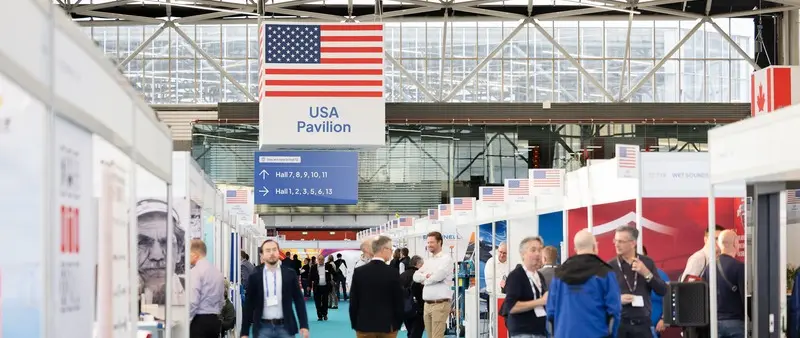
North American companies invited to Amsterdam
The National Marine Manufacturers Association has highlighted limited remaining space within the USA and Canada Pavilions at Metstrade 2026. The international marine equipment trade show takes place from 17 to 19 November at the RAI exhibition centre in Amsterdam.
The announcement is aimed primarily at suppliers and manufacturers seeking export customers rather than recreational boaters looking to attend a consumer boat show. Metstrade connects industry buyers, equipment brands, service providers and distribution partners.
Dedicated national areas help smaller suppliers
The USA and Canada Pavilions provide recognisable locations for exhibitors that want to present their products as part of a larger international group. Such arrangements may help companies meet potential distributors and service partners without organising an entirely independent stand.
Exhibiting does not itself secure export orders or distribution agreements. Companies still need to consider customer demand, product compatibility, pricing and local market requirements before expanding.
Equipment innovation is central to the event
Metstrade is an established gathering for businesses making marine components, electronics, propulsion accessories and other systems used in both powerboats and sailing craft. New products shown to trade visitors can eventually influence the choices available to owners through boatbuilders and chandlers.
Manufacturers often use international shows to compare competitor products and learn about supply-chain developments. An announced attendance at a trade show is not confirmation that any particular new model or piece of equipment is ready for retail sale.
Export support may help companies plan
NMMA notes that American suppliers can consult its Export Resource Guide for information about grants and resources that may support international exhibition costs. The guide is a starting point for assessing potential assistance rather than a promise that every exhibitor will qualify.
Interested companies should investigate application requirements and deadlines through the relevant organisers. The available pavilion spaces are limited, and the announcement does not publish a guaranteed remaining booth count.
Why this matters to everyday boating
International connections between manufacturers and distributors can affect the availability of replacement parts, maintenance products and electronic equipment in local markets. A wider supplier network may also improve access to technical support for existing boats.
The upcoming November exhibition creates an opportunity for trade discussion. Leisure boat owners should continue to assess equipment on real specifications and local service access, not solely on its appearance at an industry event.
How national pavilions help small suppliers
A company attending a major international marine trade exhibition needs a clear plan for finding the distributors, boatbuilders and service businesses most relevant to its products. A shared pavilion provides a recognisable meeting point and may offer logistical support, but it cannot create demand where none exists. Suppliers still need suitable documentation and a realistic understanding of overseas buyers.
Before reserving space, exhibitors can identify whether the show is likely to attract the customers they want. A supplier of lightweight boat fittings may be looking for production boatyards, while an electronics company may prioritise installation firms and distributors. Matching the stand's presentation to those visitors can be more valuable than simply collecting a large number of business cards.
Exporting equipment brings new responsibilities
Marine products sold internationally may need to satisfy different electrical, environmental and installation requirements. Packaging, labelling, warranty arrangements and technical support can also differ between markets. A product that works well in North America is not automatically ready to be installed or sold through every European distribution channel.
Companies should check applicable conformity requirements and take professional advice where needed before making commitments at a trade show. Buyers may ask whether manuals are available in suitable languages and how spare parts can be supplied. Clear answers help create confidence and prevent an apparently successful sale from becoming a complicated service problem.
Demonstrations should show real applications
A useful equipment display explains the problem a product solves and the kind of vessel for which it was designed. Technical visitors often want measurements, installation diagrams and evidence of testing, not just an attractive screen or polished sample. Boatbuilders may also need to know how a component behaves when exposed to vibration, salt and repeated use.
A company can prepare short demonstrations and clear data sheets so that visitors can compare its product with alternatives. Promises about savings or performance should identify the test conditions behind them. The long-term reputation of a supplier depends on whether installed equipment meets its specification after the exhibition is over.
The show is also a research opportunity
Suppliers can learn about changing materials, manufacturing techniques and the practical concerns of boatyards serving different markets. Conversations with engineers may reveal overlooked requirements or opportunities to simplify installation. Such feedback can be useful even when it does not produce an immediate order.
A disciplined exhibitor should record useful observations and follow up after returning home. That might include providing additional technical drawings, arranging a sample or clarifying a proposed distribution territory. Agreements should be put in writing and should distinguish a tentative enquiry from a confirmed commercial commitment.
Boaters eventually feel the effects
Although Metstrade is not primarily a consumer show, products first demonstrated to trade visitors may later appear on new boats or become available for refits. Improvements to connectors, charging systems or deck hardware can influence reliability and ease of ownership.
Recreational buyers should not assume that a technology shown at an international exhibition has already been independently evaluated for their boat. They still need to confirm installation compatibility and local service access. The NMMA pavilion announcement is an opportunity for industry participation, not proof of future sales or technical superiority.
Before agreeing to a foreign distribution arrangement, manufacturers should understand who will provide training and handle warranty work for installed equipment. A component used on hundreds of boats can generate recurring service questions that must be answered locally. A distributor with technical competence may therefore be more valuable than one who promises the highest sales volume without a plan for support.
Exhibiting also requires careful follow-up with potential partners. Meetings can establish interest, but businesses should verify financial terms, territory restrictions and responsibility for spare parts before committing. A supplier that promises rapid delivery without understanding manufacturing capacity could create difficulties for both the buyer and the end user.
Companies can take photographs and notes of their own demonstrations for training and future marketing, while respecting other exhibitors’ intellectual property. The most useful post-show report identifies specific enquiries and technical questions rather than relying only on the number of people who visited the stand.