
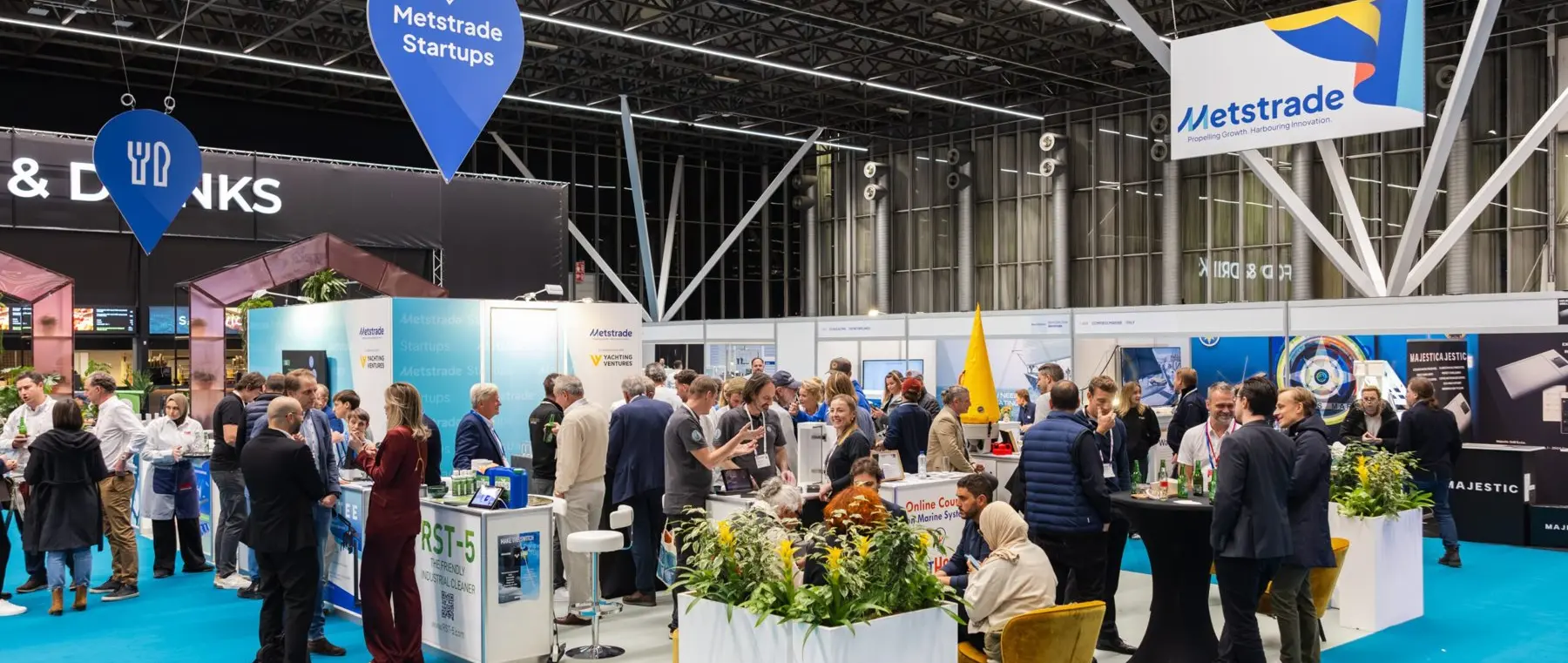
Yachting Ventures brought a 16-company startup lineup to the METSTRADE 2026 leisure-marine exhibition in Amsterdam, with projects spanning onboard electronics, digital ownership, marina software, recyclable materials, water management and alternative energy. The accelerator and industry network announced the group on 17 October ahead of the show, which took place from 17 to 19 November. The companies appeared in the METSTRADE Startups Area in Hall 5 with Fort Insurance supporting the programme. For owners of small leisure boats, the most interesting ideas are not necessarily dramatic new hulls. A reliable instrument interface, simpler marina booking or a way to keep rainwater out of the cabin can affect daily ownership more directly. These are startup propositions and exhibits, not a guarantee that every product is independently certified, widely available or suitable for every vessel.
A business exhibition with practical implications
METSTRADE is primarily a trade event where manufacturers and buyers discuss future products and partnerships. A startup area can help emerging companies meet boatbuilders, distributors and technical specialists before their products reach a larger consumer market. That is a different purpose from a retail boat show where visitors order a finished craft. Yachting Ventures organised the 16-company group across six themes, allowing a wide set of concepts to be compared in one place. The October announcement should be read retrospectively as of 22 November; the three-day Amsterdam exhibition has already finished. The companies' later commercial progress will require separate verification.
Digital records could simplify boat ownership
YachtPass develops a platform bringing together vessel documents, manuals, check-in information and links to support from dealers and manufacturers. Owners of small boats often collect important paperwork in several places, making it harder to find the correct information when it is needed. A digital record could be convenient if it is kept current and can be accessed reliably. However, a software service cannot substitute for original certificates where authorities require them. Owners should investigate data ownership, offline access and export functions before depending on one platform. The startup's proposition is a useful direction, but security and practical durability matter as much as a polished interface.
Marina administration remains a common frustration
ITN Marina Management focuses on berth allocation, bookings, invoices and guest self-service through cloud-based tools. A weekend boater may encounter marina paperwork only occasionally, but unclear instructions or a difficult reservation system can still disrupt a trip. Better administration could help facilities manage arrivals and provide customers with clear information. That does not establish that every marina will adopt the software or that berths will become cheaper. Each operator has its own processes and regulations. The startup's relevance lies in applying familiar digital-service expectations to an industry that still uses a variety of booking and record systems.
AI is appearing in customer-facing services
Cadentia Technologies has developed its AION platform for interactions among buyers, dealers and boatbuilders, aiming to support configurations, quotations and continuing ownership services. These activities are relevant when a purchaser has to choose from multiple hull, engine and equipment combinations. A digital guide might make choices easier to understand if it is accurate and supported by verified manufacturer information. Yet automated suggestions can also be wrong or incomplete. Prices, compatibility and regulatory requirements must remain under appropriate human control. Owners should insist on a confirmed written specification before treating an AI-generated recommendation as a purchase agreement.
Assisted navigation raises higher stakes
Mirai and TONJO are also working with AI and sensing, but their emphasis extends further into navigation, vessel intelligence and operator assistance. Such technology may be useful when it reduces workloads or improves awareness of hazards. It must never be interpreted as permission to abandon proper lookout or to operate outside a boat's safe limits. A concept shown at a business event is not automatically an approved autonomous vessel. Verification, sensor failure modes and applicable maritime rules remain essential. For under-12-metre craft, assistance may have promise, but implementation should be judged by real operating evidence rather than marketing labels.
Connected controls need to be reliable
Kaiman Marine manufactures custom circuit-breaker panels and monitoring modules. Electrical control can become increasingly complex even on a modest dayboat when navigation equipment, pumps, lighting and communications all depend on onboard power. Clear monitoring may help an owner identify a problem early, although it cannot replace correct wiring or appropriate circuit protection. Installation quality is important because water, vibration and corrosion affect marine electronics. Owners considering a new panel should confirm ratings and compatibility with their boat's systems. Startup innovation is relevant only if the device can be serviced and supported for years.
SWAY focuses on instrument connectivity
SWAY is developing a plug-and-play device intended to connect boat instruments and AIS information to mobile devices and navigation applications over Wi-Fi. The company also describes automatic recording of sailing trips through an accompanying app. These functions may interest small sailing and cruising boats where additional displays are costly or space is limited. However, a phone or tablet is not a complete replacement for essential navigation equipment. Screen visibility, battery life and loss of wireless connection are practical risks. AIS information may also be incomplete because not every vessel transmits a signal. A connected interface should support, rather than displace, responsible navigation.
Smart access becomes another service
AirLens is developing Passerello, a digital vessel-access system combining keyless boarding with a vessel information wallet and an integrated distress-related function. Access management may be useful for boats used by different family members or authorised crews, but any electronic entry system requires consideration of power failure, cybersecurity and emergency access. The term smart should not be assumed to mean foolproof. Owners would need to understand who can issue credentials, how access is revoked and whether physical alternatives remain available. The product may interest shared-use boats, though the suitability of the current design for smaller recreational craft remains to be established.
Recyclable composites are a longer-term challenge
Northern Light Composites, often known as nlcomp, develops a recyclable composite concept called rComposite. Traditional composite boat structures can be durable, yet difficult to recover or recycle at the end of their useful life. A material designed with recovery in mind could offer a different approach if the collection and processing systems are available. The announcement does not establish that every boatbuilder can immediately substitute this material into an existing design. Structural approval, production techniques, cost and performance remain important. Sustainability claims need lifecycle evidence rather than the presence of a word such as recyclable in a product name.
Hull protection attracts alternative ideas
HATAG MARITIME is developing a biocide-free fouling-release film for underwater surfaces, while NZeroWax works with plant-based waxes and lubricants. Both explore alternatives to products traditionally used on boats. Owners may welcome options that reduce certain chemical exposures, but actual performance will vary with water conditions, maintenance and installation. A non-biocidal product is not automatically free of environmental impact. Any hull treatment must be suitable for the substrate and the vessel's operation, with attention to local rules. These startups should be assessed through proper trials and service guidance before being recommended for a particular small boat.
Wave energy is being explored at compact scale
FETCH is developing a system designed to capture motion from waves using a relatively simple mechanical arrangement. The proposition is interesting because boats and marine infrastructure are surrounded by moving water, yet useful energy capture is not straightforward. Durability, mooring loads, conversion efficiency and reliability all affect whether such equipment is practical. The startup lineup provides only the concept, not enough independent performance data to quantify power production for small leisure boats. It would be misleading to claim that a compact wave device can replace conventional onboard charging without verified output and installation details. The idea deserves investigation, not inflated expectations.
Solar and wave generation may be combined
Primum is connected with SEAEN, an energy platform combining photovoltaic generation with wave-energy conversion in partnership with ETRA. A hybrid marine-energy system might be useful for certain fixed or floating installations, depending on its design. However, equipment serving coastal infrastructure is not necessarily suitable for a moving boat. Owners should distinguish marina and shore-energy concepts from products intended to be installed aboard a small vessel. The environmental benefit depends on actual energy generated, material use and maintenance requirements. Yachting Ventures' announcement introduces the project without providing a complete independent operating history.
Small maintenance products may matter most
Sea Mop offers a mast-base sealing solution designed to address water ingress without removing the mast. For sailing-boat owners, leaks around deck penetrations can lead to persistent maintenance concerns. A product that can be fitted around an existing mast may reduce disruption if the boat and installation are compatible. Nevertheless, a seal cannot cure structural damage or incorrect deck construction, and some repairs still require professional inspection. The startup's claim should be evaluated through fitting instructions, materials and long-term use. This is a good example of innovation aimed at an everyday problem rather than a dramatic technical milestone.
Deck showers and water systems also featured
WOW – Works on Water showed its shWOWer concept, a removable carbon-fibre deck shower using a bayonet attachment, while SensiBlue presented water-treatment technology intended to operate using the flow of water through a system. Such projects focus on convenience and onboard services. A removable fitting may simplify storage, but its installation must remain secure and appropriate for use in a wet environment. A water-treatment system raises more demanding questions: microbiological performance and potable-water suitability require verified standards. Owners should not assume a startup demonstration is proof that water is safe to drink. Both developments need careful product-specific assessment.
Sponsors and founders have different interests
Fort Insurance returned as the official sponsor of the startup areas, providing support for the programme and opportunities for founders to meet industry contacts. Such sponsorship can help emerging businesses gain visibility, but it is not an endorsement of every product's future performance or safety. A startup may be seeking manufacturing, investment, distribution or customer feedback rather than offering immediate retail sales. Visitors should clarify the development stage before discussing orders. The most valuable outcome of a trade exhibition can be technical cooperation, even when no consumer product is available the following week.
What small-boat owners should watch next
The 16-company lineup illustrates several directions worth monitoring: more accessible boat documents, connected instruments, alternative hull materials, cleaner maintenance products and systems intended to simplify daily operation. None of these should displace fundamental seamanship or regular inspection of a vessel. Buyers should ask about certifications, support arrangements, costs and how well any device works with their actual boat. The Amsterdam exhibition ran from 17 to 19 November 2026, and the October lineup announcement does not confirm which concepts have since entered production. Further reporting should follow the technologies as they become testable.
An innovation showcase rather than a shopping list
Yachting Ventures' official announcement identified 16 METSTRADE startup participants across digitalisation, AI, connected boats, materials, energy and onboard equipment. For the under-12-metre leisure market, the significance is the range of practical problems founders are trying to address. Some developments may eventually become familiar features on production boats, while others may change direction before launch. The distinction between demonstration and verified product is critical. A useful outcome from the show is a set of questions for future testing: does the device solve a real problem, can it be installed safely, and will support still be available when the first excitement has passed?
Official source: Yachting Ventures, original organiser announcement, 17 October 2026, *Yachting Ventures announces 16-startup lineup for Metstrade Startups 2026*. Lead photography: Yachting Ventures' official METSTRADE event imagery. Editorial technical and small-boat ownership analysis by Leisure Boat Guide.