
A distinct propulsion showcase at Amsterdam
METSTRADE will bring a dedicated Next Generation Propulsion Showcase to its 17–19 November 2026 exhibition at RAI Amsterdam, giving electric, hybrid and alternative marine drive suppliers a defined place within the marine-equipment event. The organiser's published exhibitor list includes twelve companies and products in a compact numbered stand sequence. For owners and builders of smaller leisure boats, the value is the chance to compare different approaches in one place rather than assume that all electric propulsion systems deliver the same capability.
The exhibition is not a declaration that conventional outboards are obsolete. It is an opportunity to examine the engineering choices behind emerging systems, question suppliers about installation and service, and understand how a product advertised for marine use relates to a particular hull. The organiser describes the zone as a way to advance lower-emission propulsion and industry collaboration. Actual performance, range and suitability still depend on the vessel, battery, route and intended operating environment.
A twelve-product lineup with very different roles
METSTRADE lists VEEM's Extreme Propulsion Package, JOOOL's Electric POD and ePropulsion's Spirit 1 Electric Outboard among its opening showcase entries. It also names Hidea's Easy 1000, VULKAN's In-line Hybrid Module HIOOO and Molabo's Aries R59. These are not interchangeable offerings. Some address simple small-boat propulsion, others concern integrated drivetrains or power systems for a different scale of installation. An informed visitor should separate direct outboard alternatives from components intended for builders.
The second half of the list contains Transfluid's Drivemaster 40W EVO, STOK electric's EPM-30, Belassi's 330 Turbo Marine Power Unit, Spinera's Fin Force 400, DR. NEMO's ZENIT Electric Motor and Remigo's RemigoMini. The breadth is itself noteworthy: a small tender owner may have very different questions from an aluminium fishing-boat builder or a yard fitting a hybrid package. Seeing the products side by side makes those distinctions easier to investigate.
Portable outboards and the tender market
RemigoMini and other compact electric drives highlight a particularly relevant segment for Leisure Boat Guide readers: tenders, dinghies and small craft that do not require high continuous power. Portability matters because an engine may be lifted in and out, stored in a locker and carried to a vehicle. But a light-looking unit must still be assessed with its battery, mounting hardware and charging equipment. A brochure motor weight does not necessarily describe the mass the owner will handle.
Ease of use is more than a question of starting without a pull cord. Compare control placement, shallow-water clearance, battery removal, propeller protection and what happens when power is low. For a tender, the ability to reverse accurately and bring the boat safely alongside may matter more than maximum claimed speed. Ask how the system behaves at low throttle, what service is expected and whether replacement components are available in the owner's cruising area.
The importance of matching power to hull
A 10-foot inflatable, a displacement dinghy and a fast-planing runabout impose radically different demands on propulsion. Electric motors are sometimes marketed using horsepower-equivalent figures, which can be useful shorthand but should not be mistaken for a complete performance guarantee. The relevant questions include usable continuous output, propeller efficiency, thrust at the speed intended and how the battery delivers energy as load changes. A demonstration on one hull cannot establish performance on every other boat.
Small-boat owners should bring measurements and practical information to a supplier conversation: length, beam, loaded displacement, transom specification, usual crew, current engine and typical route. Some installations may require electrical protection or structural changes beyond the purchase of the motor. That extra work should be included when comparing an electric system with a familiar petrol outboard. The right choice is the one that meets real usage, not the highest figure printed on a sign.
Battery capacity and usable range
Range is likely to be a central discussion in the showcase. A battery's nominal energy is only one part of endurance; boat speed, hull drag, wind, current, sea state and reserve policy all affect what can be achieved. Owners replacing a petrol outboard should be cautious about comparing fuel-tank volume with battery capacity through a simplistic conversion. A sensible demonstration reports operating conditions and how much battery remained, not merely a best-case distance.
Charging creates another set of questions. Is the battery removable? Can it be charged from ordinary shore power, and how long does the process take from a practical starting level? What do the manufacturer and installer recommend for storage, temperature and transport? A weekend angler using the boat on two successive days may need a different arrangement from someone who visits a sheltered mooring once a fortnight. The sales conversation should capture those usage differences.
Hybrid technology occupies another part of the picture
VULKAN's hybrid module and other drivetrain-focused entries show why the organiser has created a broad propulsion zone instead of treating it as an outboard showroom. Hybrid systems may coordinate more than one power source, but their advantages depend on vessel duty and careful integration. A boat with a modest service battery and a short local route is not automatically a suitable candidate for a complex hybrid conversion. Builders need to assess space, control architecture, cooling and failure modes.
For a small leisure-boat customer, the practical question is whether the system makes everyday use easier, quieter or more efficient without an unacceptable burden in cost, weight or maintenance. Some technology may first be relevant to larger or commercial installations before finding a place in small craft. The showroom is therefore as much about assessing development pathways as immediate buying decisions. Not every exhibit should be presented as a product ready for every family runabout.
Service networks could decide the winner
Propulsion purchases create long relationships between owners and equipment suppliers. A conventional outboard often benefits from a familiar dealer network, spare-parts availability and technicians with experience. Newer electric products must answer the same questions. Who diagnoses a fault? Is the battery serviced locally? Can a damaged propeller or control cable be replaced without shipping the complete unit overseas? These questions are particularly important for boaters who travel between regions or use the boat for fishing away from a major city.
METSTRADE's trade audience includes distributors and builders who can examine those support questions before a customer sees the product in a shop. A promising drive may become much more attractive when a capable dealer network is established. Conversely, a technically elegant system with uncertain warranty support may be a risky choice for an owner who depends on the boat every weekend. New technology should be judged in the context of its support infrastructure.
Safety, installation and regulation
Marine electrical systems must be designed for vibration, water exposure, corrosion and unpredictable loading. A neat motor housing is only the visible end of the installation. Buyers should examine isolation, cable routing, connectors, battery restraint, ventilation where required and manufacturer-specific protective systems. Work on high-energy equipment belongs with suitably qualified installers. There is no benefit in achieving quiet propulsion by introducing poorly understood electrical hazards into a small hull.
Local operating rules remain relevant regardless of propulsion type. An electric motor does not waive registration, speed limits, navigational lights or the obligation to carry safety equipment. Nor does it remove the skipper's responsibility for weather, a return reserve and collision avoidance. Visitors should ask suppliers how equipment complies with applicable standards and what documentation is provided. A product's presence at an exhibition is not itself a regulatory approval for installation on a given boat.
Why the Amsterdam timing matters
The showcase is scheduled for the same three days as METSTRADE, 17–19 November, at RAI Amsterdam. That provides a meeting point for suppliers, boatbuilders, retailers and other marine professionals just as many businesses are preparing future product ranges. The published stand sequence begins at 13.108A and runs through 13.108L, allowing trade visitors to prepare a practical route through the exhibition rather than rely on chance encounters.
An efficient visit could compare two or three products in the same intended power class, then ask their representatives a standard set of questions about real-world range, installation, maintenance and pricing. Retain the answers and specifications rather than trusting memory after a busy day. For an owner unable to attend, the organiser's public exhibitor list is a starting point for identifying suppliers and requesting technical information through normal channels. Announcements made during the show should be checked against each manufacturer's final documentation.
An editorial view of a developing market
The significance of the Next Generation Propulsion Showcase is its range of approaches, not a prediction that one motor will dominate. A tender that needs low-speed control, a fishing skiff that travels farther and a performance boat that demands high sustained output present fundamentally different problems. The companies in the zone may address different parts of that market, and there is room for several engineering solutions if each is candid about its limitations.
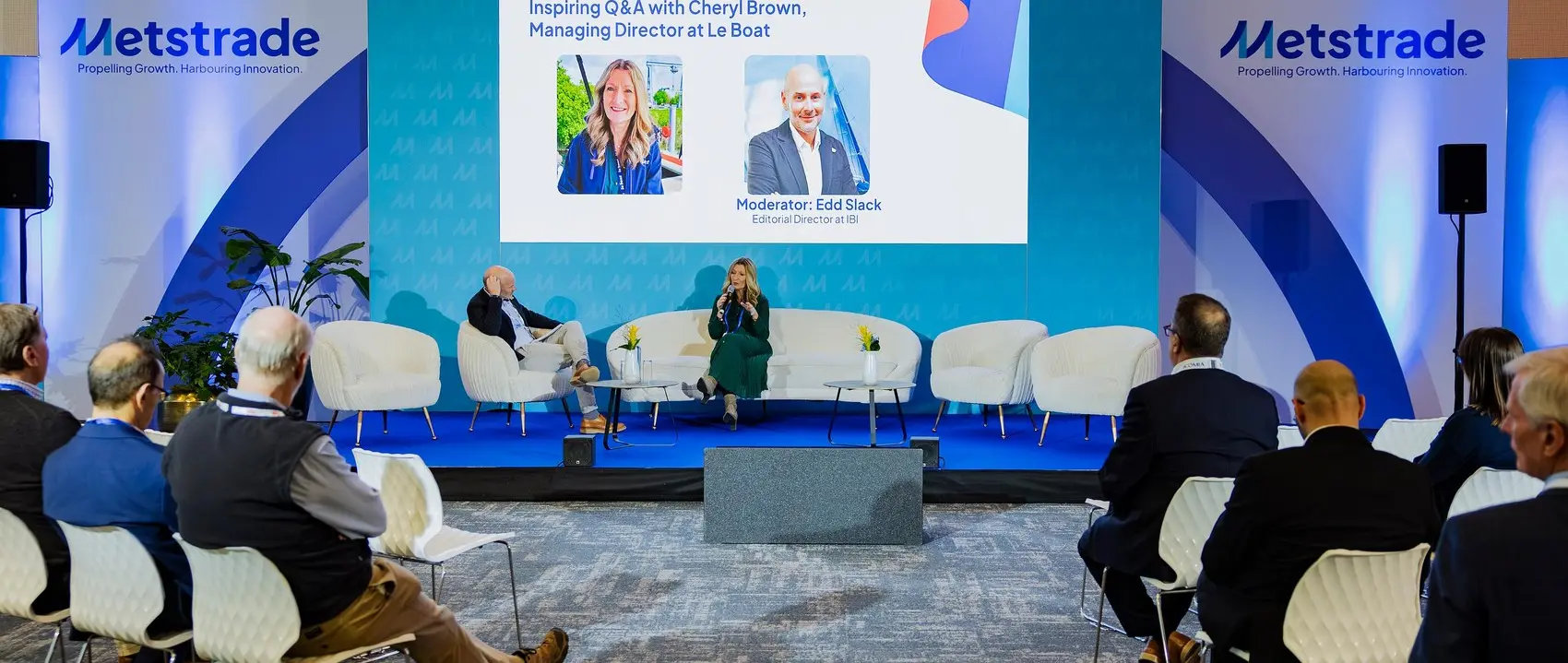
The official METSTRADE Next Generation Propulsion page lists the showcase products, stand positions and exhibition dates. Readers should use that source and the relevant exhibitors' specifications when evaluating claims. Photograph: METSTRADE's official press-room image of the 2025 exhibition, provided for media use; it illustrates the trade-show environment rather than a 2026 product demonstration. A carefully chosen drive can enhance life on a small boat, but only when performance, safety and support align with the way it is actually used.
The useful next step is less dramatic than a headline about an electric revolution: gather comparable facts, inspect the equipment and take the time to decide whether it suits the boat. An exhibition that makes those conversations easier offers a meaningful service to the sector, irrespective of which propulsion technology each visitor ultimately chooses.