
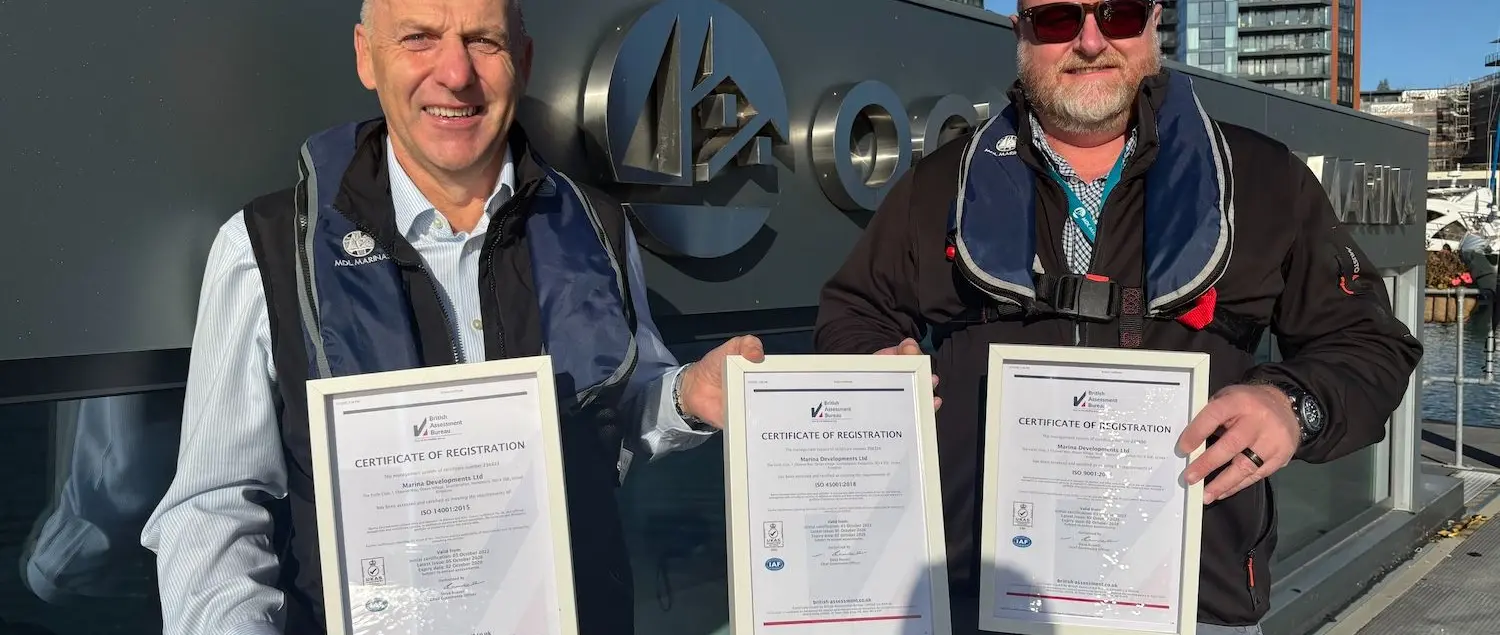
Three standards covering daily marina operations
MDL Marinas says it has retained a trio of international ISO certifications covering quality, the environment, and occupational health and safety. The 27 October announcement confirms ISO 9001, ISO 14001 and ISO 45001 respectively. MDL says it was the first UK marina operator to hold all three and remains the only major operator in the country to do so. Those latter distinctions are company claims, but the three named standards describe distinct areas of management.
For a leisure boater, the value of certification is not that it guarantees an incident-free visit or a particular berth service on any given day. The practical significance is that the operator's management processes are evaluated within defined frameworks. Whether the immediate need is a lift-out, a visitor berth or a repair contractor's access, a consistent approach to procedures and improvement can influence the quality of the experience.
ISO 9001 and the service a berth holder sees
ISO 9001 concerns the way an organisation manages quality and improves processes. In a marina setting that can include responses to customer feedback, consistent service routines and tracking actions across different locations. MDL specifically connects its renewed certification with customer experience and operational consistency. Such systems matter for owners who use several marinas over a season or who depend on a home base for recurring services.
Certification should not be mistaken for a public ranking of all marinas or a promise that all facilities are identical. It does, however, establish a structured way to examine performance. Owners can put it to practical use by asking how a marina handles reported problems, communicates work around the site and monitors customer service. These questions reveal more about day-to-day benefits than a certificate displayed in the office.
Environmental management and emissions progress
ISO 14001 addresses environmental management. MDL reports that its operational carbon emissions were 54% lower in 2025 than in 2022. The company also points to investment in renewable energy and better waste management. The time period and the word 'operational' are important: this is not a claim that the total environmental footprint of every visiting vessel, tenant or contractor was reduced by the same amount.
Marinas sit at a sensitive interface between boating activity and surrounding waterways. Waste handling, electricity use, maintenance work and staff practices can all affect local conditions. An environmental management system creates a basis for setting objectives and checking progress, but users should still look for visible details such as clear waste points, pump-out arrangements where available and guidance for keeping pollutants out of the water.
Safety training goes beyond written procedures
ISO 45001 deals with occupational health and safety. MDL says it has introduced bespoke water-safety and cold-water immersion training for marina teams, developed with Vitae Vi. The programme highlights a straightforward point: working near pontoons and open water presents risks that cannot be addressed by signage alone. Staff familiarity with immersion hazards and the available response procedures is relevant for the people who work at a marina and those who visit.
The certification does not replace individual responsibility aboard. Skippers should still plan safe boarding, manage shore-power connections appropriately and understand local instructions for fuel, lifting and movements around the yard. For boat owners, the most constructive way to interpret the announcement is as evidence that the operator is investing in staff capabilities alongside formal management processes.
Facilities at Penton Hook, Hamble Point and Northney
MDL identifies several concrete projects in the same update. These include improved customer facilities at Penton Hook, work on the marina office and roadways at Hamble Point, and a new 35-tonne boat hoist at Northney. The hoist is a notable capacity figure for owners arranging lifting operations, though suitability for any individual vessel will also depend on dimensions, lifting geometry and the yard's operating requirements.
These upgrades matter because certificates alone do not haul a boat or make a wet-weather arrival more comfortable. Physical infrastructure, accessible services and staff organisation are what owners experience directly. Anyone planning a lift or winter maintenance period should confirm current availability, dimensions, booking conditions and pricing with the marina rather than infer them from an equipment announcement.
How to judge the announcement as a boater
MDL managing director James Barnes has described retaining the accreditations as a reflection of continuing improvements across the business. The company's report gives specific examples of training, infrastructure and emissions, rather than relying entirely on a statement of ambition. It does not disclose a fresh independently audited emissions calculation in the announcement, so readers should treat the quoted percentage as MDL's reported figure.
For customers, the sensible next step is to connect those broad commitments to the services at their chosen marina. Ask which improvements are complete, what changes are planned and how feedback is handled. MDL's renewed ISO 9001, 14001 and 45001 certifications establish an overarching framework; the real test over the coming season will remain the standard of everyday berthing, maintenance and waterside operations. A useful question at renewal time is what the three standards mean for service contractors and short-stay visitors as well as annual berth holders. Standards are strongest when their procedures remain understandable to customers, with visible channels for reporting concerns and checking that a response has been completed. The latest announcement is an invitation to test that experience.