
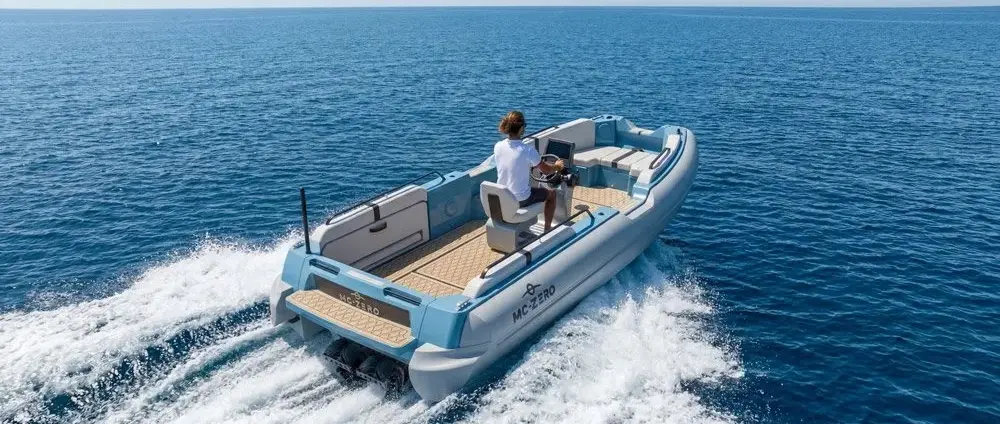
The MC-ZERO 450 electric jet tender has won the Innovative Design Solution category at the 2026 IBI METSTRADE Boat Builder Awards, recognising an unusual approach to making a compact boat more versatile. The ceremony took place in Amsterdam on 18 November, with organisers announcing the results the following day. Developed through a collaboration involving McConaghy Boats and ZeroJet, the 4.5-metre craft combines twin electric waterjets with a movable helm and openings at the bow and stern. Judges singled out those features as an example of ambitious design in a small package. The recognition is relevant to Leisure Boat Guide because this is a craft well below twelve metres, although the award should not be confused with an independent long-term performance test or a newly completed production delivery.
A category victory rather than the overall prize
The Boat Builder Awards recognise a wide variety of achievements across the yacht-construction industry. MC-ZERO 450 won the Innovative Design Solution category, which included other finalists ranging from smaller recreational designs to much larger yachts. The judges observed that the tender attracted attention despite competing against substantially larger vessels. That distinction makes the award significant without suggesting that the craft won every prize at the ceremony. Other category winners included companies working on different aspects of design, sustainability and supply-chain collaboration. The result reflects the jury's judgement about innovation, not a direct ranking of which boat is safest, fastest or most economical for every owner.
What makes a 4.5-metre boat challenging
A compact tender has limited length and beam, so each element of its layout competes for space. Passengers need somewhere safe to sit and move, the operator must see clearly, and the hull needs a propulsion arrangement and adequate buoyancy. On such a small craft, making room for another useful feature can affect several other parts of the design. The MC-ZERO 450 attempts to address these constraints with movable and folding components instead of treating every bulkhead and console as fixed. The concept is attractive, but a flexible layout must still be assessed for stability, structural integrity and how safely its components operate when passengers are aboard.
The twin electric jets are central to the design
ZeroJet supplies the electric waterjet technology used in the MC-ZERO project. A jet-driven tender has a different propulsion arrangement from a conventional boat with an exposed propeller and outboard leg. This can be attractive in certain shallow-water or passenger-transfer situations, though no jet design eliminates every hazard associated with moving machinery or water intake. The specific performance depends on the complete craft, loading and operating conditions. The Boat Builder Awards announcement identifies twin electric jets as a distinctive feature but does not provide verified figures for every range or speed scenario. Buyers should obtain current sea-trial data and learn the handling differences before assuming the craft will behave like a petrol-powered tender.
The helm can move to change the layout
The jury highlighted the movable helm among the tender's most unusual elements. A fixed steering station normally dictates a considerable part of a small boat's interior arrangement. Allowing the helm position to change could offer different ways of using the limited deck area, depending on whether the crew is transferring passengers or spending time at anchor. However, the practical procedures need to be clear. The driver must have dependable control, adequate visibility and access to emergency equipment in every permitted configuration. A prospective owner should ask for demonstrations of how the mechanism locks and how the craft can be operated safely when its layout is being changed.
Access at the bow is part of the concept
The manufacturer describes a fold-down bow arrangement, which the awards judges singled out. A low or opening bow can potentially simplify certain types of boarding, especially when approaching an appropriate beach or landing point. It must be used only within the conditions specified by the builder. The folding structure has to seal and secure appropriately for operation, and the crew should not assume that an opening can be deployed in any sea state. A beach landing, a calm marina stop and transfer from a yacht can present different hazards. The value of such a feature lies in making access easier while preserving the craft's safe operating envelope.
The stern can also be reconfigured
A fold-down transom is another feature noted by the jury. This creates an opportunity to change how passengers use the aft end of the tender, though its exact permitted positions need to be explained by the manufacturer. On a compact boat, the stern is an important area because of the propulsion equipment and proximity to the water. Any moving panel must be kept clear of people when operating, and passengers should understand when it is safe to use an access platform. An attractive demonstration of a folding component is not a substitute for proper installation, locking and maintenance. Owners should inspect the mechanism and ask what happens if it is obstructed or damaged.
Carbon construction affects the design process
The MC-ZERO project draws on McConaghy's experience with composite boatbuilding, according to the developers' information. Carbon-fibre construction can offer opportunities to manage weight and shape, but the strength of a finished boat depends on engineering, laminate quality and how loads are transferred. The use of carbon should not automatically be interpreted as proof that a particular hull is indestructible or suitable for unrestricted beaching. Damage assessment may require a specialist familiar with the material. Owners should consider repair facilities and insurance arrangements as well as weight when comparing a carbon tender with alternatives. For a boat carried aboard a larger yacht, the lifting and handling specification is particularly relevant.
Electric energy changes the preparation routine
An electric tender needs charging arrangements and an understanding of how much usable energy remains. The MC-ZERO and ZeroJet websites describe an integrated battery and propulsion platform, including lithium-based storage. The precise model configuration, total installed capacity and charging equipment should be confirmed in current documentation rather than inferred from one promotional photograph. A tender that is used for short transfers may have a different energy budget from one regularly travelling between distant anchorages. The operator needs to consider wind, current and return reserves. Electric propulsion avoids a routine of filling a petrol tank at the tender, but it introduces charging and battery-management responsibilities.
Quiet boating brings new operational considerations
One attraction of electric jets is the potential for quieter operation and the absence of engine exhaust at the point of use. That may make transfers more pleasant for passengers and reduce some types of disturbance around anchorages. It does not make the tender inaudible, entirely free of environmental impact or safe to operate close to swimmers. A quiet vessel may be harder for other people to notice, placing additional emphasis on lookout and appropriate speed. Owners also need to consider how battery electricity is generated and the maintenance or disposal of components over the life of the boat. Environmental claims should be assessed across the complete system rather than reduced to a single headline.
Manoeuvrability should be demonstrated
Waterjet propulsion can respond differently from the propeller-driven systems familiar to many small-boat skippers. Throttle, steering response and stopping behaviour may be affected by how the jet units operate, especially at low speeds. A buyer should receive specific training and practise in open water before approaching a crowded marina or yacht swim platform. The presence of two jet units does not remove the need to understand their controls and limitations. A convincing test should include controlled docking, manoeuvring in wind and operation with a realistic number of passengers. The awards announcement does not supply an independent handling report, so claims about exact turning radius or acceleration should be treated as manufacturer-specific until verified.
Passenger transfer is a demanding use case
A tender can act as the link between a larger yacht and shore, requiring passengers to step between moving platforms. Safe boarding depends on the height of the boarding point, sea conditions, crew assistance and the ability to hold position without creating danger. The MC-ZERO 450's configurable bow and stern may offer useful options, but they must be used within the instructions for the individual boat. Folding access features cannot make a rough transfer risk-free. Owners should evaluate whether passengers of different ages and mobility levels can board safely. Equipment designed for convenience is most successful when the operator understands the conditions under which that convenience can be used.
Stowage aboard a mothership matters
A 4.5-metre tender may be carried in a garage, on deck or using lifting equipment. That creates requirements for weight, secure attachment points and access to charging. Folding elements and a movable helm could influence the way the craft fits into a storage space, but buyers need actual dimensions and lifting data. A nominal length alone cannot establish that a tender will fit a particular yacht's equipment. The owner should also consider ventilation, drainage and how the battery system is isolated for storage. A well-designed tender needs to be manageable both when it is operating and when it is being secured between journeys.
A development partnership shaped the result
McConaghy Boats and ZeroJet worked together on the MC-ZERO concept, combining boatbuilding and electric-propulsion expertise. The 2026 Boat Builder Awards also considered the relationship in a separate collaborative category, where the companies were finalists, while the MC-ZERO 450 won the Innovative Design Solution prize. It would be incorrect to report two category wins on the basis of those nominations. The distinction reflects the fact that the jury assessed both the product and the development relationship. Cooperation can allow a builder and propulsion supplier to address integration early, but the completed boat still needs to satisfy the appropriate safety and operating standards for its market.
The manufacturer's photographs show the actual craft
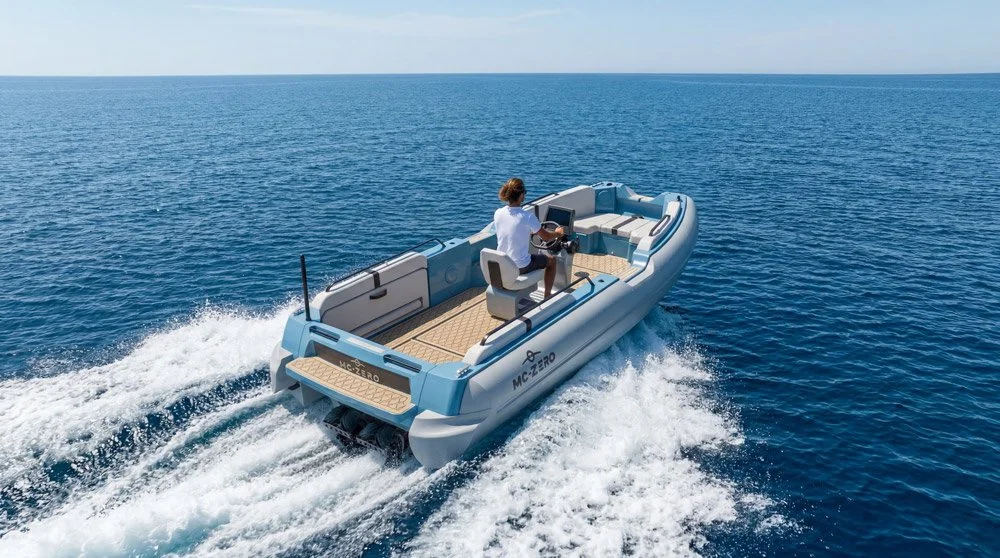
The official MC-ZERO and ZeroJet websites contain original photographs of the tender on the water, including views of the hull, helm and access arrangements. These are more relevant to a small-boat design story than generic exhibition imagery or an artistic rendering. An actual manufacturer photograph can help readers understand the proportions of a 4.5-metre boat, but it does not independently prove performance or range claims. The photograph used here is credited to its original manufacturer source and was checked against existing group-site images before publication. Visual evidence should complement technical documentation rather than replace it.
Price and availability remain buyer questions
The 19 November awards announcement confirms the design prize; it does not establish a universal retail price or delivery schedule for every specification. Owners interested in buying the MC-ZERO 450 should request current documentation from the manufacturer or its authorised representatives. Important questions include the exact battery and jet configuration, charging requirements, warranty terms, servicing arrangements and the process for obtaining replacement components. A boat offered with innovative moving features may require particular attention to those mechanisms during maintenance. The costs of lifting, storage and insurance should also be included in the ownership calculation rather than focusing entirely on purchase price.
The meaning of this small-boat award
The MC-ZERO 450's win at METSTRADE 2026 demonstrates that an innovative small craft can stand out in a competition containing some much larger boats. Its twin electric jets, movable helm and folding bow and stern have been designed to make a compact tender more adaptable. The award is a significant design recognition, but future owners should still require a realistic sea trial, proper instructions and assurance about maintenance and support. The strongest ideas are those that remain convenient and dependable during ordinary use, not only on an exhibition stage. For Leisure Boat Guide, the most interesting aspect is that this development places a 4.5-metre boat at the centre of a wider conversation about how recreational craft can use space more intelligently.
Official sources and photography
Reporting independently based on Official 19 November 2026 METSTRADE Boat Builder Awards winners.
Official source product photograph: MC-ZERO 450 actual electric tender under way, original official ZeroJet manufacturer photographic image, not a CGI rendering. Original image rights remain with the source publisher and photographer. Official press-image source.
Independent background or documentary context (not the source of the new announcement): Documentary source 1.