
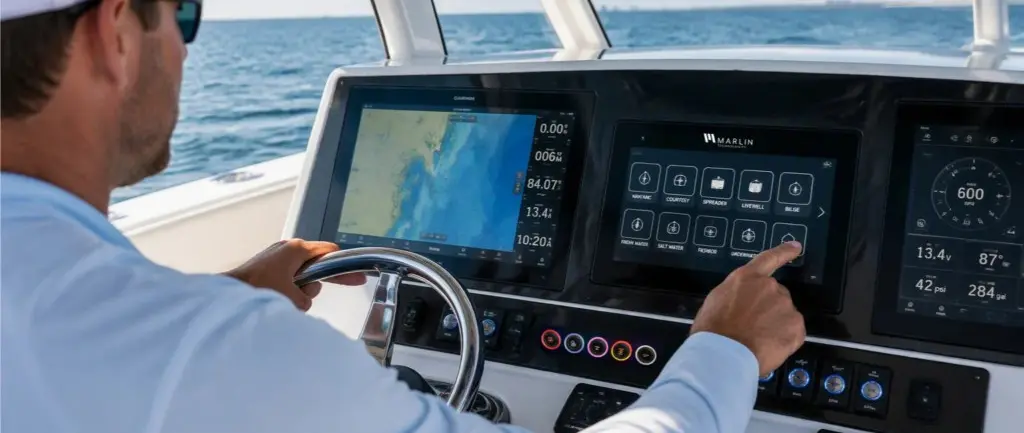
A configurable approach to boat electrical controls
Marlin Technologies has brought its marine electronic control systems to IBEX 2026, focusing on how boatbuilders can configure digital switching and helm functions around different boat layouts. Its M-Flex platform is designed to manage onboard loads through distributed electronics rather than requiring every circuit to lead to an individual mechanical switch at the helm. The result is a system intended to offer boatbuilders more flexibility in designing user controls.
For an owner of a small runabout or cabin boat, the benefit is only realised if controls remain understandable and dependable on the water. A simpler-looking dashboard does not necessarily mean the electrical installation underneath is less complex. Buyers should ask how the system behaves when a display fails and whether essential equipment can still be operated without a phone.
M-Flex connects switches and different displays
Marlin describes M-Flex as a distributed architecture with controller choices for different input and output requirements. Owners can operate compatible equipment through Marlin keypads, suitable multifunction displays or Bluetooth controls on a mobile device. That flexibility can be useful when a manufacturer offers several boat models with distinct layouts but wants to retain familiar operation across the range.
The company also provides an MFD Gateway for integration with supported Garmin and Simrad displays, placing selected vessel controls on an existing helm screen. The word supported matters: not every screen or software version is automatically compatible. Buyers considering an upgrade should verify the precise model, network interfaces and firmware requirements with an authorised marine installer.
Rugged keypads are still valuable
Although touchscreens are becoming more common at the helm, physical keypads can provide direct access to functions during rough conditions or when hands are wet. Marlin's configurable CAN keypads include illumination options and are offered with IP67 or IP69K ratings and selected Bluetooth or J1939 capabilities. The exact features depend on the device rather than applying to every member of the product family.
A practical installation might place frequently used controls near the wheel while putting less urgent lighting settings on a display. Equipment should be labelled clearly enough that a guest or second operator can understand essential functions. The system also needs protection against inappropriate operation, since a colourful interface is no substitute for safe switching arrangements.
Lighting and wiring need thoughtful engineering
Marlin's IBEX presentation includes integrated RGB lighting control alongside digital switching. A boatbuilder can use this to create configurable illumination without adding a separate system for every zone. Owners might appreciate the ability to reduce cockpit lighting at night, but any change must preserve legally required navigation lights and sufficient visibility for safe movement aboard.
Distributed control can reduce some wiring complexity, but cable protection, fusing, corrosion resistance and suitable power supplies remain essential. A digital network does not remove the need for qualified marine electrical design. When a fault occurs, technicians should have access to proper diagnostic information and documentation describing the installation.
The importance of service over the life of the boat
Marlin says it works with builders from initial system design through prototypes and production. That support is relevant because a custom electrical installation must remain maintainable as a boat ages or changes owners. Clear circuit documentation and access to replacement modules may prove more valuable than an impressive demonstration on a trade-show stand.
The company's IBEX presentation highlights modular systems rather than promising an identical solution for every craft. Small-boat buyers should ask what equipment is fitted, which functions depend on a display and how a manual recovery procedure works. The strongest connected helm is one that simplifies ordinary boating while leaving the skipper in control when technology is unavailable.