
A difficult quarter for recreational boat retail
MarineMax reported $520.1 million of revenue in its fiscal fourth quarter ended 30 September 2026, compared with $552.2 million in the same quarter one year earlier. Same-store sales fell 5.7 percent, underscoring continued pressure on the US recreational boat retail market. The Florida-headquartered company published the results on 4 November, alongside its figures for the full fiscal year. MarineMax is a diversified retailer, marina operator and service business, and its accounts cover far more than the sale of boats under twelve metres.
The results nevertheless matter to people buying, selling and maintaining smaller leisure craft. Dealers face decisions about inventory, financing and workshop capacity when new-boat demand is weak. A fall in same-store sales is a comparison for the established network, not proof that every individual dealership experienced exactly the same percentage decline. Buyers should understand the difference between corporate performance and the available stock or prices at a specific location.
Revenue falls while gross margins increase
Fourth-quarter gross margin rose to 37.4 percent from 34.7 percent in the prior-year period, an increase of 270 basis points. Gross profit increased from approximately $191.4 million to $194.3 million, despite the lower sales total. MarineMax said that a greater contribution from higher-margin businesses, including marinas, service and parts, supported the improvement. It also referred to better boat profitability. This combination illustrates why a company can sell less in one area while preserving or increasing gross profit through other services.
The figures should not be taken as an increase in the margin earned on every small boat sold. Gross margin is calculated for the corporate business, whose mix includes services, brokerage and other operations. Some areas can grow while others contract. A particular customer may encounter a discount on a stock boat, a different service rate or unchanged prices. The consolidated result cannot be converted into a rule about what any owner will pay.
The company reports a quarterly net loss
MarineMax recorded a fourth-quarter net loss attributable to the company of $13.0 million, compared with a $0.9 million loss one year earlier. The group attributed a large increase in selling, general and administrative expenses partly to costs associated with its pending acquisition by Safe Harbor Marinas. The quarterly expenses reached $196.1 million, compared with $177.6 million previously. Such transaction-related spending matters when interpreting the loss because it is not a direct measure of everyday boat sales.
Adjusted earnings measures also appear in the release, including $21.8 million of adjusted earnings before interest, tax, depreciation and amortisation. These management-adjusted measures are not identical to net income under standard accounting rules. The business reported both, and they should not be presented interchangeably. For LBG readers, the useful conclusion is that retail conditions remain difficult while the company's broader service and marina activities provide a different contribution.
Full-year numbers confirm the pressure
For the fiscal year, MarineMax reported approximately $2.164 billion in revenue, against $2.309 billion in the prior year. Same-store sales fell 5.5 percent across the year and gross margin improved to 34.9 percent from 32.5 percent. The company recorded a full-year net loss of $8.2 million, smaller than the $31.6 million loss in fiscal 2025. These figures describe a business adjusting to softer boat retail activity while increasing the relative contribution of other operations.
Fiscal-year accounts do not reveal a single market trend for every boat type. MarineMax's product range spans compact recreational craft, larger yachts and supporting services. A lightweight fishing boat and an expensive motor yacht can face very different demand, financing and storage arrangements. Sales weakness at the group level should not be used to claim that all small-boat purchases have stopped or that the value of every used craft is declining.
Marinas and workshops become more important
Marina services can generate continuing revenue from berth or storage arrangements, maintenance, repairs and other owner needs. These services exist even when a family keeps its existing boat for another year instead of buying a new one. MarineMax's results highlight the value of higher-margin activities within its portfolio, including parts and service. Such businesses are important to owners of small leisure boats, who still need engine maintenance, safety equipment, seasonal storage and assistance when faults occur.
A boatyard's success cannot be judged by a single corporate margin figure. The quality of work, ability to obtain parts, technician training and clarity of invoicing determine the experience of individual customers. A marina might grow revenue while an owner's particular repair is delayed. Buyers and existing customers should assess actual services rather than assume that a larger company provides either better or worse support automatically.
Inventory is being brought down
MarineMax reported inventory of about $812.8 million at the end of September, down from $867.3 million one year earlier. Reducing inventory can help free cash and avoid carrying unsold boats for long periods. In a market where customer demand is uneven, this can be an important response by retailers. However, a lower inventory balance does not tell the reader how many specific six-metre or ten-metre boats remain in stock at a particular dealership.
Customers should ask whether a boat is an existing stock unit or a new factory order, and compare its equipment, age and warranty terms. A dealer may offer different options on a boat that has been in stock for some time, but it is not reasonable to infer a guaranteed discount from the corporate figure. Inventory management is one indicator of the business environment, not a substitute for a current written quotation.
A pending acquisition adds uncertainty
MarineMax has entered into an agreement under which Safe Harbor Marinas would acquire the company in an all-cash transaction valued at approximately $1.5 billion on an enterprise basis. The deal calls for $53 per share and remains subject to conditions, including shareholder approval, according to the companies' regulatory information. The fourth-quarter results were published while the proposed transaction remained pending. It would be inaccurate to report that the ownership change had already closed.
Boat owners with existing sales, service or berth arrangements should not assume their contracts have changed solely because a proposed acquisition has been announced. Corporate transactions can take time and may be subject to regulatory or other conditions. Practical changes at individual locations should be confirmed with the business itself. The pending deal is relevant context for interpreting MarineMax's financial statements, particularly the transaction costs, but its future operational consequences are not yet established.
Why same-store sales matter
Same-store sales measure revenue trends at comparable established operations rather than allowing an expanding network to present growth solely through new acquisitions. MarineMax reported a fall of 5.7 percent in this measure for the quarter and 5.5 percent for the year. Those figures provide evidence of pressure in the continuing retail network. They are not a nationwide government count of small boats registered, nor a measure of all US marine purchases.
Different parts of the recreational boating industry use different statistical measures. A manufacturer can report shipments to dealers, a retailer records sales and a public authority registers vessels. The numbers are related but not identical. A boat purchased in September may be registered later or may have been manufactured months earlier. Readers should keep these distinctions in mind before comparing MarineMax's results with other industry reports.
Owners may feel indirect effects
When dealers carry fewer boats, choices and immediate availability can change. A customer may find fewer stock colour combinations or options even when a manufacturer still offers a full range. Conversely, a dealer concentrating on service and storage may improve its workshop capacity or customer support. The financial release does not specify that either outcome will occur at any particular MarineMax branch. Owners should use it as background rather than as a prediction about local services.
For a person buying a leisure boat under twelve metres, the essentials remain suitable hull design, realistic operating costs, warranty conditions and access to qualified maintenance. A new boat is a long-term purchase and should be compared with used alternatives on its merits. A corporate quarterly loss is not, by itself, evidence of a bargain or a warning that all boats supplied by that dealer are unsuitable.
The November retail-market takeaway
The confirmed story is weaker retail demand alongside higher reported gross margins at MarineMax. Fourth-quarter revenue was $520.1 million, same-store sales decreased 5.7 percent and the company recorded a $13.0 million net loss. The full fiscal year also showed lower same-store sales, but continuing contributions from marinas and services. These figures describe an industry in which recurring ownership services are increasingly significant alongside transactions involving new boats.
Leisure Boat Guide will treat MarineMax's results as one company's financial evidence, not a definitive measure of the entire small-boat market. The pending Safe Harbor transaction adds uncertainty about future corporate arrangements, and no specific customer changes should be inferred until announced. For owners, the practical priorities remain reliable dealers, understandable contracts, competent maintenance and sensible budgets that reflect how often the boat will actually be used.
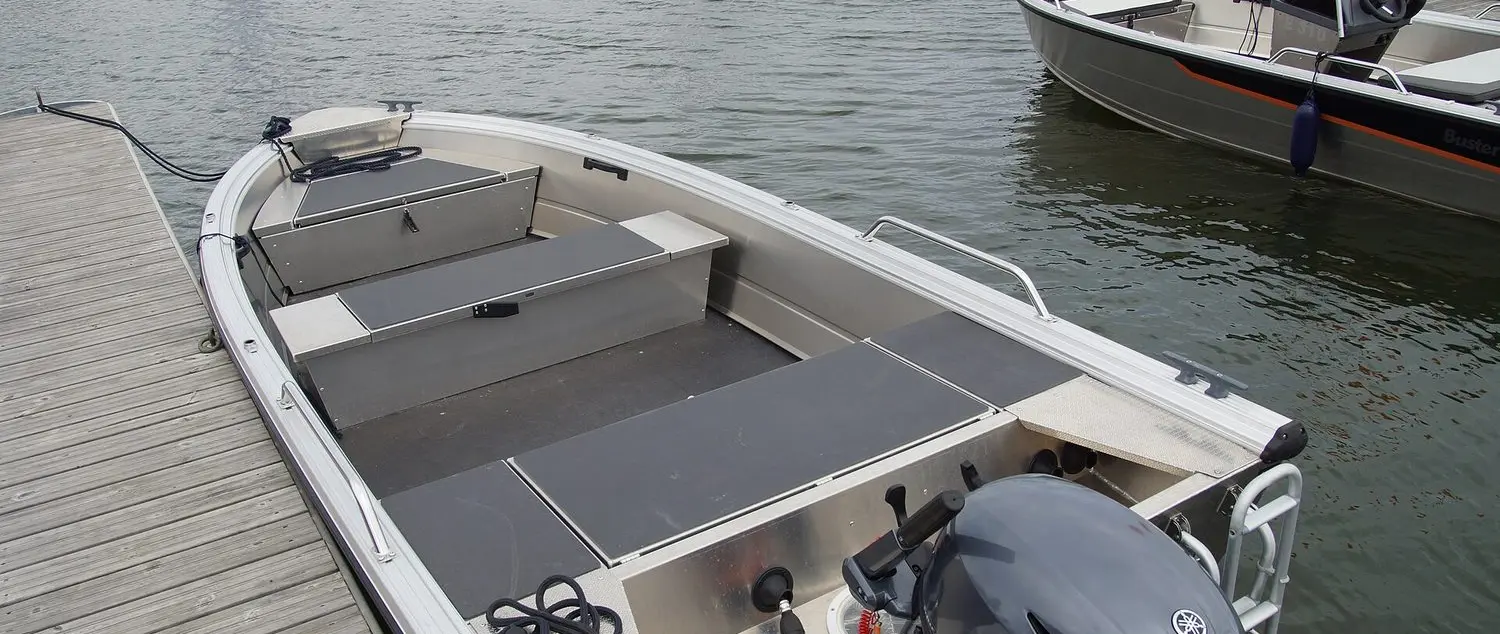
Sources: MarineMax 4 November 2026 company earnings announcement and MarineMax regulatory earnings exhibit filed with the SEC. Photograph: a small aluminium motorboat by Mikasarkijarvi, Wikimedia Commons, CC0; illustrative model, not a MarineMax stock boat.
