
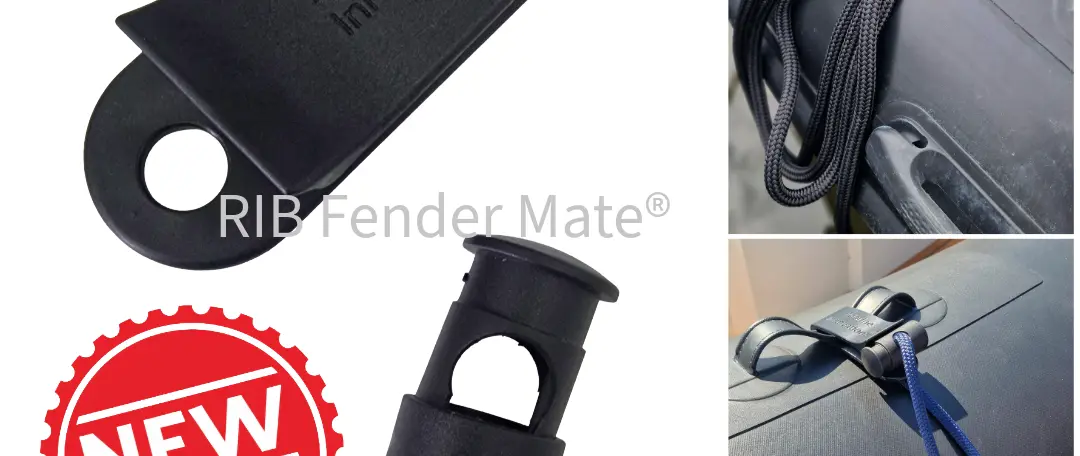
Marine Innovations will give its RIB Fender Mate a world premiere at the Southampton International Boat Show from 18 to 27 September 2026. The small fitting is designed to clip directly to flexible RIB grab handles so owners can attach and adjust fenders without repeatedly tying and untying knots at the tube.
A simple answer to awkward RIB fender attachment
Conventional fenders are easy to rig from rails or cleats but can be more awkward on an inflatable tube where the available attachment point is often a flexible grab handle or short rope loop. The RIB Fender Mate creates a dedicated attachment and adjustment point at that handle, allowing fender height to be changed by operating the built-in adjuster.
Marine Innovations says the fitting can be removed just as quickly when leaving the berth and can also be used as a rope tidy. The design is intended for everyday marina use rather than permanent heavy-load mooring, which keeps the product focused on a very specific but common RIB handling problem.
Designed around common rope sizes
The manufacturer recommends rope up to 10mm diameter and states a maximum of 12mm, covering the line sizes normally used with small and medium leisure-boat fenders. It can be used with three-strand or double-braid line and incorporates a marine-grade 316 stainless-steel spring within the fitting.
That size range makes the product relevant to tenders, family RIBs and day boats rather than only larger craft. Owners should still check that the RIB handle itself is suitable for fender loads, because the accessory cannot increase the structural strength of the handle or its attachment to the tube.
Small hardware can still improve marina handling
Fender setup is a minor task until a short-handed crew needs to adjust several fenders quickly while approaching a pontoon. A fitting that can be clipped on and moved without knots can reduce preparation time and make it easier to reposition protection when berth height, tide or pontoon geometry changes.
The Southampton debut will be useful because visitors can inspect the locking and adjustment action directly rather than judging the system from photographs. For RIB owners, the key test will be whether the fitting remains secure, easy to operate with wet hands and durable after repeated exposure to salt, UV and tube movement.