
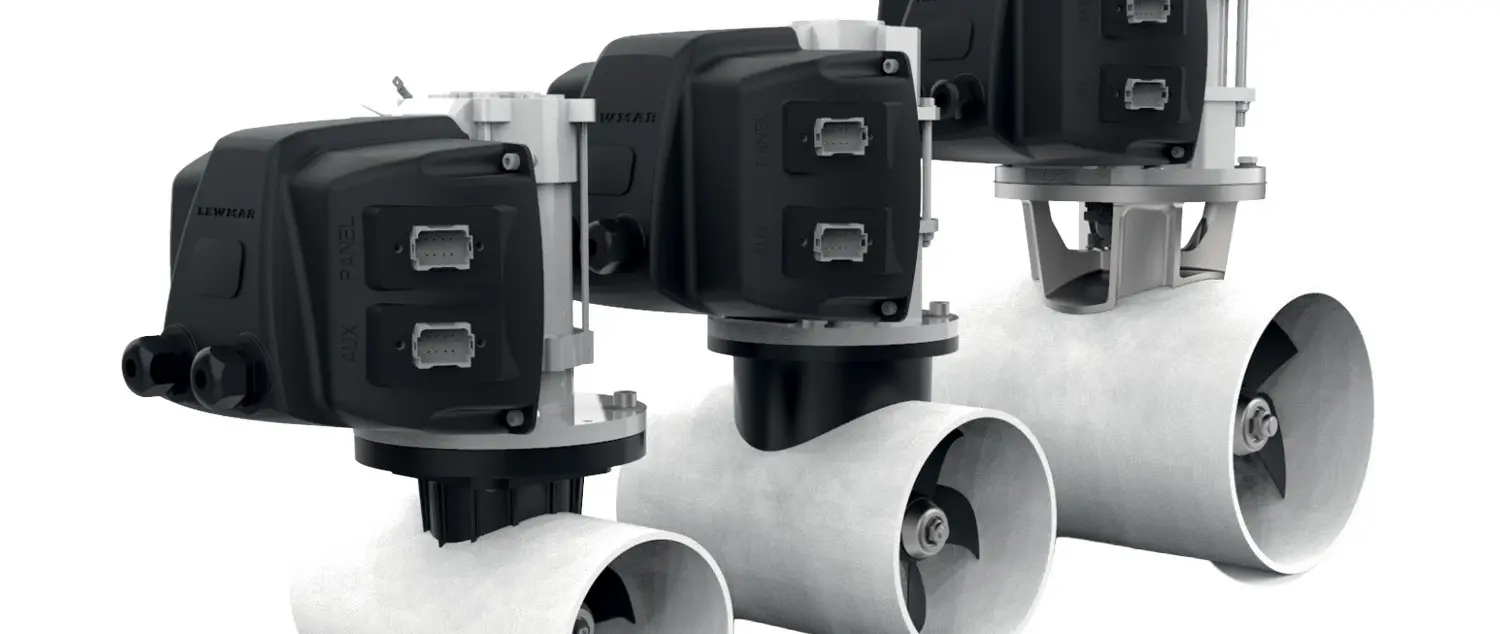
Lewmar expands its approach to docking control
Lewmar has introduced a range of proportional bow and stern thrusters intended to give boat operators finer control at low speed. A manufacturer announcement published on 11 November 2026 describes variable-speed thrust rather than the abrupt on-off response familiar to owners of many conventional electric tunnel thrusters. Lewmar says the new systems include brushless motor technology and integration with NMEA 2000 networks, making them relevant to both original installations and suitably matched upgrades.
For Leisure Boat Guide readers, the immediate interest lies in handling small motorboats where an awkward berth, crosswind or short-handed crew can make a relatively simple manoeuvre feel difficult. Bow thrusters do not replace good seamanship, and every model must be sized for the vessel's particular displacement, windage and arrangement. But a controlled application of sideways thrust can be less abrupt than a full-power burst, particularly when a skipper needs to make several small corrections while remaining aware of surrounding traffic.
From all-or-nothing to variable thrust
A traditional on-off thruster responds to a command by producing a relatively fixed thrust in one direction. Operators learn to use short pulses, allowing the hull to respond before making another correction. Proportional systems change the nature of that input by allowing the user to request different levels of power. In a tight marina, where the distance between a boat and a pontoon can be measured in just a few feet, the difference may allow a more deliberate and predictable approach.
The advantage should not be exaggerated into a claim that every docking manoeuvre becomes easy. A thruster acts on a vessel moving through wind and water, and external forces may change during an approach. The boat's momentum, propeller response and rudder effects still matter. A poor technique performed with sophisticated controls can remain unsafe. Owners need practice in benign conditions to understand how much thrust is actually required and how the boat responds after the joystick returns to neutral.
Lewmar's new brushless motor platform
Lewmar attributes the proportional functionality to a new brushless DC motor platform. It describes the product as offering quieter operation, a longer service life and less routine motor maintenance than designs relying on replaceable brushes. The maker also says the units are designed for extended continuous operation, subject to available battery capacity. These are manufacturer statements and should not be treated as independently verified performance ratings across the entire product range.
An owner considering the upgrade should request model-specific details. Total system demand depends on the chosen motor, tunnel diameter, electrical supply and operating conditions. An installation described as brushless still contains bearings, seals, propellers and other components that may require checks or periodic servicing. Fouling or damage to a tunnel can reduce effectiveness regardless of motor technology. The owner should obtain the exact service manual rather than infer that the phrase 'maintenance-free' applies to the entire assembly.
Twenty-four-volt systems and electrical integration
Lewmar's product information identifies a 24-volt electrical platform. That makes electrical engineering central to any installation. A small boat with a predominantly 12-volt domestic system may need additional arrangements or may not be a suitable candidate for a particular unit. The cables supplying a powerful thruster must be correctly sized and protected, while batteries need enough available energy to support the intended manoeuvres without compromising essential systems.
A retrofit quotation should specify how the thruster will be powered, how voltage drop is controlled and what isolation and overcurrent protection will be provided. The installer also needs to account for ventilation, access and the location of any control electronics. A 24-volt label is not a promise that the system can be connected directly to any battery bank. On owner-operated craft, straightforward emergency isolation and clear fault information can be just as important as the sophistication of the command interface.
NMEA 2000 as an integration route
The November announcement highlights NMEA 2000 compatibility, a marine data standard already used by many multifunction displays, sensors and control devices. Integrating a thruster into an onboard network can create opportunities for clearer status displays and coordination with other supported systems. It may also make later service and diagnostics easier if the manufacturer's installation and commissioning tools are available to the technician responsible for the boat.
Network compatibility is not the same as universal plug-and-play control. Different brands and product generations may support different messages, modes and permissions. Owners should request a compatibility list for the exact thruster, helm panel and electronics fitted aboard their boat. A networked system must be protected against unsuitable commands and designed so that loss of a screen or a data connection does not create uncontrolled propulsion. These points deserve a written response, not just a promotional assurance.
Bow and stern thrusters are not interchangeable
Bow thrusters are normally intended to move the forward part of a boat sideways, while stern thrusters apply a lateral force near the aft end. Where both are fitted, operators can sometimes perform more complex low-speed corrections. The arrangement can be useful for a boat with high windage or restricted access to certain berths, but it also requires the skipper to understand how each input interacts with the main propulsion and the water flow around the hull.
Fitting both systems is not necessarily worthwhile on every leisure boat. The cost, weight and electrical demand may outweigh the benefit for a small craft that is easy to handle under its own propulsion. Hull form and tunnel placement can also limit effectiveness. An installer should inspect the actual vessel and identify whether a bow-only system, another form of propulsion control or improved skipper training would be the better investment. Convenience should not be bought at the expense of sensible design.
Tunnel size and how the hull affects performance
Lewmar lists multiple tunnel sizes and power ratings, meaning that the range is intended to cover different types of vessel. The correct unit is determined by more than length alone. Windage, displacement, freeboard, distance to the bow, usable tunnel space and access for installation all influence the choice. A thruster that can produce a useful force on one hull may be ineffective on a wider or heavier boat in the same length bracket.
Owners contemplating a retrofit should expect some invasive work, especially if a new tunnel must be installed in the hull. The location needs sufficient immersion to avoid drawing air during use, and its structure and bonding arrangements require proper attention. Tunnel openings should be professionally finished and checked for the correct corrosion protection. A neat control panel at the helm is only the most visible part of a substantial engineering installation below the waterline.
The practical realities of a marina approach
Consider an owner arriving at a berth with a gusting side wind. A proportional thruster may allow a series of modest corrections rather than full-power bursts, helping the boat remain aligned while the crew prepares lines. Yet good preparation remains essential. The skipper needs to assess the available space, establish an abort route and avoid placing crew between the hull and the pontoon. Nobody should attempt to stop a moving boat with their hands or feet.
In shallow water or strong tidal flow, thruster performance may differ from a manufacturer's standard demonstration. The boat may also move unexpectedly if a line catches or if a sudden gust turns the bow. Operators should practise familiar scenarios in a clear area before relying on the system in difficult conditions. A thruster is one more manoeuvring tool, not an excuse to approach a tight berth faster than the crew can safely manage.
Retrofit appeal and its limits
Lewmar describes the proportional system as compatible with selected existing Lewmar installations, offering a potential route to upgrade a boat without redesigning every element of the original setup. That possibility may be attractive to owners with a working tunnel and a serviceable helm position. But a retrofit-friendly description does not guarantee that an older motor, existing cables, battery arrangement and control panel can all be retained. The precise compatibility must be checked model by model.
An owner should ask the installer for an itemised proposal covering components to be reused, removed or upgraded. If a new control unit is required, it should be matched to the operator's familiar method of manoeuvring. The installer should demonstrate the system after commissioning, including maximum thrust, smaller proportional inputs, fault displays and emergency isolation. A clear handover can prevent both wasted money and the loss of confidence that arises when unfamiliar controls behave differently from expected.
Maintenance and seasonal ownership
Thrusters operate in one of the more demanding parts of a small boat, near the waterline and often inside a tunnel that attracts marine growth. Even if the motor itself requires little regular attention, the installation needs inspection for fouling, corrosion, vibration, seal condition and electrical integrity. A winter maintenance period can offer an opportunity to clean and inspect components, but the procedure must follow the current manufacturer documentation for the exact model.
A buyer planning a long cruise should consider availability of replacement parts and service technicians along the intended route. Faults that do not prevent the main engines operating can still make certain marina berths inconvenient. The skipper should therefore remain capable of handling the boat without relying completely on the thruster, within the vessel's safe operating limitations. Skilled boat handling and thoughtful equipment choices should reinforce one another rather than compete.
Questions worth asking at METSTRADE
The new product range is being discussed ahead of METSTRADE 2026, running 17–19 November at RAI Amsterdam. Potential purchasers should request current technical data, tunnel dimensions, installation drawings and the compatibility schedule for proportionally controlled helm equipment. It is also useful to clarify whether an existing boat will require a new supply bank or changes to its electrical distribution. Those items can dominate the true installed cost.
Ask the supplier to explain what the quoted continuous-operation claim means under different loads and operating temperatures, as well as what limits the available battery can impose. A knowledgeable technical representative should distinguish motor capability from total vessel endurance. Owners should not assume that a manufacturer's statement about unlimited runtime means literally unlimited energy or immunity from all faults. Transparent limits are a sign of engineering maturity, not a weakness.
A practical advance rather than automatic docking
The confirmed development is that Lewmar is offering proportional bow and stern thruster technology using brushless motors and NMEA 2000-compatible integration. For small-boat owners this may allow more refined low-speed manoeuvring, especially where crew numbers and berth space are limited. The range's potential will depend on correct matching, hull installation, electrical design and the operator's training rather than the presence of a variable-speed joystick alone.
Owners considering the product should begin with a specific problem they want to solve: difficulty controlling the bow in crosswinds, excessive thrust from an existing system or a need for easier handling with a smaller crew. An installation designed around that requirement can be measured against real results after commissioning. Leisure Boat Guide has not independently tested Lewmar's new units, and the manufacturer's performance and maintenance statements should be confirmed against the final product selected for each boat.
Official editorial source: www.lewmar.com. Lewmar official proportional thruster product photograph.