
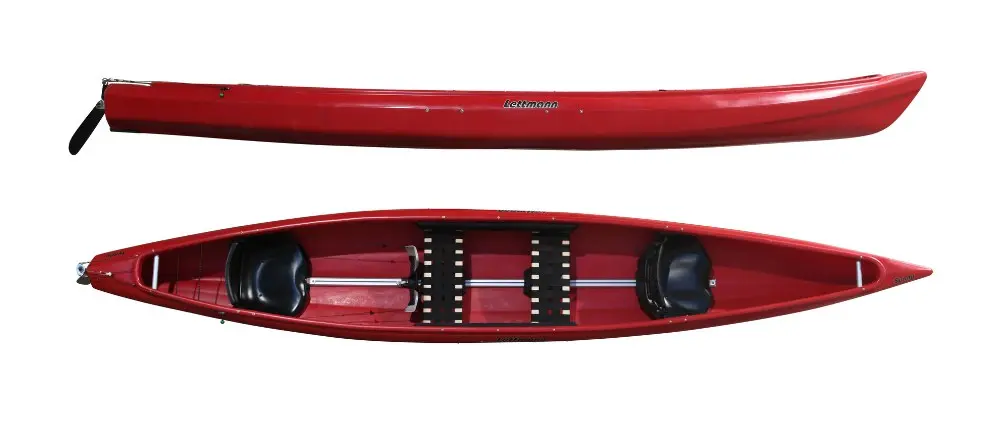
A shared paddling craft with room for four
Lettmann has introduced the Sunny 500 to the Paddle Sports Show's 2027 recreational product selection, highlighting an unusual approach to group kayaking. Instead of limiting the craft to one or two paddlers, the German manufacturer describes a configuration in which a family of four can sit together and participate in paddling. The company positions the boat as a potential alternative to a family canoe, combining elements of traditional kayak seating with raised central benches.
The distinction is more than simply adding seats to a longer hull. People of different ages need sufficient room to move their paddles without striking another occupant, while the boat must remain balanced under changing passenger loads. Lettmann's design is intended to create a shared experience rather than leave two younger passengers as passive observers during a relaxed lake or river outing.
Five metres long and designed around stability
The Sunny 500 measures approximately five metres in length and 84 centimetres in width, with a volume listed at 700 litres. Published weight varies from roughly 39.5 to 41 kilograms depending on configuration. Those dimensions make it considerably larger than an ordinary single-person recreational kayak, with practical consequences for launching, roof transport and storage.
Lettmann describes a wide U-shaped hull intended to promote reassuring stability and good directional control. A replaceable fin at the rear can also help the boat hold a course. These characteristics are appealing on sheltered waterways, but a long kayak with several passengers still needs careful handling around wakes and strong wind. Stability is not permission to overload the boat or ignore the conditions.
Raised benches are a deliberate design choice
The company uses its Comflex seating system at the front and rear while placing higher benches in the middle of the four-person arrangement. These benches create a more canoe-like seated posture for central passengers, offering additional legroom and the possibility of turning to face another direction during a stop. The layout recognises that four separate conventional kayak seats might make the middle of the hull feel cramped.
A raised position affects the centre of gravity, particularly when children move unexpectedly. Occupants should remain appropriately seated while the boat is underway and avoid changing places unless it can be done safely. The skipper should establish how the group will board and distribute weight before departure, rather than assume a family kayak behaves exactly like a stable pontoon.
Three-seat options broaden the appeal
Lettmann also offers a Sunny 500/3 with a different seating arrangement. Removing one central bench provides additional space for the rear paddler's legs or for luggage, while a three-seat configuration with Comflex seats is intended for three adults. This gives customers a choice between a larger group paddling arrangement and a version that prioritises comfort or cargo.
The better configuration depends on the normal crew rather than the maximum theoretical passenger count. A family with two young children may have different needs from three adults using the boat for a long summer journey. Buyers should examine the actual seating positions and verify the load limits of the precise version they plan to use.
A canoe alternative rather than a canoe replacement
Many families choose canoes because open seating and room for equipment make them versatile for calm inland waters. The Sunny 500 follows part of that logic while retaining a kayak-derived form and handling philosophy. It may appeal to people who like paddling with a double-bladed paddle or who prefer the seating support associated with the company's other recreational kayaks.
The difference in paddling posture will influence technique. A four-person crew may be able to contribute significantly to propulsion, but strokes need to be coordinated so that paddles do not clash and the boat holds its course. A couple of practise outings on calm water can help establish an enjoyable rhythm before planning a longer route.
The realities of moving a forty-kilogram craft
At roughly forty kilograms, this is not a boat that most owners will casually lift onto a roof rack without assistance. The overall length also requires a suitable transport system and adequate storage space at home or near the launch. Buyers should check vehicle roof ratings and use appropriate loading equipment, with professional advice when necessary.
An owner with frequent access to a lakeside storage facility may find the arrangement practical, while a household transporting the kayak from an apartment may not. Wheels or a suitable trolley can help move the craft over firm ground, but ramps, beaches and uneven terrain create different difficulties. Transport requirements are part of the true cost and convenience of ownership.
Families need a realistic safety plan
The ability to accommodate more people makes individual safety arrangements especially important. Each occupant needs appropriate flotation equipment and clear instruction about remaining seated while underway. Younger children may need a separate, dedicated supervising adult, and the group's age and abilities should influence which routes are appropriate.
Before launching, the crew should practise the boarding sequence and discuss how to respond to a capsize. A craft with four people may be more complicated to manage than a standard tandem, particularly if one occupant becomes distressed. Learning in sheltered water with experienced support is preferable to attempting a distant crossing because the boat looks stable in a brochure.
What the 2027 product selection establishes
The Sunny 500's inclusion in the show selection confirms Lettmann is presenting the family configuration to the industry, but it does not establish that the model won the final recreational award. The official image shows the actual five-metre craft, offering a useful view of the seating arrangement. Availability, exact options and the manufacturer's final passenger-weight guidance should be checked directly before purchase.
For small-boat readers, the main innovation is an attempt to make paddling participatory for a larger family without relying on a motor. Whether the concept succeeds for a particular household will depend on fit, storage and the routes available nearby. Its strongest quality is the promise of an outing in which more of the family can paddle together.