
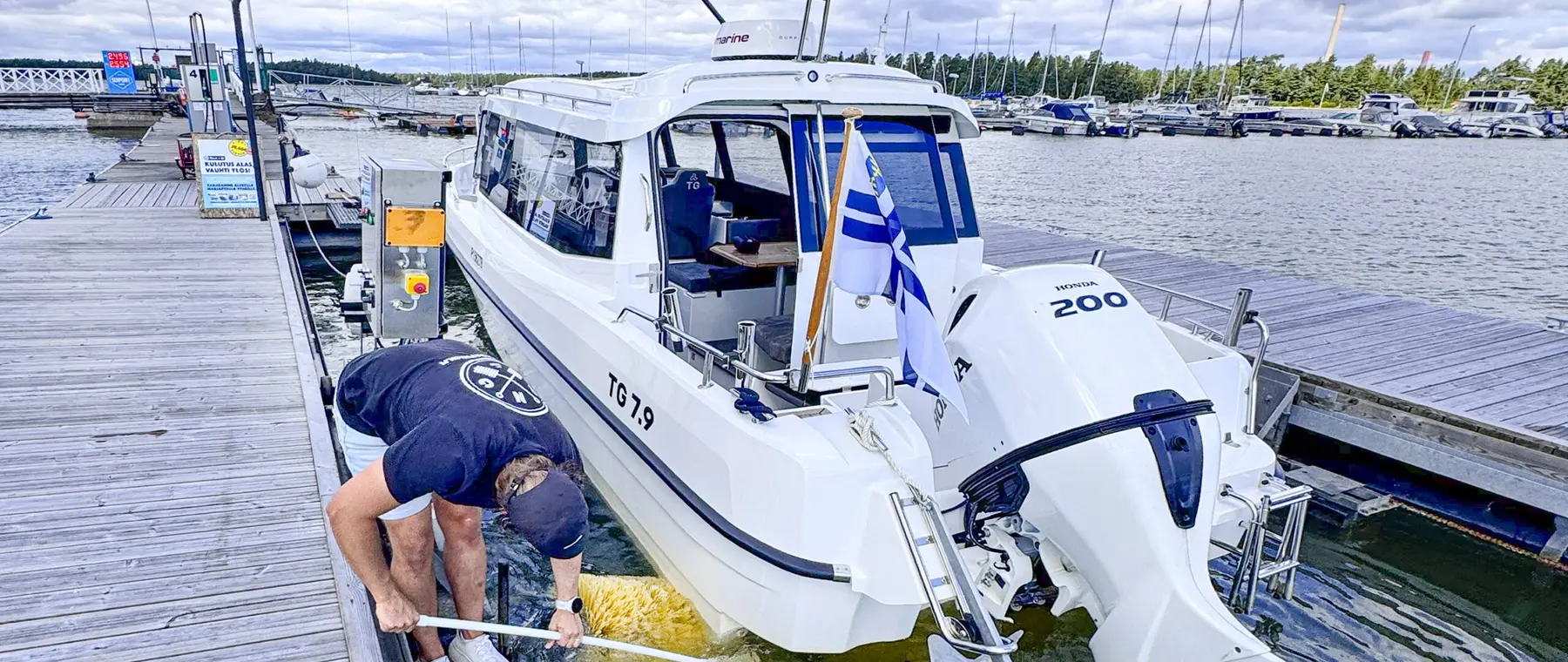
For people who sail, paddle or operate a small powerboat, the practical cost and organisation of getting afloat matter as much as the boat itself. Three Finnish boaters recorded changes in speed and fuel consumption before and after hull cleaning with Brush ’n Go equipment, highlighting the operational cost of fouling.
The original industry announcement documents the release, while this report considers its relevance to the under-twelve-metre boating market without assuming every model or installation is eligible.
Hull condition can change the energy needed to push a vessel through the water, but the effect depends on the craft and its operating profile. A Finnish trial involving three privately operated boats has reported lower fuel consumption and improved speeds after in-water cleaning with Brush ’n Go equipment.
The findings were reported by Yachting Ventures on 7 September after tests carried out between April and August. They are observations from three different vessels under everyday boating conditions, not a controlled study establishing a universal saving for superyachts.
Three boats, three operating profiles
The participating boaters compared performance before and after removing fouling. One unpainted TG 7.9 recorded cruising and maximum-speed gains of around four knots, with a reported reduction of up to 0.5 litres per nautical mile.
A Bella 550R increased its economical cruising speed from 21.3 to 24.2 knots while consumption fell from 0.82 to 0.59 litres per nautical mile. A Buster XXL experienced significant speed and fuel penalties when fouled, according to its owner's observations.
Fuel data require careful interpretation
The 0.82-to-0.59 litres-per-mile change for the Bella is a reduction of approximately 28% on that particular comparison. Other vessels, sea states, loads and speed settings may yield different results.
Because the three tests involved different vessels and everyday use, the figures should not be presented as an independent percentage forecast for a large yacht or a managed fleet. Repeatable testing under comparable conditions would be needed before making that claim.
Mechanical cleaning instead of a haul-out
Brush ’n Go says its service uses mechanical in-water cleaning without soaps or solvents, and it reports operations at about 60 Finnish marinas. The approach aims to address hull fouling without requiring a boat to be lifted each time.
For commercial operators and yacht managers, in-water cleaning should still be considered alongside the vessel's coating specification and any rules applicable at the particular harbour. The equipment and cleaning method must be appropriate to the hull and its finish.
Maintenance decisions for larger yachts
On a superyacht, biofouling can affect propulsion load, passage planning and maintenance costs, but the relevant economic case should use vessel-specific operating data. Recording baseline fuel use at comparable speeds can help teams assess whether a cleaning schedule is delivering measurable value.
The Finnish report is a reminder that underwater condition matters to routine efficiency. Its results provide an example for further testing, not a one-size-fits-all claim about the performance of every yacht.
Small-boat owners should treat the announcement as a starting point for their own plans rather than a guarantee of suitability. The original provider can confirm eligibility, current availability and the conditions for a particular vessel.
Any cruising or berthing decision still calls for an appropriate weather window, local information and realistic operating limits. Those practical checks sit alongside the official announcement.