
Two international venues confirmed for the returning championship
World Sailing has confirmed the hosts of its 2027 and 2028 Open Team Racing World Championships, giving the small-keelboat discipline an international calendar beyond its recent return. The 2027 edition is scheduled for 15–19 December at Royal Prince Alfred Yacht Club on Pittwater, New South Wales, Australia. The 2028 championship is assigned to Société Nautique de Genève on Lake Geneva, Switzerland, with exact dates to be announced. The governing body's news was published on 16 November 2026 and subsequently carried by Australian Sailing. The announcement is relevant to Leisure Boat Guide because the competition uses compact keelboats rather than superyachts or offshore cruising vessels. It also puts emphasis on tactical manoeuvres and close competition, giving recreational sailors and small-boat racers a clear reason to follow the development of the format.
The format uses teams, not isolated boat results
The event is not a conventional fleet championship in which each boat races only for its own finishing position. World Sailing describes a two-against-two format, with two boats on one team racing two from another team. Its stated scoring principle makes the last boat's finishing position decisive for the team result. That changes the incentives around positioning, passing and helping a team-mate. A fast boat may have a reason to protect a slower partner rather than simply extend its lead. The result is racing that can look unfamiliar to followers accustomed to straightforward individual boat placings. The official announcement describes qualifying round robins and later knockout stages, including quarter-finals, semi-finals and finals. It does not give a final entry list or a schedule for individual races at this stage.
Pittwater provides the Australian base in December
The 2027 championship will operate from Royal Prince Alfred Yacht Club on Sydney's Northern Beaches. World Sailing identifies Pittwater's sheltered waters, relatively low commercial traffic and variety of possible course orientations as advantages for team racing. Its announcement says the proposed race area is about a fifteen-minute sail from the club's marina, allowing competitors, officials and supporters to operate from a compact base. Those are host-location characteristics, not guarantees that every day of competition will proceed in identical conditions. For visiting teams, a workable relationship between the marina, launching and racing areas can make a material difference to the logistics of a tightly scheduled championship. The confirmed announcement provides the venue and dates; detailed transport, accommodation and qualification arrangements have not yet been released and should not be invented.
Summer breezes are part of the venue assessment
According to the official announcement, December on Pittwater typically brings north-easterly breezes averaging around 12–18 knots. This is a planning description of prevailing conditions rather than a weather forecast for each race day in December 2027. No individual start, delay, cancellation or course adjustment can be predicted more than a year ahead. The relevance to team racing is understandable. Close boat-to-boat exchanges demand enough wind for consistent manoeuvring without compromising the ability to run fair races safely. Organisers must still respond to the conditions that actually occur. For small-boat sailors considering travel to watch or participate, the published seasonal expectation is useful background, but it should not be mistaken for a promise of a particular wind strength or a specific amount of racing.
Elliott 7 boats keep the emphasis on crew handling
World Sailing identifies Elliott 7 keelboats for the 2027 championship. The class fits the small-keelboat nature of the event, with compact hulls intended for crew coordination and active sailing rather than the scale of a large offshore yacht. As with other one-design-style competition formats, using comparable boats allows tactical decisions and handling to carry more weight in the outcome. The source does not provide a detailed technical equipment inventory, individual boat numbers, manufacturer agreement or performance figures for the 2027 fleet. Those details should not be supplied by assumption. What is confirmed is that the selected venue intends to conduct the event using its Elliott 7 keelboat fleet. The choice reinforces the fact that the championship belongs to the small-craft sporting world even though it carries a world title.
A club with international hosting experience
Royal Prince Alfred Yacht Club has already hosted significant sailing events, and World Sailing cites several examples in its announcement. They include the 2025 Hansa World Championship, the Harken International Youth Match Racing Championship and the 2020 International 5.5 Metre World Championship. This history matters because the logistical demands of an international event reach beyond arranging a racing course. Entries, equipment, visiting sailors, officials, communication, facilities and suitable onshore coordination all require attention. Prior hosting experience is relevant evidence of organisational capability, but it is not proof that a future championship will encounter no problems. The club is also planning further team racing development activities before December 2027. Those activities have not been fully specified in the announcement, so none is presented as already taking place on a particular date.
Geneva takes the event back to Europe in 2028
The second announced venue is Société Nautique de Genève, situated on Lake Geneva in Switzerland. World Sailing says the 2028 championship will bring the same international format to an established sailing club on the lake. A Swiss venue changes the geographic setting after the Australian edition, potentially making the discipline visible to a different set of local sailors and national teams. That broader reach is a stated reason for the host selections, but exact entries and attendance are not available yet. In particular, World Sailing has not announced the final 2028 racing dates in this release. Travel plans, event schedules or claims about the prevailing weather in Geneva would therefore require later official information. The verified news is the choice of host and the expectation of a later publication setting out the detailed arrangements.
A discipline recently restored to the world calendar
World Sailing explains that the Team Racing World Championships returned to its international calendar in 2025. The 2027 and 2028 host announcements build continuity after that return. For an event organiser, continuity can help clubs and national authorities plan programmes and training, while for sailors it provides a reason to develop the specific tactical skills that team racing requires. Yet a host announcement should not be treated as proof of a guaranteed annual championship indefinitely. The public information confirms only the editions and venues named. The wider sporting significance is that the governing body has committed to two successive international settings for the same team-based small-keelboat format. Whether participation increases or new national teams emerge will be measurable only when future entry and results records are available.
Who can participate remains subject to qualification
World Sailing says each championship can feature up to sixteen teams, with two boats per team and crews assembled under event rules that include gender representation. The source describes teams of six to eight sailors and sets specific requirements for participation by women and men. Details of qualification and the final arrangements remain to be published. That distinction is essential. The announcement does not establish that sixteen nations have registered, that any named sailor has been selected or that a country has secured a particular place. Equally, the presence of a host club does not mean every local entrant will automatically qualify. Readers interested in entry should follow official World Sailing and host-club updates rather than treating a preliminary format description as a complete notice of race.
What makes two-versus-two tactically different
A central feature of team racing is the need to manage risk for the whole group. In a fleet race, being first may be enough; in a two-versus-two contest, a team has to consider where both its boats will finish. Crews may seek a tactical advantage through positioning at marks, controlling overlaps or affecting the available wind to opponents, always subject to the applicable racing rules. That makes the discipline demanding for communication and timing. These are general explanations of the sport's strategic character, not a report of manoeuvres that occurred at the unheld 2027 event. No future winner, tactical incident or protest can be described as fact. The eventual championship will provide its own race records, decisions and outcomes, which should be covered only after official confirmation.
Opportunities for young and club-level sailors
Team racing is especially familiar in some schools, universities and clubs, where teamwork and short-course handling can be central to competition. A world championship gives an additional focus for those skills, even though not every participant will aspire to international entry. The host club's intention to promote further development ahead of the event could help make the discipline more visible locally. However, the November announcement does not supply enrolment forms, guaranteed coaching places or funding arrangements for grassroots sailors. Clubs should not advertise such opportunities as confirmed until the host has published them. For the leisure-boat sector, the practical value of the news is that a respected international event is being organised around manageable keelboats and close crew coordination rather than very large, expensive vessels.
Race administration matters as much as boat speed
The small scale of the boats should not be confused with simple event administration. A field of up to sixteen teams racing short, closely contested contests requires efficient starts, clear instructions, dependable umpiring or rules processes as applicable and careful scheduling. Clubs hosting international team racing also have to manage equipment availability and visiting crews within a compressed period. World Sailing has provided the broad championship structure and host credentials but has not issued a complete technical or operational handbook through this particular announcement. A responsible report can explain why those functions matter while leaving implementation details to the notice of race and subsequent official documents. There is no basis here to claim a specific number of daily starts or a guaranteed spectator arrangement.
Why the calendar matters to the small-boat sector
The announcement offers more than a destination story. It confirms that a compact form of keelboat competition will have world-level events at two established clubs on opposite sides of the world. Equipment suppliers, class organisers, coaching programmes and club committees can all watch the development as an example of the continuing role of smaller boats in international sailing. Nothing in the source supports a new market-size estimate, a forecast of yacht sales or claims about a commercial sponsorship package. Those figures belong outside the report until independently documented. The measurable facts today are the 2027 dates, the named hosts, the 2028 venue without final dates and the published two-versus-two format. Every other implication is best described as context or a potential avenue for future coverage.
The dates and rules to keep on the record
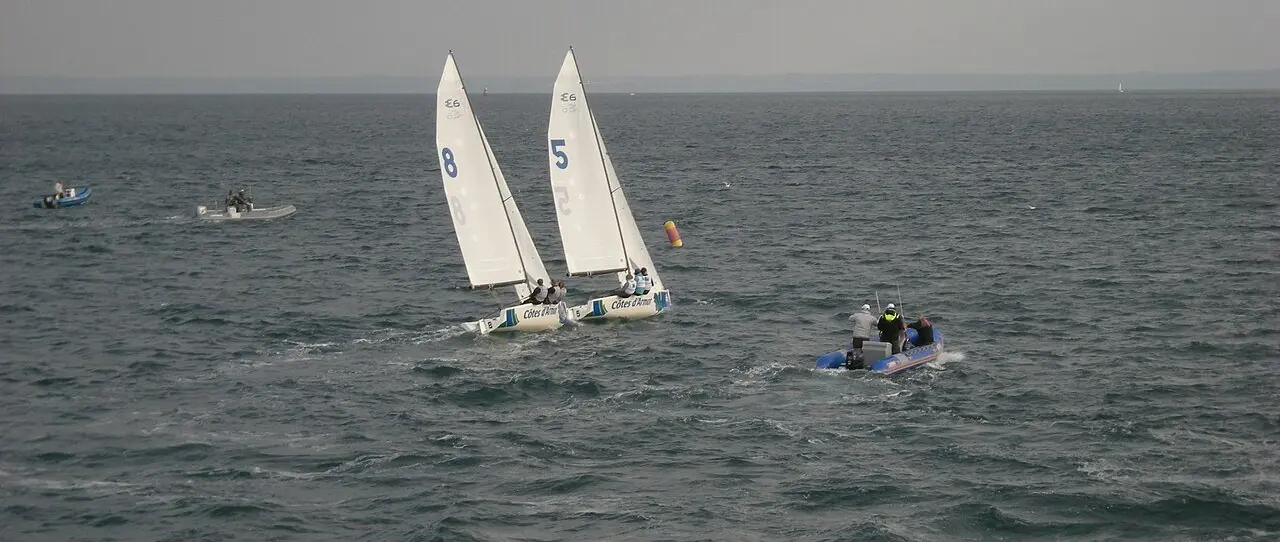
Readers following the championships should retain two clear markers: Royal Prince Alfred Yacht Club, Pittwater, 15–19 December 2027; and Société Nautique de Genève, Switzerland, during 2028 with exact dates pending. World Sailing says more details of qualification, entry and arrangements will follow. The event is planned as a two-versus-two contest using small keelboats, with up to sixteen teams. A historical, independently licensed photograph of Elliott-class match racing used with this article is contextual and does not depict the announced 2027 or 2028 championships. The news should be understood as a host and format confirmation, not as a race report. That careful distinction leaves room for future reporting when World Sailing issues the next documents and when competitors finally take to the water.
Original industry sources and image credits
Reporting based on Official World Sailing announcement.
Lead image: Historical Elliott six-metre match-racing photograph, NOT the 2027 Pittwater or 2028 Geneva world championships. Historical contextual image by Barbetorte, File:Elliott 6m match race 7.jpg, Wikimedia Commons; CC BY-SA 3.0 (https://creativecommons.org/licenses/by-sa/3.0/). Image resized for display; Historical Elliott six-metre match-racing photograph, NOT the 2027 Pittwater or 2028 Geneva world championships. Original: https://commons.wikimedia.org/wiki/File:Elliott_6m_match_race_7.jpg.. Licensed original image, author and terms.
