
A year-end campaign with a defined match
US Sailing has announced a year-end fundraising campaign under which an unnamed donor has committed up to $100,000 to match eligible contributions dollar for dollar through 31 December 2026. The national governing body published the announcement on 12 November, describing the campaign as support for sailing opportunities at every level, including clubs, community centres, beginner programmes, coach training, safety education and competition. The figure is the size of a donor's matching commitment, not a verified total already raised by the federation or an allocation to any one yacht club. For Leisure Boat Guide, the news is relevant because the wider sailing community depends heavily on people and organisations who introduce newcomers to small boats. The offer creates a defined opportunity for supporters to contribute within a stated period, subject to the organisation's actual donation arrangements.
How a matching gift is intended to work
The phrase dollar for dollar means that a qualifying contribution is matched by the pledged donor according to the campaign's rules. If the full $100,000 commitment were used and a corresponding $100,000 were donated by other eligible supporters, the combined contributions could amount to $200,000. That is an illustrative maximum based on a fully used matching pledge, not a statement that such a total has already been received. The official announcement does not provide a running tally or establish the exact number of donors who have taken part. It is also important not to describe the match as unlimited: the announced commitment has a stated upper amount. Anyone considering a contribution should use the current official US Sailing donation page and check the campaign terms rather than assume that every later gift will necessarily receive an additional matching dollar.
Community clubs are among the stated beneficiaries
US Sailing says the appeal supports yacht clubs, community sailing centres and learn-to-sail programmes. These organisations often provide the earliest practical experiences that encourage people to keep boating. A beginner might first encounter a dinghy through a short introductory session, then move into a structured course before becoming a crew member or boat owner. That pathway requires instructors, maintained equipment and welcoming facilities. The fundraising message describes support for these activities in broad terms; it does not disclose a list of grants already approved for individual clubs as a consequence of the new campaign. Responsible reporting should distinguish the donor's intention from the actual distribution of funds. The significance is that grassroots sailing is explicitly included alongside high-performance programmes in the appeal.
Introduction is only one step towards participation
An introductory sail can be memorable, but the challenge for a club is helping a new participant find a reason to return. Equipment availability, cost, timing, confidence and the social environment can all influence whether someone continues. A community sailing programme that offers a clear progression may make participation easier for adults and children with little previous experience. The federation's donation appeal refers to expanded access and opportunity, a broad goal that does not imply a single standard solution for every sailing centre. This article does not invent figures for how many new sailors a donation might produce. If later reporting evaluates the campaign's impact, it should examine actual participant numbers and programme activity rather than assume every donated dollar converts directly into a lasting club membership.
Developing young sailors is part of the appeal
The national body also identifies youth development as a purpose, emphasising skills and confidence. Young people may learn small-boat handling, teamwork and the discipline of considering wind and other water users. The experience can be valuable even if a participant never pursues a national championship. Competitive sailors may benefit from further opportunities to train or race, but grassroots development is broader than producing an elite athlete. Youth programmes require suitable supervision, equipment and an educational approach appropriate to participants' abilities. Donations can help support such work, yet funding alone does not guarantee a safe or effective programme. Clubs remain responsible for following applicable safeguarding and instruction requirements. Those obligations exist independently of a fundraising campaign and should be central to any organisation receiving support.
Coaches and instructors are essential infrastructure
A fleet of dinghies is of limited educational value if there are not enough competent people to teach students how to use it. US Sailing lists the development of coaches and race officials among the ways the donations may strengthen the sport. Coaching education can help clubs adopt more consistent methods, while instructors need practical experience and the ability to communicate with learners of different backgrounds. A volunteer may be highly experienced on a boat but still benefit from specific training in lesson planning or safety supervision. These are general reasons why people matter alongside equipment, not newly published data about the number of instructors funded by the campaign. The official appeal recognises that strengthening the skills of those who serve the sport is part of supporting the participants themselves.
Race officials have a separate set of needs
Competitive events rely on people who understand starting procedures, course management and the appropriate application of rules. Small-boat clubs can struggle to deliver regular racing when only a few volunteers know how to operate a race committee. Training more officials may give an organisation greater resilience and make it easier to host events without repeatedly depending on the same individuals. The campaign explicitly refers to race officials, but it does not say how many courses will be run or specify which officials have received funding. A future impact report would need those details. For now, the important point is that the federation includes the operational side of racing within its definition of participation support. The sport needs organised opportunities as well as boats and individual sailors.
Safety education connects racing and recreation
US Sailing also names safety education as a priority. The importance of this work extends beyond competitive fleets to people who sail casually, volunteer at events or use small craft for recreation. Appropriate instruction can help participants recognise changing conditions, prepare equipment and respond thoughtfully when plans need to change. The relevant skills vary according to the vessel, location and activity, and a generic safety course cannot replace the specific training required for a particular environment. The appeal does not announce a new mandatory US-wide certification or rule change. It identifies education as an area in which additional resources may create opportunities. Any actual programme should be evaluated by the quality and accessibility of its content, not only by the amount raised during a donation period.
Support also reaches competitive sailing
The governing body describes a pathway stretching from local racing to the U.S. Sailing Team. It therefore presents the appeal as relevant to several levels of activity, rather than confined to either beginners or elite athletes. A club competitor may benefit from more reliable race organisation, while a promising young athlete may require access to specialised coaching and equipment. The needs are different, and the announcement does not allocate a fixed percentage of the matching fund to each category. It would be misleading to claim that all donations will be spent on Olympic campaigns or, conversely, exclusively on introductory sailing centres. The precise division of support should be reported when the organisation provides appropriate financial and programme records. The verified news is the broad stated scope of the appeal.
The December deadline is part of the offer
The year-end matching period runs through 31 December 2026, according to US Sailing. That gives potential donors a clear date, but the matching commitment is finite and could be fully used before the calendar deadline. The announcement does not specify when that might happen, and no real-time availability of the match is asserted here. Interested supporters should review the current official campaign page, particularly if making a contribution later in December. The same principle applies to any donation with conditions: terms should be checked before a financial decision. No article about the campaign should make unsupported promises about tax treatment. The consequences of a donation can depend on the donor's circumstances and applicable law, so any such question needs an appropriate qualified source.
What a club can learn from a national appeal
A national governing body may be able to coordinate donations at a scale beyond a single sailing centre, but the basic challenge is familiar to local committees. People want to understand what a contribution is intended to support. Explaining that an initiative can help instructors, boats, safety or youth participation is more concrete than an appeal based solely on vague enthusiasm for the sport. At the same time, meaningful stewardship requires later information on how money has been used. A donor may be interested in immediate access for beginners or in longer-term programme development. These are different objectives that can both have value. A small club planning its own fundraising should define priorities clearly and avoid presenting future results as guaranteed merely because a campaign has an encouraging headline.
Matching campaigns should not be confused
Earlier in November 2026, US Sailing also reported a separate $1 million athlete-support commitment from Pacific Life associated with the national team. That is not the same programme as the new $100,000 year-end matching gift. The two announcements have different sponsors, purposes and financial structures. Combining the numbers into a single new grant or implying that one automatically funds the other would mislead readers. A matching gift depends on eligible contributions being made to release the donor's corresponding support, whereas the Pacific Life announcement describes a broader athlete-support fund and related partnership arrangements. Correctly distinguishing these commitments is important in financial and charitable reporting. The present article deals with the November 12 fundraising appeal, whose published maximum match is $100,000.
A small-boat ecosystem supported by many roles
The health of recreational sailing depends on an interconnected set of activities. A newcomer needs a safe first opportunity; an instructor needs suitable training and equipment; a club committee needs manageable operations; and a local racing fleet needs people capable of organising fair competition. The federation's appeal includes all these areas, recognising that participation cannot be built solely by investing in a single high-profile team. The actual effectiveness of the fundraising effort will depend on its implementation and the quality of the programmes it helps sustain. That conclusion cannot be established in advance through campaign publicity. An appeal is a starting point for support, while the results should later be judged through transparent programme reporting and direct evidence of what changed.
The confirmed terms as of 26 November
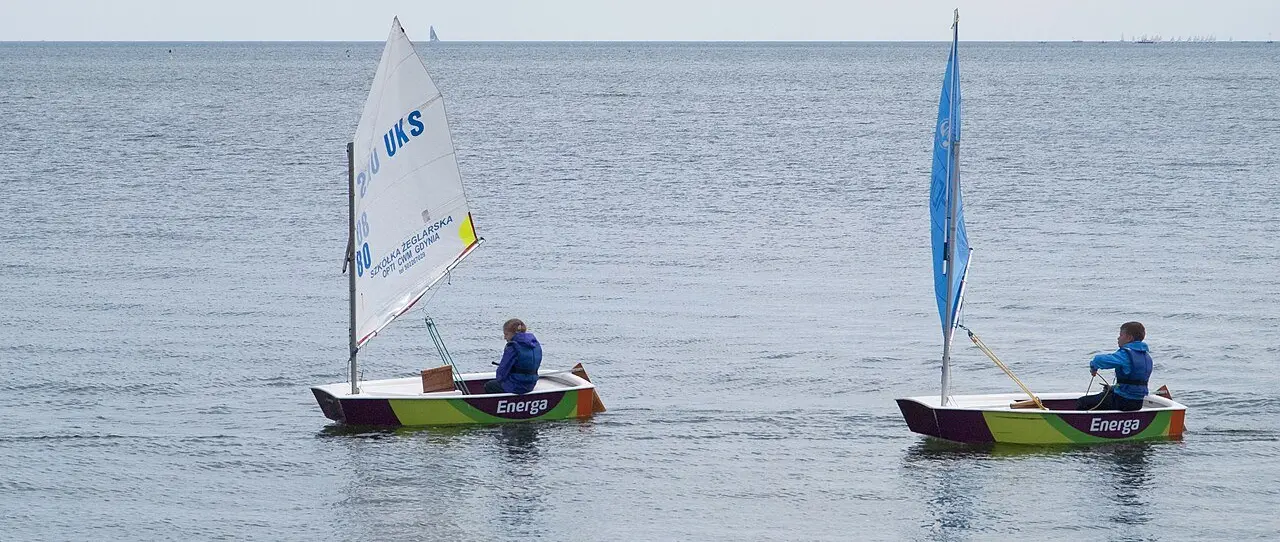
The documented announcement is a donor commitment to match eligible year-end gifts to US Sailing dollar for dollar, up to $100,000, during a campaign extending through 31 December 2026. The federation lists clubs, sailing centres, education, safety, youth opportunities and competition among its intended priorities. It does not provide a verified total already collected, a list of grant recipients or a promise that an individual club will receive money. A separately licensed historical photograph of a small-boat sailing school accompanying this report is an illustration of the sector, not evidence that the pictured group has benefited from the campaign. The story is a defined opportunity to support grassroots and competitive sailing, with any real-world impact still to be demonstrated through future reporting.
Original industry sources and image credits
Reporting based on US Sailing official programme announcement.
Lead image: Historical sailing-school dinghy photograph in Poland; NOT a US Sailing donor-funded program or evidence of 2026 donation distribution. Historical contextual photograph by Jacek Halicki, File:2014 Żaglówki szkółki żeglarskej w Gdyni 02.jpg, via Wikimedia Commons. License: CC BY-SA 4.0 (https://creativecommons.org/licenses/by-sa/4.0/). Image resized for editorial display. Historical sailing-school dinghy photograph in Poland; NOT a US Sailing donor-funded program or evidence of 2026 donation distribution. Original file: https://commons.wikimedia.org/wiki/File:2014_Żaglówki_szkółki_żeglarskej_w_Gdyni_02.jpg.. Licensed original image, author and terms.
