
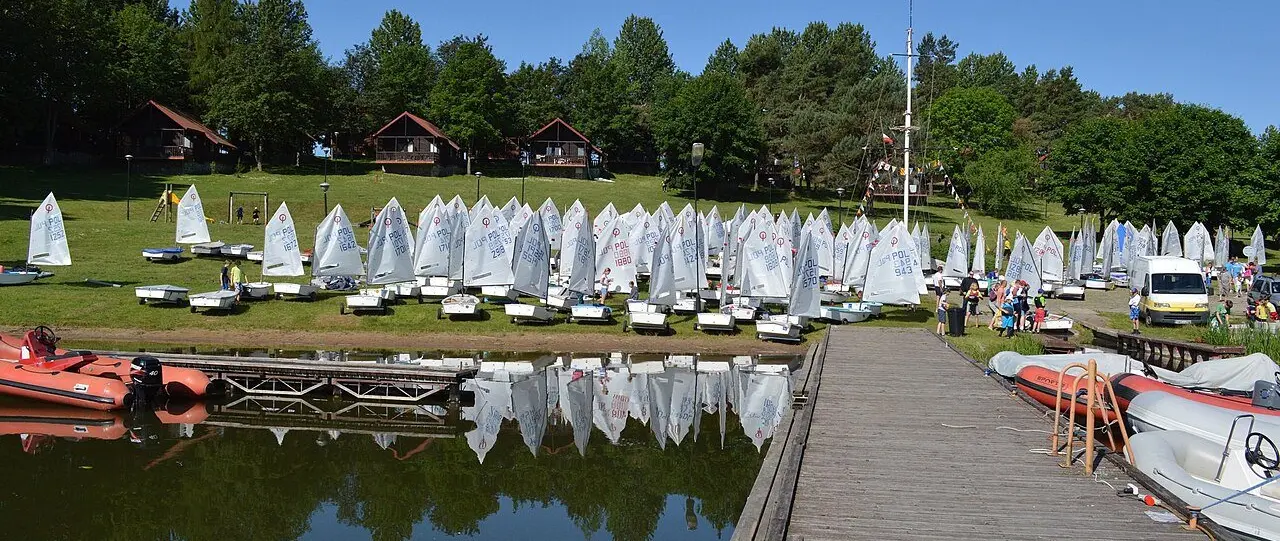
A December gathering for young centreboard sailors
Torbay Sailing Club is preparing to stage the 24th Sir Peter Blake Torbay Regatta at Waiake Beach on Auckland's North Shore on 5 and 6 December 2026. Yachting New Zealand published the event announcement on 6 October and described the gathering as the largest mixed centreboard youth regatta in the Southern Hemisphere. It is designed to welcome young sailors from introductory fleets through to more technically demanding dinghy and foiling classes. At the time of this report, the 2026 racing has not yet happened, so no winner or new fleet total can be asserted. The entry invitation applies to youth sailors under 19 on 31 December 2026. For small-boat families and clubs, the significant news is an approaching event that deliberately combines competitive sailing with enjoyment, fair play and the legacy of an influential New Zealand sailor.
Last year's fleet shows the event's scale
The official preview records 352 sailors racing 327 boats in fifteen fleets during the December 2025 edition. Participants represented 32 clubs, including some from outside New Zealand such as Singapore and New Caledonia. These are historical participation figures and should not be relabelled as the final 2026 entry list. They do, however, indicate the scale of logistics Torbay Sailing Club is accustomed to managing. Hundreds of small craft launching and returning around the same beach require careful organisation of shore areas and course allocations. The combination of individual and crewed boats also means a count of sailors will differ from the number of hulls entered. A useful preview recognises that distinction rather than presenting a simplified total that might mislead readers unfamiliar with centreboard regattas.
Four race areas require a substantial support fleet
Last year's regatta needed four racecourses, thirty-five official boats and around forty coaching and other support craft. Separate fleets require race officers, marks, safety cover and ways to communicate decisions when the wind changes. The precise requirements for 2026 will depend on the final entry list and conditions, so those previous numbers should be treated as context rather than promises about this December's arrangements. A large youth regatta is not simply a cluster of small boats that can be left to race independently. It needs people capable of monitoring separate groups, supporting inexperienced sailors and maintaining clear channels to shore. A well-run programme can give participants opportunities to learn good seamanship within structured competition, even when their main ambition is to enjoy a first major regatta.
Volunteers make the weekend possible
Yachting New Zealand reported that more than 150 volunteers helped deliver the 2025 event, split roughly evenly between on-water and shore-based duties. Their work included an extraordinary volume of catering: more than 1,200 sausages, forty kilograms of bacon and 2,100 slices of bread were served during the weekend. These figures are memorable but are not the reason the event matters. They illustrate the wider community effort required to create a positive experience for visiting young sailors and their families. The race committee, beach marshals, safety crews, food volunteers and organisers all contribute in different ways. A championship can have excellent racing while leaving people exhausted if shore operations are neglected. The Torbay example shows how practical hospitality and race management form two parts of the same event.
Different classes at different stages of learning
The class programme stretches from Optimist Green Fleet through ILCA, 29er, RS Feva, 420 and iQFOiL. These boats and boards are not interchangeable, and it would be inaccurate to suggest that a first-time Optimist sailor competes directly against a high-performance foiling board. The value of hosting them at one club is the opportunity to see how the sport develops across age groups and skills. A beginner may watch a 29er crew coordinating high-speed manoeuvres, while an older sailor can remember the first time they approached a regatta start in a much simpler craft. Coaches and race officers need to tailor expectations to the divisions. A common event can celebrate different levels of achievement without forcing every participant into one general classification.
A special emphasis on character
Torbay Regatta Director David Wright attributes much of the event's continuity to a dependable venue, fixed dates and a commitment to the founding purpose. The official preview explains that sportsmanship, fair play and attitude are deliberately important alongside podium results. Some awards recognise sailors who take their own penalty turns honestly, even when nobody else might have noticed the incident. This approach is worth highlighting because race results can dominate youth sporting coverage. An event that makes room for recognition of ethical behaviour may encourage competitors to think beyond the position recorded on a scoreboard. That does not replace the racing rules or require officials to overlook infringements. It offers an additional way to reward the choices young sailors make while learning to compete.
An unusual way to mark beginner courses
In the Green and White fleets, the event has used inflatable flamingos, unicorns and a peacock as course marks, according to Yachting New Zealand. Such details distinguish the regatta from an intimidating high-performance selection trial. They can make a young sailor's first experience of racing feel more playful without discarding the underlying need to understand starts, marks and the correct course. Bright, memorable shapes are not a substitute for competent race instructions, but they can contribute to an atmosphere where participation is celebrated. The official account says the event is deliberately not a ranking regatta. That is an important difference from competitions in which sailors are primarily attempting to secure national selection points. At Torbay, the organisers want competition to remain enjoyable in its own right.
The Sir Peter Blake Trophy has a wider purpose
The event's principal award, the Sir Peter Blake Trophy, recognises leadership and attitude as well as speed. Past recipients include Olympic medallists Jo Aleh, Peter Burling and Sam Meech, demonstrating that the award has connected with sailors who later became internationally known. Those careers should not be used to promise similar outcomes for every recipient. In 2025 the trophy went to the 29er pairing of Nelsen Meacham and Louis Quere, whom the organisers recognised for their composed series and contribution to the wider fleet. This is a confirmed past result, not a prediction of who will be honoured in 2026. The trophy connects the event with the values of one of New Zealand's best-known offshore sailors while making those values meaningful at a small-boat level.
Historic yachts have provided a visible link
The event's connection with Sir Peter Blake has sometimes been represented by larger historic yachts visiting the bay. Steinlager II, associated with his 1989 Whitbread victory, was present in 2024, while Lion New Zealand visited during the 2025 regatta. The official preview describes the attraction these vessels created for young sailors between races. Their presence is interesting because junior dinghy sailing and ocean racing can feel like separate worlds. Seeing an important historic yacht may help a student understand how skills developed in smaller craft can form part of a much wider sailing life. The announcement does not say either vessel will attend in December 2026, so that must not be implied. Past visits are context for the regatta's identity, not a guaranteed feature of this year's weekend.
Why the age rule matters
The organisers invite participants who are younger than 19 on 31 December 2026. An age cutoff gives clarity to a youth programme whose sailors may be close to a birthday during the event. It should still be read alongside the relevant class eligibility, measurement and entry requirements. A sailor who meets the age condition is not automatically eligible to sail any boat in any division, and appropriate skills, equipment and paperwork remain important. Clubs preparing to send young competitors should confirm the latest race documentation and ensure that boats are properly maintained before travelling. The official announcement called for registrations, but a report dated late November should not assume that a specific entry window remains open without checking the current system. Organiser updates take priority.
Families and first-time participants have a role
An event of this scale attracts parents, guardians, coaches and other supporters as well as sailors. First-time regatta families can find the logistics unfamiliar: boat parking, rigging areas, launch procedures and the need to be ready when a fleet is called. Good pre-event communication helps people avoid unnecessary pressure. A small sailor may be more concerned about finding the right course than about the official title of the meeting. The atmosphere described by Torbay emphasises encouragement while maintaining proper racing structure. It is reasonable to take that as evidence of the organisers' intention, but no article can guarantee the experience of every child. Weather, the particular fleet and the availability of support all affect the day. Preparing in advance can make the event more rewarding.
A bridge between participation and excellence
A large youth regatta can contain sailors whose primary objective is making friends and others working towards competitive careers. Torbay's programme recognises both without requiring every newcomer to adopt an Olympic ambition. The mixture may be valuable to the health of the sport. If young people associate their first competitive experience with confidence and enjoyment, they may be more willing to continue attending club sessions. A talented racer also gains experience dealing with many boats and varied conditions, which can support further development. These are possible benefits, not quantified outcomes from a published evaluation. The organiser's documented focus remains accessible competition, a positive club culture and recognition of good conduct. Those elements are relevant to any dinghy association considering the design of its own events.
Looking ahead to 5 and 6 December
The verified information is that the 24th Sir Peter Blake Torbay Regatta is scheduled for the first weekend of December 2026 at Waiake Beach, with participation aimed at youth sailors under nineteen and a programme covering introductory and advanced small-craft classes. The 2025 turnout and volunteer figures provide scale, but the final 2026 entries and results will need separate confirmation. A historical photograph of Optimist dinghies accompanying this article must be credited under its Creative Commons licence and described as contextual, not as an image from the upcoming regatta. For boating families, the story is about an approaching opportunity to experience a major youth event where sportsmanship and learning are considered as meaningful as the racing itself.
Original industry sources and image credits
Reporting based on Yachting New Zealand official report.
Lead image: Historical Optimist dinghy sailing photograph; NOT the December 2026 Sir Peter Blake Torbay Regatta. Historical contextual photograph by Gurthg Shae, File:Optimist dinghies.jpg, via Wikimedia Commons. License: CC BY-SA 4.0 (https://creativecommons.org/licenses/by-sa/4.0/). Image resized for editorial display. Historical Optimist dinghy sailing photograph; NOT the December 2026 Sir Peter Blake Torbay Regatta. Original file: https://commons.wikimedia.org/wiki/File:Optimist_dinghies.jpg.. Licensed original image, author and terms.
