A hybrid approach joins the small-boat equipment discussion
PRETECH Marine has presented a hybrid outboard propulsion system combining electric and petrol power in its official METSTRADE exhibitor catalogue. The product is described as supporting quiet, locally emission-free operation at low speeds while retaining a combustion-powered option for extended range and higher-demand use. That basic proposition is relevant to small motorboats whose owners may want to manoeuvre quietly near a marina but still need the flexibility of conventional fuel for longer journeys. The official product listing provides a clear statement of intent but relatively few engineering specifications. This report therefore examines what has been announced and the practical questions that builders and owners need to resolve, without treating the equipment as a fully independently tested propulsion package or claiming delivery dates that have not been published.
Two energy sources are not the same as two complete engines
The catalogue calls PRETECH's proposal an electric-gasoline hybrid outboard propulsion system. It does not establish the internal mechanical arrangement, whether one propeller is driven by two alternative power sources or how a control unit selects between modes. Different hybrid products can use substantially different architectures, and the word hybrid alone does not identify one of them. Owners should not assume the system resembles a particular automotive arrangement or that it can recharge its own batteries under every operating condition. The responsible interpretation is narrower: the manufacturer has publicly described a dual-energy concept intended to combine the characteristics of electric low-speed operation with petrol-powered range. Further technical documentation is needed before discussing how the machinery achieves that result.
Quiet movement at low speed is an understandable goal
Many recreational boat trips include long periods moving slowly. A small motorboat may spend time leaving a berth, crossing a harbour, approaching a safe anchorage or complying with local speed restrictions. These stages do not require the same power as sustained planing, but they still demand precise steering and responsive thrust. Electric propulsion can be attractive in such settings because motor torque and the absence of combustion noise may change the experience aboard. PRETECH says its system is intended for quiet electric cruising at low speed. The available product page does not provide acoustic measurements or an independently demonstrated manoeuvring test. The claim should therefore be understood as the manufacturer's design objective rather than a guaranteed reduction in noise for every installation.
The petrol option addresses a different concern
A conventional petrol outboard carries energy in a liquid fuel that can be replenished comparatively quickly where suitable facilities are available. An electric boat depends on its battery capacity and the charging arrangements available on the route. A hybrid design attempts to draw on the strengths of both systems, potentially reducing reliance on battery range alone. The PRETECH listing describes a gasoline-powered option for longer range and higher torque when needed. It does not publish fuel economy, sustained speed, battery capacity or the distance a particular boat can travel in either mode. It would therefore be misleading to state that a vessel equipped with this outboard can complete a specified passage, travel a certain number of nautical miles or automatically save a fixed percentage of fuel.
The difference between low-speed and planing requirements
Small powerboats can require a substantial change in power when moving from displacement speeds to planing. Hull shape, loading, sea conditions and engine characteristics influence that transition. A hybrid product intended for leisure boats must accommodate the kind of vessel for which it is specified, not simply provide attractive power figures in isolation. PRETECH's short catalogue description emphasises low-speed electric operation and petrol-powered performance, but it does not describe the suitable hull types or provide a power curve. Buyers should therefore resist drawing conclusions about acceleration, top speed or suitability for towing from the announcement. The outboard should be assessed as part of a complete boat design, with the appropriate operational envelope confirmed by the supplier.
Battery planning remains fundamental
An electric mode requires stored electrical energy. Even where a hybrid can draw on petrol, the battery still has to be sized, protected, monitored and charged in a way that suits the intended use. A marina-focused owner may have reliable shore charging; someone using a trailer boat at different launch sites may need a different plan. The catalogue does not state the chemistry, capacity, charging rate or location of the battery system for PRETECH's product. Those are central questions, not minor accessories. A complete specification should clarify whether the system uses a dedicated propulsion battery, how it interfaces with conventional 12-volt boat loads and which protective devices are required. Without that information, electrical installation costs cannot be estimated responsibly.
Weight can change a small boat's behaviour
On a compact recreational craft, additional equipment weight can affect trim, freeboard, handling and useful payload. A hybrid outboard may involve machinery and energy storage that need to be accommodated in or around the vessel. Whether the result is heavier than an equivalent conventional package cannot be established without actual manufacturer figures. It would be especially unwise to assume that any hybrid is a straightforward replacement for an existing transom-mounted engine. The boat's maximum permitted engine mass, power rating and structural requirements must all be respected. A proposed retrofit should be discussed with the builder or a qualified marine engineer, rather than treated as a purely cosmetic change at the stern.
Installation is more than a transom bolt pattern
An outboard replacement may appear simple because the engine is mounted outside the hull. In practice, a hybrid system could require new controls, cabling, battery housing, ventilation or cooling arrangements, depending on its design. The official PRETECH summary does not say which components are integrated into the engine and which must be installed separately. It also does not provide transom standards or steering compatibility. Boatbuilders would need to examine the whole package before specifying it for a production model. Private owners considering a repower should request the full installation manual and confirm that the existing helm, steering system, electrical infrastructure and boat documentation are compatible with the proposed equipment.
Controls must be clear and predictable
A dual-energy outboard raises a human-factors question: how does the operator know which mode is active and what will happen when more throttle is applied? A well-designed system should make its state understandable and prevent confusing transitions. The catalogue does not provide a helm-display photograph, describe the switching sequence or establish whether the user can manually choose the operating mode. Those details need to be verified before assessing ease of use. A small-boat skipper should be able to understand propulsion status without looking away from the water for long periods. Control clarity is particularly important during tight manoeuvres, when unexpected changes in thrust or sound could distract the operator.
The environmental claim needs a defined boundary
PRETECH describes electric low-speed operation as having zero emissions at the point of use. That is a narrower and more defensible idea than saying the entire hybrid system is emissions-free. Petrol combustion still produces exhaust gases, and battery production and electricity generation have their own environmental impacts. A genuine lifecycle comparison would need to consider energy sources, operating profile, manufacturing and the useful life of the equipment. The exhibitor listing does not supply such an assessment. It would therefore be misleading to attach a quantified carbon reduction to the product. The actual benefit will depend on the fraction of time spent in electric mode and how that electricity is supplied, among other factors.
Fuel savings are a possibility rather than a published result
Hybrid propulsion can be discussed in terms of efficiency, but savings must be measured against a defined conventional system on a comparable boat. PRETECH says its design aims to optimise fuel efficiency, yet the public listing reviewed does not provide fuel-flow data or a test protocol. A claim that owners will save a particular amount of petrol would require evidence about load, speed and the use of the different modes. For a recreational operator, useful questions include how much time the boat spends at low speed, what charging access exists and how often the petrol engine will still be required. Without those inputs, even a carefully built engineering system cannot be assumed to deliver the same economic outcome for every owner.
Safety standards remain a decisive issue
A hybrid arrangement combines electrical and fuel-related safety requirements. Appropriate battery protection, isolation, fuel-system design, wiring and operating procedures depend on the actual product and installation. The public catalogue does not specify its complete certification status, and editorial coverage should not imply that a particular standard has been independently verified. A boatbuilder should obtain the necessary conformity documentation and assess the design against the rules applicable to the finished vessel and market. A private owner should rely on competent marine installers and the equipment maker's current instructions. These precautions are not unique to PRETECH; they are part of responsible adoption of any propulsion technology that changes how a boat is powered.
Servicing can become more complicated
A conventional outboard already requires scheduled maintenance, checks of cooling and fuel systems, and access to suitable parts. Adding electric machinery and associated controls introduces further elements that may need diagnosis or software support. Whether this particular hybrid will be easier or harder to maintain has not been demonstrated publicly in the source reviewed. An owner should ask what service training is available, whether authorised dealers can support both power modes and how faults are handled during a passage. For boats used regularly away from major service centres, the availability of competent support may be as important as any claimed efficiency advantage. Reliability needs a track record, not just an attractive product image.
The METSTRADE setting is relevant
The hybrid outboard appears in the official METSTRADE catalogue under PRETECH Marine. Trade exhibitions allow component makers to show prospective boatbuilders and distributors the direction of their product development. A catalogue listing is evidence of a product being presented to an industry audience; it is not proof of a volume-production schedule, a retail price or an independently completed trial. Those distinctions are especially important when a system is described as new. The 2026 Amsterdam show provides context for the announcement, but this article does not claim to have attended a demonstration or measured the product. The manufacturer's own technical and commercial documentation will need to substantiate the next stage of the story.
Which boat owners may be interested?
The likely audience includes owners who spend substantial time at reduced speeds but also undertake passages where a petrol engine remains desirable. That could include particular dayboats, small family cruisers or tender operators, provided each application falls within the equipment's actual specifications. It would be irresponsible to promise suitability for any arbitrary craft, because the source does not give a rated power range or supported boat list. The useful next step for interested owners is to prepare a realistic operating profile: hull model, total load, typical speeds, distance travelled, available charging and the environmental conditions in which the boat is used. Those details will help determine whether a hybrid proposition merits further technical investigation.
What the first-party record establishes
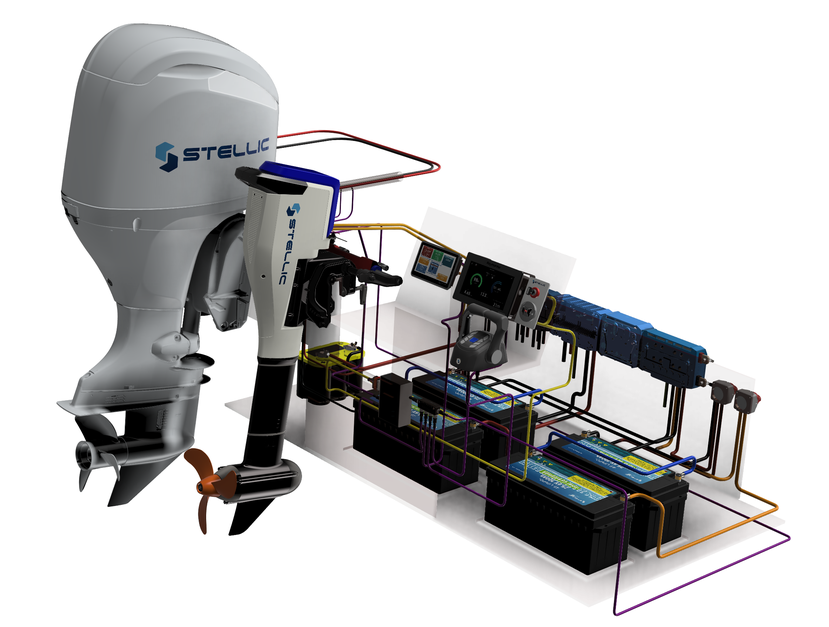
The [official PRETECH Marine METSTRADE product page](https://www.metstrade.com/exhibitors/pretech-marine/products/new-hybrid-outboard-system) describes an electric-gasoline hybrid outboard propulsion system intended to offer quiet electric movement at lower speeds with petrol-powered extended range and higher-demand performance. It does not provide independently verified range, battery capacity, weight, speed, price or availability figures. The accompanying illustration is the manufacturer's own product image, identified as the advertised equipment rather than a photograph of a vessel that has completed trials. For the leisure-boat industry, the development is a reminder that manufacturers are investigating combinations of propulsion technologies suited to mixed operating patterns. The proof of practical value will come from complete specifications, appropriate approvals and real-world performance rather than the hybrid label alone.
Original industry sources and image credits
Reporting based on Original first-party PRETECH Marine METSTRADE original first-party product announcement.
Lead image: Original PRETECH Marine hybrid electric and petrol outboard equipment image from METSTRADE. © PRETECH Marine / METSTRADE. Original manufacturer's current hybrid outboard equipment image.. Original supplier image.