
National titles after a week of changing conditions
Sixteen young sailors took national honours across six classes at the 2026 PredictWind New Zealand Youth Championships at Murrays Bay Sailing Club in Auckland. Yachting New Zealand published its results report on 29 September after four days of racing that included winds reaching thirty knots, lighter shifting conditions and several tightly contested final races. More than one hundred competitors took part. The event also served as an important stage in the selection process for the World Sailing Youth Championships in Vilamoura, Portugal, scheduled for 15–19 December. The domestic results are confirmed historical facts, not predictions about that later competition. For small-boat enthusiasts, the championship offers a useful view of the depth of New Zealand's youth dinghy, skiff and foiling fleets and the different skills needed to perform across their classes.
A difficult opening tested the fleet
The first part of the competition brought strong conditions before more manageable breezes allowed the later races to continue. Young sailors in dinghies and skiffs have to manage both speed and the practical demands of staying upright, communicating with a partner and returning safely when conditions become challenging. Different classes have different thresholds and handling characteristics, so a reported thirty-knot wind should not be interpreted as proof that every fleet raced continuously at that exact speed. Race officials decide how to operate the programme according to the conditions and the boats involved. The federation highlighted the resilience of the participants, including some making their first appearance at the national youth trials. Their efforts provide context for the results without needing to invent individual rescues, penalties or equipment failures that were not documented.
The boys' 29er title went to Meacham and Stone
Nelsen Meacham and Oli Stone won the boys' 29er division after taking three wins from eleven races and finishing second on six occasions. The pair ended the series five points ahead of Matteo Barker and Leo Brown, with Will Leech and Will Mason third. Such consistency is important in a fleet where each race creates another opportunity for a tactical mistake or change in weather. Winning the most recent start is not necessarily enough to take the championship. The 29er is a high-performance double-handed skiff, and the crew must work closely together to balance and control the boat. The result shows a pairing capable of repeating strong finishes over a series rather than relying on a single dominant performance. The federation did not publish a full crew debrief, so particular tactical decisions should not be invented.
Jenkins and Handley stood out in the girls' skiffs
Bella Jenkins and Jess Handley took the girls' 29er title, building on a strong international season. The pair had also won the female under-19 world title in the class in Kiel, Germany, in July 2026. The official account identifies them as contenders for another Youth Worlds campaign. Their domestic result and previous world title are confirmed, but that does not establish the final outcomes of December's Youth Worlds. A national selection process depends on the relevant federation's procedures and decisions, and a championship result may be one important piece of evidence. For junior crews observing the class, their achievement demonstrates what can be developed through coordination and repeated competition. At the same time, it is important to recognise that individual progression is never guaranteed and that crews develop at different rates.
The girls' 420 division had a dramatic final race
Tessa Clinton and Lucy Luxford took the girls' 420 title despite capsizing during the last race. Yachting New Zealand says Clinton joined the pairing as a late replacement less than a week before the start, and they led the division for much of the competition. Amber Hughes and Phoebe Willis finished second. A capsize at such a moment can be unsettling for a crew, but the final series outcome depends on points gathered over more than one race. The result is a practical example of why a dinghy team's preparation and recovery habits matter. It does not mean capsizing is harmless or that a successful outcome will always follow. Coaches emphasise safe handling because different conditions, fatigue and equipment problems can make a recovery more complex. The official result is the title won, not a guarantee about the risk profile of other events.
Brown and Nicholas controlled the boys' 420 standings
Hamish Brown and Zenon Nicholas won the boys' 420 title with four race victories and no finish worse than fourth, according to the federation. The combination of wins and consistently strong placings indicates effective performance across conditions. In double-handed sailing, steering, sail trim and communication have to be coordinated under pressure, particularly around mark roundings and when a gust arrives. The 420 has long been used by young sailors developing towards other two-person classes, but success in one boat does not confer automatic mastery in a faster skiff. The pair's first Youth Trials title together is a meaningful domestic achievement in its own right. Any claim that it guaranteed international selection would need confirmation from the relevant team announcement, and this article does not make that unsupported leap.
Pilkington won ILCA 6 by a single point
Tom Pilkington secured the boys' ILCA 6 title after a final race in which he finished second, one place ahead of rival Arran Begic. The final championship margin was a single point. That result helps explain why one-design dinghy racing can remain open until the closing leg of the series. A sailor who has performed consistently still has to make good decisions in the final contest, particularly when a close competitor is nearby. The ILCA 6 is single-handed, leaving the helm to manage steering, balance, sail controls and tactical choices alone. Pilkington had placed fifteenth at the previous year's Youth Worlds, according to the federation, but his past international result should be viewed as experience rather than a prediction of the next event. The domestic title is the verified achievement.
Turner added another ILCA title
Chloe Turner won the girls' ILCA 6 division following a season that already included international podium finishes. The federation records bronze medals at the ILCA 6 Youth World Championships in Aarhus in August and the Youth European Championships in Greece a few weeks earlier. These results suggest a competitor comfortable operating at a high level in a large international fleet. However, a youth sailor's development is influenced by many factors, from coaching and physical preparation to the weather encountered in different competitions. It would be misleading to assume that domestic success removes those challenges. Turner's championship belongs in a broader story about the increasing experience within New Zealand's single-handed fleet, while the international achievements should be dated and kept separate from results that had not yet happened in December.
Windsurfing also produced national champions
Vlad Misescu won the boys' iQFOiL division, holding off Ben Rist and Josh Tuck, while Elbe White won the girls' title ahead of Margarita Konstantinova. The iQFOiL is a foiling windsurfing discipline, not a conventional dinghy, and it requires a different approach to balance and board control. Its inclusion alongside skiffs and small sailboats demonstrates the breadth of the current youth sailing pathway. A board sailor may share knowledge about wind patterns and race strategy with a dinghy crew while using entirely different techniques to accelerate and turn. The official account confirms the divisional winners but does not provide an individual performance analysis for every race. A balanced article can recognise the champions without pretending that the same tactics or equipment apply across all six classes.
Waszp and wingfoil appeared as invited classes
The 2026 championship included Waszp and wingfoil fleets as invited categories, even though neither was part of that year's Youth Worlds class programme. Oliver Tiedemann and Dahlia Fyfe won the boys' and girls' Waszp titles, while Riley Peet and Valentina Gladiadis led the wingfoil standings. Their participation illustrates the development of newer foiling disciplines within youth events. It should not be taken to mean that the World Sailing Youth Championships automatically offer those same classes or that everyone who raced them was eligible for Youth Worlds selection. The distinction between domestic invited classes and international championship categories is essential. Clubs considering new equipment need to understand local activity and class calendars rather than assume every popular training boat has the same pathway into a global event.
The relationship with international selection
The domestic championships were also Youth Worlds trials, with the federation explaining in September that male and female winners in four of the six classes would be considered for the New Zealand team. Selection was to be determined after the trials by the relevant authorities. The word considered matters: it does not mean all champions gained automatic places, and a November article should not treat the September selection process as still pending without checking later announcements. The December Youth Worlds at Vilamoura represented the next major international target. Young competitors would need to take lessons from the national event into subsequent training, whatever their ultimate selection outcome. The championships' importance therefore extended beyond the medals awarded at Murrays Bay, while the eligibility process remained separate from the on-water results.
A development pathway that crosses classes
Some of the sailors at Murrays Bay had competed in different disciplines during earlier seasons. Oli Stone, for example, had won a Youth Worlds bronze medal in the boys' 420 with Cam Brown in 2025 before moving into the 29er with Meacham. Such transitions require adjustments in handling and crew communication. They also show that a youth sailor's progression does not always mean remaining in the same boat through every stage of development. A federation's training programmes can help athletes explore different options, but a change of class introduces costs, learning curves and uncertainty. The official source identifies certain sailors' experience; it does not establish a universal pathway or state that every sailor should move from the 420 to the 29er. Individual choice and circumstances remain important.
What younger club members can learn from the results
The championships show that small-boat racing rewards several qualities beyond raw speed. Meacham and Stone demonstrated consistency through multiple strong 29er results. The girls' 420 winners had to manage an unexpected late change of crew and a final-race capsize. Pilkington's single-point ILCA title illustrates the importance of making decisions under pressure. These are supported observations from the results, not invented coaching interviews. A young club sailor can learn from the examples without assuming that a national event is the only measure of success. Safe boat handling, practising with teammates and enjoying local racing all provide useful foundations. A national championship simply tests some of those habits at a more demanding level.
Confirmed results, clearly dated
The official September report confirms more than one hundred participants, sixteen title-winning sailors across six classes and the results described in this article. It also documents unusually varied conditions and the importance of the event within New Zealand's youth competition pathway. It should not be recast as a fresh November race or used to claim a result at December's Youth Worlds. A historical, separately licensed image of a 29er skiff may be used as context only when clearly labelled as unrelated to the Murrays Bay championship. The lasting significance is an established national youth fleet with success across conventional dinghies, high-performance skiffs and foiling disciplines, together with close results that demonstrate the value of preparation and consistent racing.
Original industry sources and image credits
Reporting based on Yachting New Zealand official report.
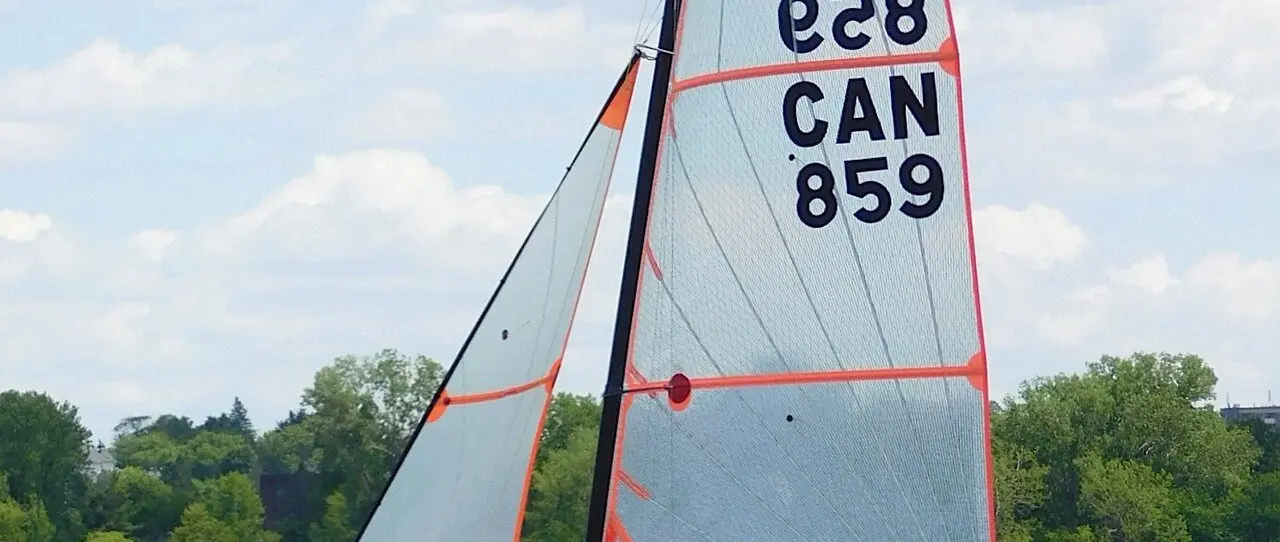
Lead image: Historical 29er skiff sailing photograph; NOT the September 2026 New Zealand Youth Championships at Murrays Bay. Historical contextual photograph by Ahunt, File:29er dinghy sailboat 7382.jpg, via Wikimedia Commons. License: CC0 (https://creativecommons.org/publicdomain/zero/1.0/). Image resized for editorial display. Historical 29er skiff sailing photograph; NOT the September 2026 New Zealand Youth Championships at Murrays Bay. Original file: https://commons.wikimedia.org/wiki/File:29er_dinghy_sailboat_7382.jpg.. Licensed original image, author and terms.
