
A New Zealand team joins the Port Phillip fleet
Yachting New Zealand reported on Thursday 26 November that a substantial Kiwi contingent is competing at Sail Melbourne 2026, which has begun at Royal Brighton Yacht Club on Port Phillip Bay. The regatta runs from 26 to 29 November and includes Olympic classes, youth sailors and para competition. New Zealand competitors are entered in ILCA, 49erFX, iQFOiL and Formula Kite fleets, creating an opportunity for small-craft sailors from several disciplines to race alongside established international competitors. The announcement identifies entries and the significance of the event; it does not yet establish final race placings or medal winners. Readers should distinguish a list of sailors scheduled to compete from results published after racing. That caution is especially relevant on the opening day, when the official competition programme remains subject to weather, race management and the developing circumstances on the water.
Why the Australian regatta matters to Kiwi sailors
Sail Melbourne offers New Zealand competitors a significant regional test without the full distance involved in travelling to many northern-hemisphere regattas. The two countries have established sailing links and access to competition in similar classes, but a strong field does not automatically guarantee a particular outcome for any entrant. Yachting New Zealand describes the event as a chance for sailors to benchmark progress, gain race experience and handle the demands of a four-day multi-class regatta. Those are practical goals rather than medals awarded in advance. For athletes moving towards larger international programmes, encountering different crews and unfamiliar race situations can reveal strengths and areas needing work. For the wider small-boat community, the event demonstrates how regional competition can sit between home-club sailing and the expense of racing far from home.
The ILCA fleets bring together several stages of development
Yachting New Zealand identifies George Gautrey, Caleb Armit and George Pilkington for the ILCA 7 fleet; Greta Pilkington and Chloe Turner for ILCA 6; and Sofia Turner for ILCA 4. These classes differ in rig size and competition profile, providing pathways for sailors at different stages of development. The entries are not evidence that every athlete is the same age, has the same ranking or faces an identical field. ILCA racing places considerable emphasis on boat handling, physical endurance and the ability to recognise shifts while managing a single-handed dinghy. Small changes in timing or positioning can matter over several races, and equipment setup must respect the relevant class rules. The published list is useful because it shows New Zealand participation across three ILCA divisions, not just a headline name in one fleet.
Two sister combinations in the 49erFX
The Kiwi 49erFX entries include sisters Nicola and Rebecca Hume and sisters Erin and Isla Kee. A 49erFX is a high-performance two-person skiff, so the relationship between helm and crew is a central part of race execution. Crews must coordinate sail handling, movement and tactical decisions while the boat responds rapidly to wind and waves. That remains true whether the sailors are related or not; family relationships by themselves do not prove a performance advantage. The official list confirms who is entered, not how any of those pairings will finish at Sail Melbourne. For club sailors watching this class, the accessible lesson is the importance of repeated training and clear division of responsibilities between two people sharing a small but demanding craft. The same principles apply in less specialised boats, even though the speed and technique differ considerably.
Board sailors add another dimension
New Zealand will also be represented in iQFOiL, with Josh Armit, Eli Liefting, Josh Tuck and Vlad Misescu listed for the men's fleet and Veerle ten Have for the women's fleet. The iQFOiL discipline combines sailing with foil-supported board performance and demands a different set of handling skills from a conventional dinghy. It therefore should not be grouped uncritically with keelboat racing or described as the same type of vessel. Yet the entries belong within the small-craft environment that Leisure Boat Guide covers. Foiling introduces questions of balance, control and speed management alongside wind tactics and racing rules. Those features can make the racing compelling to follow, but expected speed ranges or course outcomes cannot be assigned to individuals without event data. The confirmed point is the breadth of New Zealand's representation across both board and dinghy disciplines.
Formula Kite completes the announced entries
Lucy Bilger is named as the New Zealand entrant in women's Formula Kite. Kite competition differs again from conventional dinghy racing because propulsion is produced by a kite controlled by the athlete rather than a mast and sail mounted on a hull. Including this discipline in the regatta creates a varied event where spectators can observe different approaches to harnessing wind. The report should not be read as suggesting that kite entrants are boat owners or that their equipment and safety requirements mirror those of a small yacht. Equipment preparation, weather and specialised competition rules remain central, but their exact application belongs to the class and race officials. The breadth of disciplines at Sail Melbourne is a positive feature of the event, making it possible to compare different pathways in sailing without pretending all the craft operate identically.
Royal Brighton Yacht Club hosts a significant calendar fixture
The event is being staged by Royal Brighton Yacht Club on behalf of Australian Sailing. Sail Melbourne began in 1992 and has developed into an important regional event for Olympic and invited sailing classes. Yachting New Zealand's account notes a history that includes more than thirty world championship regattas, the Oceania leg of the Sailing World Cup from 2012 to 2015 and the 2016 Sailing World Cup Final. Those historical facts establish the venue's experience in hosting international racing; they do not determine what will happen in 2026. The club and race management still face the current programme's needs, including multiple classes sharing the same waters and shoreside facilities. An event with varied boats and boards places a premium on clear communications and appropriately planned competition areas.
Para sailing is part of the programme
The 2026 edition incorporates the 2.4mR Australian Para Sailing Championship. This is significant because it situates para competition within a multi-class sailing event rather than treating it as an unrelated activity. The 2.4mR is a compact keelboat sailed by a single person, and its design and class rules create a distinct form of competition. Eligibility and race arrangements should always be checked against official documents, not inferred from a broad description of accessibility. The inclusion of para sailing demonstrates the range of disciplines represented at the regatta, alongside dinghies, foiling boards and kites. It also offers an opportunity for different groups of sailors to share a major sporting venue. At the opening of racing, however, no para championship result can be claimed unless organisers have formally published it.
From club training to international starts
Yachting New Zealand highlights the connection between developing sailors and more established international athletes. That connection is important because progression rarely occurs in one step. A sailor may begin in a local club programme, enter regional events, build experience in national competition and then test themselves in a larger international fleet. Each stage has distinct demands, from safe boat handling to understanding race documents and managing equipment away from home. Sail Melbourne provides one such competitive occasion. The official entry list does not establish personal training histories for every athlete, and the article should not invent them. The useful lesson for a reader is the existence of practical intermediate opportunities where sailors can encounter stronger fields and identify what they need to improve before pursuing further competitions.
Four days require more than a fast first race
A multi-day regatta rewards consistent routines. Crews need to maintain equipment, understand the race schedule, respond to changes in weather and recover sufficiently between sessions. Travel, storage and communication with race officials are also part of preparing to compete. The sequence of races may change if conditions require adjustments, so a four-day calendar is not a promise of a fixed number of completed starts. A sailor who performs strongly on the opening afternoon still has to manage the rest of the series. These observations apply generally to competitive small-boat sailing rather than to any unreported incident at Sail Melbourne. They explain why Yachting New Zealand regards the event as useful practice: the challenge extends beyond one short contest to maintaining quality and attention throughout a programme.
What spectators can follow responsibly
The names on the official New Zealand entry list make it possible to follow individual fleets, but rankings should be taken from current organiser results and updated when races finish. A social-media post or incomplete leaderboard can show an intermediate picture, not necessarily the final classification. Readers should distinguish an entered sailor, a completed race, an event result and the overall regatta standings. Each is a different type of information. It is also worth remembering that classes may race on different schedules and in different conditions. Comparing a foiling board speed with a dinghy result does not establish a winner across all disciplines. The event's official documents and results service provide the authoritative basis for reporting; this advance account confines itself to confirmed entries, structure and significance as of 26 November.
The wider meaning for recreational sailors
Most recreational dinghy sailors will not be preparing for Olympic-class regattas, but they can recognise familiar features: launching, checking equipment, reading a course, working with a crew and responding to variable wind. Seeing several disciplines race at one venue may also introduce people to forms of sailing they have not previously considered. National teams and clubs gain value when new sailors can identify a route from first instruction to regular participation. That does not mean every beginner will pursue high performance, and participation programmes should offer worthwhile recreational options as well. Sail Melbourne's blend of established competitors and developing sailors helps illustrate the range of opportunities in the sport. The small craft remain central, but the relationships among instruction, competition and local clubs are part of the wider story.
An opening-day report with clear limits
The verified news is that Sail Melbourne 2026 is underway from 26 to 29 November, that New Zealand has entries across ILCA, 49erFX, iQFOiL and Formula Kite, and that the competition includes the 2.4mR Australian Para Sailing Championship. The named competitors and event history are taken from Yachting New Zealand's announcement on 26 November. No race winner, medal or final point total has been inserted without supporting results. Any separately licensed photo from an earlier dinghy event must be identified as historical context, not passed off as an image of this year's Melbourne fleet. The next genuine update will be the results and developments documented by the organisers as the four days of racing unfold.
Original industry sources and image credits
Reporting based on Yachting New Zealand official report.
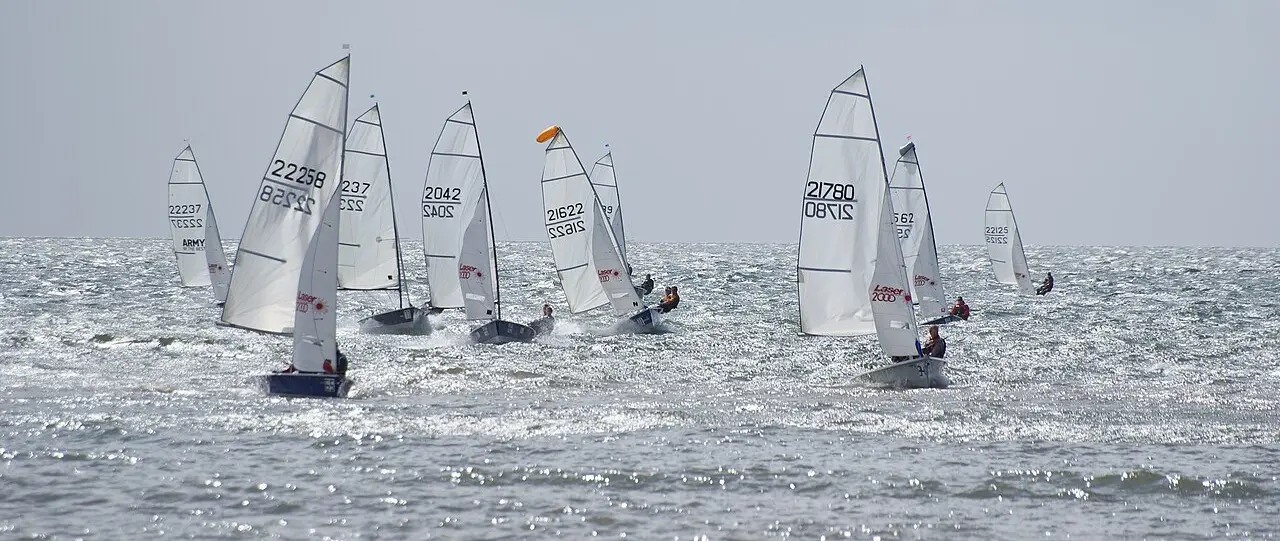
Lead image: Historical Laser 2000 dinghy racing at Sidmouth; NOT an ILCA or 49erFX photograph from Sail Melbourne 2026. Historical contextual photograph by Johanning, File:Laser 2000 Nationals Sidmouth 1.JPG, via Wikimedia Commons. License: CC BY-SA 3.0 (https://creativecommons.org/licenses/by-sa/3.0/). Image resized for editorial display. Historical Laser 2000 dinghy racing at Sidmouth; NOT an ILCA or 49erFX photograph from Sail Melbourne 2026. Original file: https://commons.wikimedia.org/wiki/File:Laser_2000_Nationals_Sidmouth_1.JPG.. Licensed original image, author and terms.
