
A two-point deficit becomes a twelve-point victory
Ireland's Headcase won the 2026 Epigen J/24 World Championship at Sandringham Yacht Club in Victoria after overturning a two-point deficit on the final day. Australian Sailing's official 12 November report records three decisive races and a 1-3-2 scoreline for the winning crew, who finished with 21 net points. Australia's Checkmate took second on 33 points, with Haywire third on 45. That result is more than a narrow change in the standings. It shows how an established one-design keelboat class can produce major shifts when competitors encounter several races in contrasting conditions. The J/24 is a 24-foot design, placing it firmly in the small-leisure-boat size category. The reported outcome is confirmed; explanations about individual tactical choices should be treated as analysis unless backed by specific crew or race-official records.
Three final races changed the picture
Checkmate had a two-point advantage over Headcase after seven races, according to the official account. An attempted eighth race had been abandoned on Tuesday, leaving three races to be sailed on the championship's last day. Headcase's first, third and second places across those races provided the decisive swing. The published final classification gives a 12-point margin to the Irish crew, not merely a victory on countback. A series can be particularly volatile when the final day's races contribute a substantial portion of the total points. Boats still need consistent speed, good starts and sensible risk management, but the arithmetic rewards crews able to perform repeatedly rather than dominate a single moment. Exact alternative results for other teams in those races should not be invented from the overall standings; the primary result provides the confirmed headline.
Why the J/24 still tests experienced crews
The J/24 combines a relatively compact hull with a keelboat crew system that makes sailing dependent on teamwork rather than a single operator. Trimming, helming, positioning and decision-making must work together, particularly in close one-design racing. Because the boats are of the same class, the emphasis moves towards preparation, execution and reading conditions rather than comparing radically different vessel concepts. That does not eliminate equipment differences, setup choices or the role of well-maintained hardware. The 2026 championship attracted highly experienced sailors as well as younger competitors, showing the continuing appeal of an established boat class. For the leisure boating sector, it is a useful counterpoint to the idea that every significant development must involve a newly launched model. Competitive value can come from crews learning how to use familiar boats well.
Port Phillip provided two very different tests
Australian Sailing describes opening conditions with winds of 20 to 30 knots and large seas, which challenged crews with broaches, damaged equipment and retirements. Later racing brought a mid-teen breeze followed by light, shifting air below five knots. That variation makes simple predictions about the fastest boat unreliable. A crew accustomed to strong wind must be prepared to alter trim and tactics when pressure becomes unstable, while a light-air specialist may need to manage control and boat handling as the breeze rises. The full details of each boat's adjustments were not supplied in the official summary, so assigning particular sail changes or decisions to Headcase would be speculation. What can be said is that the regatta rewarded adaptability across substantially different conditions, a lesson relevant to anyone using a small boat beyond sheltered, predictable water.
Strong wind increases the importance of preparation
A small keelboat racing in 20 to 30 knots is exposed to forces that affect sails, rigging, deck hardware and crew movement. A well-prepared crew checks the condition of lines and fittings, considers how to reduce problems during manoeuvres and keeps communication clear. Australian Sailing's account reports broaches, breakages and retirements within the championship fleet, without attributing a particular equipment failure to every competitor. Those reports should not be treated as evidence that the J/24 class is generally unsafe or that the championship lacked appropriate management. Regatta courses are organised within the framework of sailing rules and event safety procedures. The general operational lesson is that sailors need to respect the range of conditions they may encounter, rather than judge a trip only by a forecast's headline wind number.
Light airs demand a different form of discipline
Below five knots, a boat can lose a significant proportion of its momentum through steering corrections, poorly timed movements or an unsuitable approach to a shift. Crews may need to concentrate on balance, smooth transitions and keeping the yacht moving while interpreting small changes in breeze. The J/24 championship moved from rougher early races to such lighter conditions, giving teams a broad test of skills. That change does not prove any one sailor's particular technique caused the final result. Instead, it explains why a series involving different wind strengths can be revealing. Teams that can maintain clear roles and patient decision-making when speed is low often appear more consistent than crews expecting the same tactics to work in every race. These are transferable principles for club owners, not confidential insights into the winning yacht.
Technology recorded speed, but not the whole race
The official report says Vakaros tracking recorded a maximum speed of 14.9 knots for Amuse Bouche on the opening day. It is a striking figure within the context of demanding conditions, but it must not be confused with an average race speed, a class record or an indication of the winning team's performance. Tracking systems can illuminate a race by showing courses and speeds, yet the quality of a championship result depends on many more variables. Time spent sailing the wrong side of a shift may outweigh a brief period of high speed. Accurate use of race data requires specifying what the measurement represents and when it was recorded. The 14.9-knot figure belongs to Amuse Bouche, not Headcase or the entire fleet, and readers should preserve that distinction.
An international fleet across ten nations
Thirty-eight teams from ten nations contested the Open fleet, according to the championship report. The participating countries were Argentina, Australia, England, France, Germany, Greece, Ireland, Japan, New Zealand and the United States. The range of national backgrounds demonstrates the international reach of a class that can be raced from a relatively compact platform. Large global fleets still require transport, accommodation, measurement and shore-side planning, all of which carry a cost beyond the hull itself. The accessible size of the boat should not be mistaken for a guarantee that championship racing is inexpensive. But an established one-design class can provide a common technical format for sailors arriving from different clubs and countries. Sandringham supplied the host venue, while the series results reflected competition among crews rather than between unrelated yacht categories.
Youth and women's divisions had distinct winners
The official results identify Saltine from the United States as the leading Youth crew and Kaotic from Australia as the Women's division winner. Headcase also won the Corinthian division in addition to the overall title. These are separate achievements, and the winners should not be confused with the second and third finishers in the Open standings. Having several categories can recognise different forms of participation within a common racing environment, although exact eligibility conditions are governed by the event's formal documents. Competition organisers must distinguish class, overall and special-category awards so that the public can understand results without assigning inaccurate labels. The 2026 championship report supplies those names directly. No additional youth ranking, women's placing or unpublished result is claimed in this account.
Racing brought teenagers and veterans together
The report describes competitors ranging from a 14-year-old sailor to one participant older than 80. That breadth of experience is a notable feature of the event. An established keelboat class can bring people from several generations into a shared activity in which crewing requires practical coordination and clear roles. Age alone does not determine competence, nor does it establish that every part of the regatta was open to anyone without training. High-level sailing still demands appropriate preparation and conditions. The broader point is that a competitive small-boat community can preserve knowledge through experienced sailors while creating places for younger crews. The event's social programme also provided opportunities for international teams to meet, though the race results remain the objective measure of the sporting championship.
Shore-side organisation supported the event
Australian Sailing reports a Parade of Nations and a Welcome to Country at the opening ceremony, including a smoking ceremony led by Boon Wurrung Elders. Race days featured briefings from race management and opportunities for competitors to review previous-day footage and hear observations from John Bertrand AO. Crews also gathered after sailing for informal debriefs and shared events. This organisational detail matters because a world championship is not only its start line and finishing order. Clear communications, opportunities to understand race management decisions and respectful engagement with the host community all contribute to the experience of visiting sailors. The account does not provide independent participant satisfaction scores, so no numerical claim about how organisers were rated should be inferred. The confirmed structure itself shows considerable work beyond what spectators see on the water.
Lessons for ordinary club racing
A club sailor might never enter a world championship, but the 2026 J/24 results offer several practical lessons. A series is not necessarily decided after an early lead. Preparing for both heavy wind and light air can matter more than targeting a single expected condition. A well-drilled crew needs to communicate across sail handling and navigation tasks, and its members must be ready for changes in the race schedule. These conclusions are interpretations supported by the reported results and conditions, not a claim to know every team's private tactics. In smaller club fleets, the same ideas may improve consistency and enjoyment even when the stakes are modest. Racing can be rewarding precisely because the boat remains familiar while the conditions and competitive problems continue to change.
A verified result, not a prediction
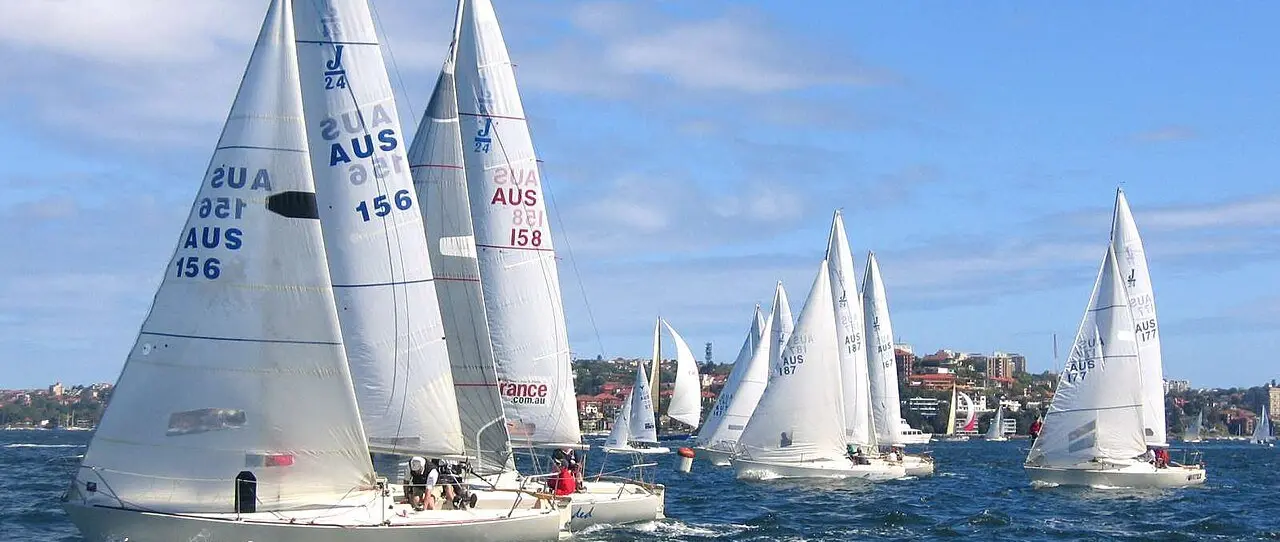
The championship is complete. Headcase finished first on 21 net points, Checkmate second on 33 and Haywire third on 45. The winner's 1-3-2 final-day sequence and the broad range of conditions are supported by Australian Sailing's official account. A historical J/24 racing image from another regatta can provide a meaningful visual reference for the class, but it must not be described as a photograph of the Melbourne finish or an image of the winning crew. Readers seeking detailed individual race scores should consult the event's official results rather than extrapolate from this narrative. The lasting story is that a 24-foot one-design keelboat class can still produce a demanding world-level competition in which preparation, teamwork and consistency determine the outcome.
Original industry sources and image credits
Reporting based on Australian Sailing official report.
Lead image: Historical J/24 class racing in Sydney Harbour; NOT the 2026 Melbourne world championship. Historical contextual photograph by Rling, File:J-24 yacht racing, Sydney Harbour.jpg, via Wikimedia Commons. License: CC BY-SA 3.0 (https://creativecommons.org/licenses/by-sa/3.0/). Image resized for editorial display. Historical J/24 class racing in Sydney Harbour; NOT the 2026 Melbourne world championship. Original file: https://commons.wikimedia.org/wiki/File:J-24_yacht_racing,_Sydney_Harbour.jpg.. Licensed original image, author and terms.
