
A final-day victory on Galveston Bay
Brian Doyle and crew Steve Kirkpatrick, Hannah Swett and Shane Wells won the 2026 U.S. Adult Sailing Championship at Lakewood Yacht Club in Texas, taking the Clifford D. Mallory Trophy for the Northeast Sailing Association. US Sailing reported the result on 10 November after an eleven-race series contested by eleven teams from eight states. The event was raced on Galveston Bay in the host club's RS21 fleet, a compact sportsboat class whose crews rotate among available boats. The title was not secured through a sequence of uncontested wins: a closely packed leaderboard and changing light wind gave numerous teams opportunities. Eight different winners emerged across the eleven races, according to the official report. That depth makes the championship especially relevant to owners and crew interested in competitive small-boat racing, where consistent decisions can matter more than a single outstanding finish.
A field with narrow margins
Just one point separated the top three teams before the final day's racing, leaving little room for an early celebratory prediction. Three races remained on the Saturday programme, and the standings were vulnerable to changes whenever a leading team finished further back. That situation makes a championship's last day both tactically and psychologically demanding. A skipper may know that conservative sailing can preserve position, but a large fleet and shifting breeze can make apparently safe choices costly. The official account records that many teams exchanged places during the final day, which is consistent with the tight spread in scores. It does not provide a complete table of every interim ranking, so those should not be manufactured. The important verified picture is an unsettled contest in which Doyle's team ultimately converted its position into an overall victory.
The RS21 format changes the ownership equation
Lakewood Yacht Club supplied RS21 sportsboats for the competition, allowing teams to rotate through the fleet rather than compete only in their privately owned vessels. That matters because variation in hull design and owner investment can otherwise dominate comparisons in a handicap event. A supplied one-design fleet cannot eliminate all equipment differences, but it makes boat-handling, tuning and team organisation more prominent. Competitors must adapt quickly to an unfamiliar or recently rotated craft and identify the correct settings for prevailing conditions. Doyle specifically appreciated the relative equality of the boats, according to US Sailing's report. For leisure-boat readers, this format illustrates an alternative to purchasing a dedicated racing boat: a club fleet can provide opportunities for serious competition when operating and maintenance arrangements support it.
Eleven races produced eight different winners
The unusual spread of race wins provides a measure of the fleet's competitiveness. No team could simply assume that an early successful start would translate into dominance across three days. Multiple crews showed the ability to beat the field at least once. Doyle's team won the first event day's races twice, while other wins went to teams led by Ed Feo, Mike Mergenthaler and Patrick Hitchins. This early pattern helped establish the close scoreboard. In a championship with no throw-out race, even one poor finish remains part of the score. US Sailing reports that Doyle's team won despite recording a last place in the series, an illustration of how strong overall consistency can overcome an isolated setback. Readers should not infer that a last place is an effective tactic; it simply shows how the final arithmetic worked in this competition.
Thursday's shifting breeze set the pattern
Principal Race Officer Ellen Pesch and deputy race officer Shannon Bush managed a programme in which the opening southeasterly breeze weakened to just over four knots before a sea breeze allowed further racing. Five races were completed on Thursday, nearly half the full round robin, with later winds around seven to nine knots. On several occasions, as many as three boats finished overlapped. Those details underline how small the margins could be after an entire course. Light-air racing rewards smooth boat handling, keeping clear wind and identifying the right shifts. But the event's official summary should not be transformed into a claim about any particular skipper's secret technique. It shows an unusually competitive fleet, challenging race management conditions and narrow finishes. The resulting standings remained close enough to keep the championship open.
Friday required patience before sailing
Fog and very light conditions delayed the second day's racing. Race 6 eventually started in approximately five knots, with Rudi Arntson's team winning its first race of the event. Concerns about weakening breeze and oscillations initially suggested racing might end after that one start, but the wind stabilised enough for Race 7 and Race 8. Doyle won Race 7 and Jasper Van Vliet took Race 8 as the sun lowered towards the Texas mainland. This sequence demonstrates why race management needs flexibility rather than rigid expectations. A postponement can be necessary for safe, meaningful competition even when boats are ready to launch. It also tests competitors' ability to stay prepared without becoming unnecessarily anxious. The report confirms the races actually completed; any additional imagined start attempts or decisions would need further evidence.
Saturday began with a recovery
In the first race of the final day, Doyle was seventh around the first leeward mark but recovered to second by the finish. At the same time, Van Vliet's team, which had been challenging near the top of the standings, finished seventh. The change moved Doyle into the lead. A comeback of that scale can depend on tactical decisions, changes in conditions and other boats' results, but the official report does not give a complete manoeuvre-by-manoeuvre explanation. The supported statement is that the team gained five places between the leeward rounding and the finish. This shows why an early poor position need not determine a small-boat fleet race. As long as boats remain close, subsequent legs can present opportunities, although the right choices remain uncertain until the racing plays out.
Race 10 provided a decisive advantage
Patrick Hitchins and crew entered Race 10 in second place overall but were early at the start and struggled to recover. Doyle's team won that race, creating a six-point lead over Van Vliet heading into the final contest. The change was especially important given the previous day's narrow separation. A premature start is a familiar risk in one-design racing where boats want to establish favourable position near the line. This does not mean every aggressive start is unwise; the correct approach depends on timing and the competition format. The verified event, however, demonstrates the cost of a mistake in a championship where few races remain. Doyle had turned an uncertain position into a substantial cushion, although the title still required him to complete the final race under the applicable scoring rules.
Second place in the last race sealed the title
In the eleventh and final race, Doyle rounded the opening windward mark in sixth place, then improved to second. The breeze was light and weakening, following a slow persistent shift to the right. That second-place finish secured the Mallory Trophy for the Northeast Sailing Association team. The podium was completed by Van Vliet's Yacht Racing Association of San Francisco Bay crew in second and Terry Flynn's Texas Sailing Association team in third. Flynn's team had been nine points away from third before the final day but made a successful late improvement. It finished tied on points with Van Vliet, who won their countback. These details illustrate that separate battles for first, second and third can unfold simultaneously. It would be wrong to report a definitive points margin without reference to the full results table.
Sportsmanship received its own recognition
A championship need not reward only the highest finishing team. US Sailing says the Staton J. Peele Sportsmanship Trophy went to the Southern California Yachting Association team led by Ed Feo, with Greg Naiman, Michael Oliver and Susannah Pyatt. Nominations came from fellow competitors and race officials. Feo had also won the award at the 2022 edition held at Bay-Waveland Yacht Club. A separate sportsmanship trophy acknowledges that respectful competition is important even when every crew is striving for the best finishing position. It should not be confused with the Mallory Trophy, which goes to the championship-winning crew. The official report supplies both winners, and accuracy requires keeping those distinctions clear. This aspect is particularly relevant to club racing, where repeated contact among the same members can make sporting conduct central to a healthy participation culture.
Race officers and club volunteers mattered
The championship involved more than eleven racing crews. The host club's volunteers managed course setting, starts, mark placement and boat rotations, while officials adapted to fog, shifting breezes and unusually close results. Pesch credited the Lakewood Yacht Club race committee team for helping provide fair competition. A supplied-boat event adds practical complexity because boats need to be rotated and prepared for the next crew without creating excessive delays. Organisers must balance the desire for a full programme against the wind actually available. A successfully completed round robin depends on this work, though the report does not publish an independent audit of every operational decision. The broader lesson is that small-boat championships can require sophisticated planning even when the equipment is simple compared with much larger sailing events.
Lessons for ordinary club crews
The Texas competition illustrates several practical ideas. Owners do not always need to bring their own hull to access serious racing; a maintained club fleet can support a level playing field. In light wind, communication among helm and crew matters as boats respond to small shifts. A poor rounding does not necessarily end a race, but a risky start can become costly. Scoring systems can reward consistency even when a team never dominates every contest. These observations are grounded in reported incidents and results but should not be presented as a confidential debrief from Doyle's crew. Recreational crews can apply the same habits more informally: prepare equipment, agree on clear roles and review where they gained or lost ground after a local race. The championship shows those habits tested in a national setting.
A verified national result
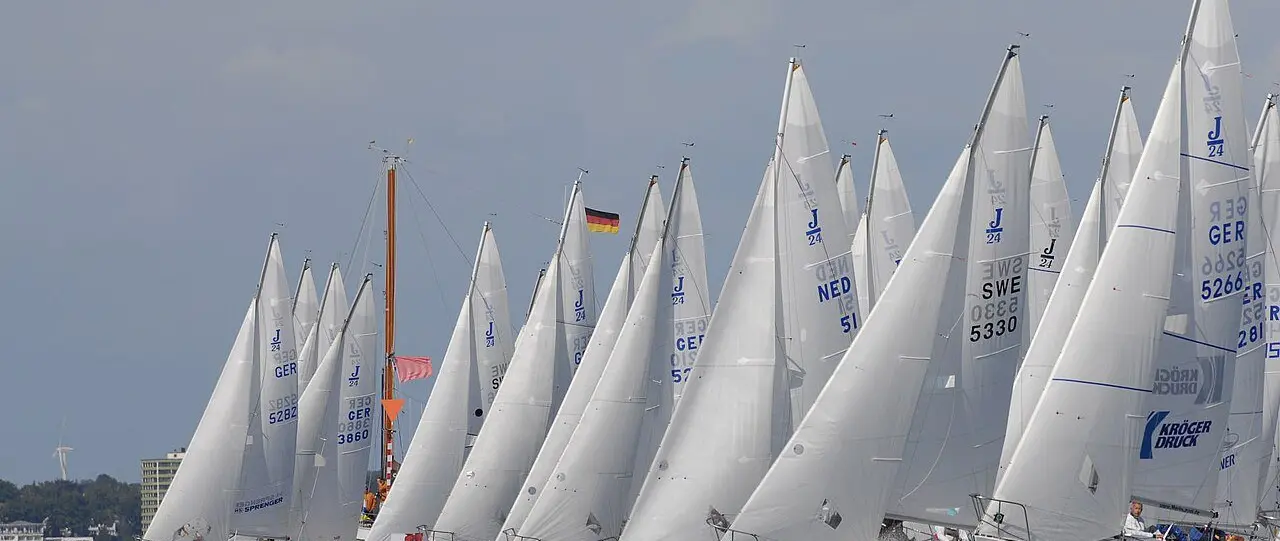
Doyle, Kirkpatrick, Swett and Wells are the confirmed 2026 champions, representing the Northeast Sailing Association. Van Vliet's crew finished second, Flynn's team third, and Feo's crew earned the sportsmanship award. Eleven teams competed on Galveston Bay in RS21 sportsboats during a three-day programme with eleven races and eight different race winners. Any licensed historical photo of small keelboat racing used alongside this report must be described as contextual, not an image of the Texas championship or its winning crew. The lasting news is a closely fought national contest in which a team recovered places repeatedly, made the most of variable conditions and secured its result only as the final-day races unfolded.
Original industry sources and image credits
Reporting based on US Sailing official announcement.
Lead image: Historical J/24 keelboat racing at the 2007 European championship; NOT RS21s or the 2026 U.S. Adult Sailing Championship. Historical contextual photograph by Jmulrich, File:J-24 sailboats racing at Europameisterschaft 2007.jpg, via Wikimedia Commons. License: CC BY-SA 3.0 (https://creativecommons.org/licenses/by-sa/3.0/). Image resized for editorial display. Historical J/24 keelboat racing at the 2007 European championship; NOT RS21s or the 2026 U.S. Adult Sailing Championship. Original file: https://commons.wikimedia.org/wiki/File:J-24_sailboats_racing_at_Europameisterschaft_2007.jpg.. Licensed original image, author and terms.
