
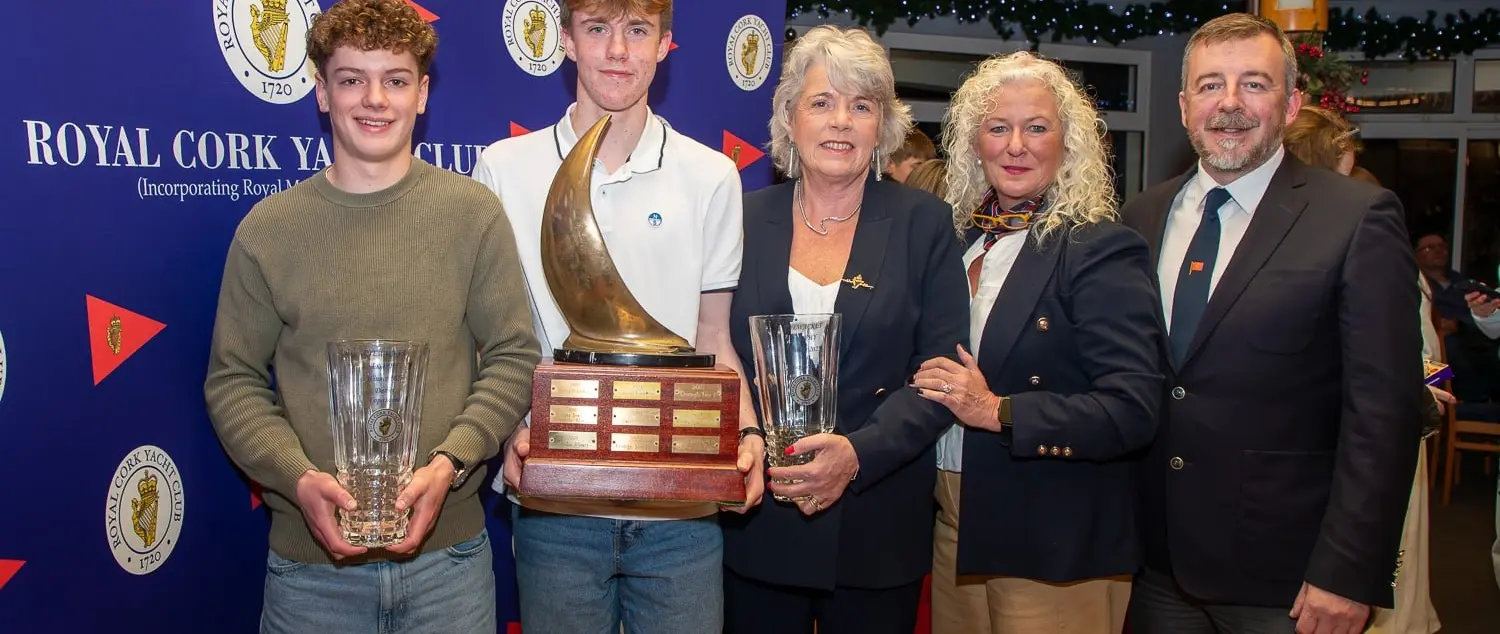
Royal Cork Yacht Club has scheduled its 2026 Junior Laying Up Supper for Saturday 28 November, bringing sailors and parents together at Crosshaven to review the season and recognise young people who have contributed across the club's dinghy fleets. The official event announcement, updated on 12 November, lays out a specific evening programme, including individual class presentations, fleet sailor-of-the-year awards and two concluding honours. The Frank Thompson Dinghy Volunteer of the Year and Pyewacket Junior Sailor of the Year prizes are due to be presented by the club's Admiral at 8pm. These are planned future presentations, not results that have already been announced. The event matters to the under-twelve-metre sailing community because the organisation of junior dinghy fleets depends as much on volunteers, safety teams and families as on the sailors themselves.
The confirmed Saturday programme
The club's original notice states that sailors and parents should arrive from 6:15pm, with a slideshow of photographs from individual fleets. At 6:30pm, Dominic Daly, listed as Rear Admiral Dinghies, is scheduled to open the evening, followed by food at 6:40pm. Class captains are expected to begin reviewing their fleets and presenting sailor-of-the-year awards at approximately 7:15pm. The Admiral's presentation of the two named club honours is planned for 8pm. These times provide a practical guide for participants, but they are not a guarantee that every stage will begin to the minute. Families should confirm booking and final arrangements with the club. At the time of this 25 November report, none of the winners of the scheduled 28 November awards can truthfully be named.
Why junior sailing awards matter
Small-boat sailing is built on repeated opportunities to learn, practise and compete. Many children begin in simple training dinghies, then progress to more demanding singlehanded or doublehanded classes as their experience develops. An annual gathering allows a club to recognise more than the finishing order at one regatta. Volunteers and coaches can acknowledge persistence, improvement, sportsmanship and participation in the wider club community. For parents, the occasion also provides an opportunity to hear how the fleet has developed and what activities may be available in the following season. An award evening should not be mistaken for evidence that every young sailor has won a major title. Its importance lies in maintaining a supportive culture where sailors can continue to enjoy the water while learning to act responsibly.
The role of class captains
Royal Cork's programme gives class captains a dedicated part of the evening to review the year and present fleet honours. This is significant because different dinghy classes can have very different training and racing needs. A fleet dominated by beginners will value reliable practice sessions, patient coaching and safe progression, while a more experienced racing group may place greater emphasis on competition and tactical development. Class captains can explain how the fleet approached those priorities and recognise people who helped organise activities. Their role can also bring consistency when young sailors move from one boat type to another. Families should ask about the expectations associated with changing class, including training requirements, equipment costs and the level of support available.
Volunteers are central to the programme
The scheduled Frank Thompson Dinghy Volunteer of the Year award highlights a reality of junior sailing: much of the work happens off the water, before or after a race. Safety boat crews, race officers, instructors, boatyard helpers, administrators and parents contribute time to make sessions possible. A successful club needs people who can check equipment, prepare courses, maintain communications and respond calmly when plans change. Recognising a volunteer may encourage others to become involved, but the club should also provide clear training and supervision rather than rely indefinitely on goodwill without support. Parents considering how to contribute should ask which roles require formal qualifications and which can be learned through the club. Building a dependable group is an important part of protecting the future of small-boat sailing.
The Pyewacket junior honour
The club also lists the Pyewacket Junior Sailor of the Year award for presentation by the Admiral. The notice does not identify the recipient in advance, so speculation would be inappropriate. What can be said is that this is a distinct recognition within the junior sailing programme, and it sits alongside the fleet-by-fleet presentations scheduled earlier in the evening. A club-wide honour can help celebrate commitment beyond an individual day's result, provided it is administered according to the club's own criteria. Young sailors can also learn from seeing peers recognised for effort and conduct. The relevant source is the club's official award announcement, not a social-media prediction or an unsupported claim that a particular crew is favoured.
Dinghy sailing is a practical route into boating
For young people, a small sailing dinghy can provide direct experience of boat handling, wind awareness, navigation decisions and cooperation with others. Unlike a larger yacht, a dinghy frequently puts the effects of sail trim and weight distribution within immediate reach of the sailor. The learning experience can be highly rewarding, but it also needs appropriate supervision and safety equipment. Clubs should match boats to the age, weight and ability of participants and provide a structured path from introductory sessions to independent sailing. An awards evening offers an opportunity to recognise the people who maintain that path and make activities accessible throughout a season. The objective should be confident, responsible participation rather than pressure to move too quickly toward competition.
Safety teams make a meaningful difference
Junior sailors may be able to operate their own dinghies independently in appropriate conditions, but organised activity still requires a plan for changing weather and incidents afloat. Safety boat crews should have suitable training, equipment, communications and a clear understanding of the day's operating area. Instructors and coaches need to know how to manage the group and recognise when an individual requires assistance. Parents should understand the club's processes for briefing, launching and accounting for participants after a session. These tasks rarely attract the same public attention as a race result, yet they make routine sailing safer. Recognition of volunteers is valuable when it reflects the serious responsibilities involved in delivering small-craft activity for younger people.
How families can prepare for the next season
The end of a sailing season is a sensible moment to inspect boats, sails and safety equipment rather than leaving every problem until the first warmer weekend. Check fittings, buoyancy arrangements, ropes and the condition of a child's personal flotation device. Growth over a year may make previously suitable clothing or buoyancy aids too small. Parents can also talk with coaches about how a sailor's skills have changed and whether the existing class remains the best fit. Moving to a larger rig or new boat should depend on experience and confidence as well as age. A club presentation can provide a natural opportunity to make those plans and understand what training dates and financial commitments might arise.
Club racing and recreational sailing can coexist
Not every junior wants to focus on competitive results. Some enjoy boat handling, exploring familiar waters and sharing a day with friends. A healthy fleet offers ways for different interests to develop, whether through training, informal events or organised racing. Awards and club social occasions can celebrate participation without suggesting that racing is the only valuable outcome. For many families, the cost of a boat, storage and travel to regattas can be a practical limitation. Shared boats, local coaching and flexible programmes may help keep sailing open to more young people. The club's published evening programme demonstrates attention to fleet identity and volunteer recognition; the wider challenge is translating that community energy into opportunities throughout the following year.
The connection to local winter sailing
Royal Cork also has a separate November dinghy Frostbite Series, with a final day scheduled for Saturday 28 November. The awards supper and the racing programme are separate events, even though they take place on the same date and involve the same broad sailing community. Participants should not assume that one programme changes the time or arrangements for the other. Any racing activity remains subject to weather, the club's published sailing instructions and the availability of the organising team. Families attending the supper should check the evening booking details separately. This distinction matters because an awards dinner can proceed as planned even if on-water conditions make racing inappropriate.
A chance to preserve the season's experience
The club's planned slideshow of photographs from each fleet has a purpose beyond entertainment. Pictures can help young sailors remember courses completed, friendships formed and the effort involved in learning difficult skills. They also provide an opportunity for parents and volunteers to share a sense of what the club achieved. Photographs from earlier seasons should be clearly labelled, and children should be portrayed respectfully in line with club safeguarding and media policies. The official notice links to a 2025 gallery as a retrospective reference, not evidence of what happened at the forthcoming 2026 evening. Accurate dates and captions are important whenever such material is used in public reporting.
What remains to be confirmed
Royal Cork has published the schedule, planned award categories and booking invitation for Saturday 28 November, but the winners and attendance are not yet known. The club is the appropriate source for post-event results and any changes to the programme. Readers should also verify whether food arrangements, seating and access require advance booking. A future award may have strong local significance without being a national championship; those are different kinds of achievement. The newsroom should report the actual outcome only once the club has made it available. Until then, the reliable news is that the junior sailing community is preparing to recognise its fleets, volunteers and young sailors.
Why the announcement deserves attention
Junior sailing is a foundation of recreational boating, and a well-organised local programme depends on many people whose work is not always visible. Royal Cork Yacht Club's scheduled laying-up supper makes that contribution explicit by including both fleet awards and recognition for volunteer service. Its precise published timing also gives families a practical reason to prepare for the final weekend of November. The event will not determine the future of international boatbuilding, but it supports the skills, confidence and participation on which the small-craft community relies. The club has confirmed the evening for 28 November; the achievements honoured that night will need to be reported from official results after the ceremony.
Original industry sources and image credits
Reporting based on Verified original primary-source announcement by the identified maker, authorised dealer, club or show organiser; date and facts independently checked.
Lead image: Royal Cork Yacht Club original archive photo of the 2025 junior evening, not the planned 2026 awards. © Royal Cork Yacht Club and original 2025 event photographer.. Original supplier image.
