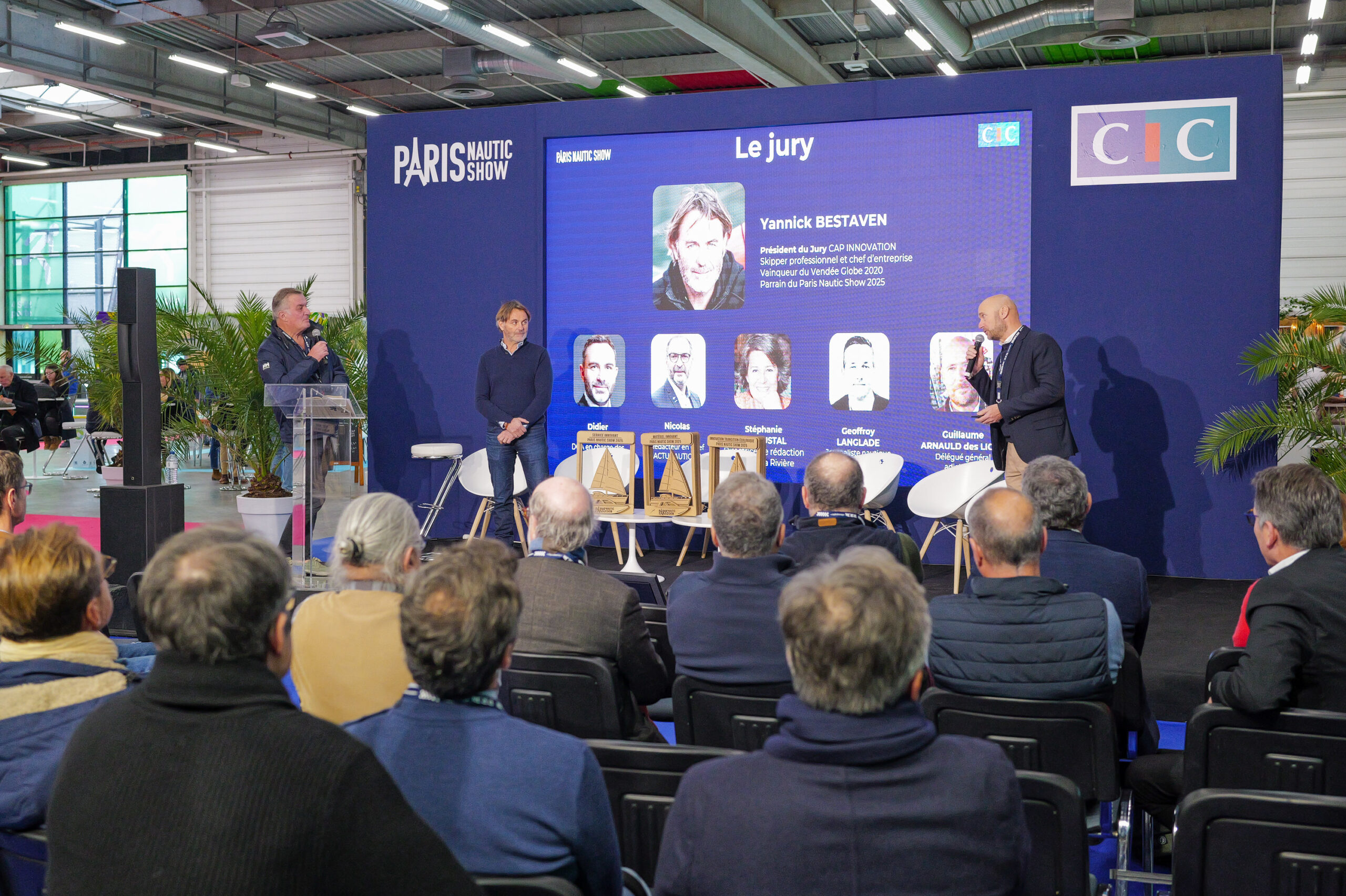
Paris Nautic Show has confirmed the 15 finalists for its 2026 Cap Innovation awards, with winners scheduled to be named on Thursday 26 November at 14:30 on the exhibition's Nautic Stage. The organiser's official announcement, dated 20 November, says the competition received 56 applications and was held under the auspices of France's Fédération des Industries Nautiques. The shortlist spans boat design, electric propulsion, electronic controls, recycled materials, training and marine equipment. Although some shortlisted vessels are larger than twelve metres, several of the nominated technologies are directly relevant to owners and operators of smaller leisure craft. For an industry trying to make dayboating cleaner, safer and easier to maintain, the list provides a timely look at projects moving from product development into public scrutiny. The prizes themselves have not yet been awarded.
The confirmed competition timetable
Paris Nautic's announcement identifies 15 finalists chosen from 56 applicants, with awards covering innovative products, innovative services and environmentally responsible innovation. The organiser says the number of entries is more than double the previous year and that almost one-third of the submissions concern environmental subjects. These statements describe the organisers' reported application pool, not an independently audited measure of the entire European marine industry's research activity. The awards presentation is scheduled for 26 November, while the boat show runs from 25 to 29 November at Paris–Le Bourget. Readers should therefore distinguish today's confirmed finalist list from tomorrow's still-unknown winners. A shortlist represents the jury's selection for the final stage; it does not prove that any entry has already won its category or passed every subsequent commercial test.
An electric outboard in the 300-horsepower conversation
Among the nominees is the Kronos 300, identified by the organiser as an integrated 300-horsepower electric outboard project from Weenav. That rating makes it a particularly interesting signal for owners accustomed to conventional petrol outboards on sizeable family dayboats or fast tenders. It does not, by itself, establish a production model's range, weight, battery requirement, sustained output or price. A prospective buyer should ask how the complete propulsion package is specified, including batteries, cooling, charging equipment and safe isolation. The question is not whether an electric motor can deliver impressive instantaneous power, but whether the boat can perform the required journeys and return with a prudent energy reserve. Early awards recognition is one step in evaluating such a system, not a substitute for documented marine trials.
Electric propulsion needs charging infrastructure
An electric outboard can reduce local exhaust emissions and noise during operation, but ownership depends heavily on available charging arrangements. Small leisure boats may be stored on trailers, moored in marinas with limited shore-power capacity or used in areas where commercial fast charging is uncommon. The complete system must be planned around electrical supply, battery protection, appropriate marine connectors and regulatory requirements. A power figure alone cannot answer whether a particular hull can maintain its usual cruising programme. Buyers should also investigate what a battery replacement could cost later in the vessel's life. The public shortlist shows that larger electric propulsion products are attracting attention; the next stage is evidence of practical performance, service support and total cost rather than marketing predictions.
TEMO's T700 is another useful small-boat nomination
The organiser identifies the T700 as an electric outboard from TEMO, highlighting repairability and an environmentally considered design approach. That places the product closer to the needs of many small-boat owners who use compact propulsion for manoeuvring, short trips or auxiliary duties. Repairability deserves careful examination because a small engine can spend more time in storage than in operation and may need support several years after purchase. Ask about access to batteries, service documentation, waterproofing and availability of spare parts. A system that can be inspected and maintained locally may offer genuine value even if its headline performance is unremarkable. As with all shortlisted products, readers should not infer a prize win or a verified lifecycle benefit merely from the fact that the entry reached the final round.
Controls at the helm are part of the innovation story
Yamaha's Helm Master EX remote-control technology appears on the shortlisted product list. Modern joystick and remote steering systems can make manoeuvring easier in particular configurations, but they also increase reliance on electronic integration. The owner should know what happens when a wireless link is interrupted, how emergency stop functions behave and whether mechanical or conventional steering controls remain available. Training is essential: a control that looks intuitive during an exhibition demonstration may be more complicated around wind, current and nearby boats. The underlying propulsion and steering architecture must be compatible with the proposed installation. The shortlist is evidence of industry interest in better interfaces, not proof that every skipper or vessel will benefit equally from the same equipment.
Corrosion control is less glamorous but important
Suzuki's Edge eCoat anticorrosion process is included among the environmental finalists. An effective surface-treatment system may help maintain the durability of engines and components exposed to salt spray, but the actual result depends on substrate preparation, application and operating conditions. For an ordinary dayboat owner, corrosion-related repair bills can be substantial over a long ownership period. Ask manufacturers how a coating is tested, what maintenance remains essential and whether a damaged coating can be repaired outside a factory. A new protective process is valuable only if it works alongside sensible cleaning, correct anode maintenance and proper electrical installation. The public shortlist does not provide comparative corrosion-test outcomes, so specific durability claims should be left to verified technical documentation.
Materials and sails feature on the list
Dimension-Polyant's Tyra Tec sailcloth is nominated as a lighter, finer and stronger fabric concept, while Echo Mer appears for equipment made from recycled materials. These examples reflect different aspects of environmental innovation. Better sail materials could change sailmaking choices and longevity for owners of smaller racing or cruising boats; recycled accessories could reduce demand for virgin material in products bought frequently by clubs. But neither advantage should be assumed without understanding strength, repairability, manufacturing and disposal. A club purchasing replacement sails needs predictable shape retention and the ability to obtain repairs. An owner choosing recycled equipment needs assurance that it remains durable and safe in a saltwater environment. Such practical questions should be part of the final evaluation beyond award-stage publicity.
Why refit and circularity deserve attention
BENETEAU's Neo refit and reconditioning programme is shortlisted in the service category, and the E-Lektra electrification initiative involving BENETEAU and Fountaine-Pajot is also named. Both are examples of change beyond the launch of an entirely new hull. In many leisure markets, the majority of boats afloat were built years ago, and owners need better ways to maintain them responsibly. A refit strategy can extend a vessel's useful life if structural integrity and service standards are preserved. An electrification programme requires careful engineering to balance battery mass, range and existing onboard systems. Buyers of used vessels should not assume that every old boat can be converted economically. The shortlist suggests increasing attention to the lifetime of boats, not just the showroom appeal of new construction.
Training is also being recognised
Boat&Sea's Electra Marina electrical qualification initiative is listed as a service finalist. This makes a useful point: the adoption of electric propulsion creates an ongoing demand for skilled technicians, safe operating procedures and suitable workshop equipment. A battery installation can involve hazards quite different from those associated with a conventional outboard fuel system. Owners should work with competent marine professionals who understand the particular components and the relevant standards. A training programme can be valuable even when it produces no hardware of its own. The award nomination recognises this service dimension, but participation alone does not verify that every garage or marina already has the people and facilities needed for new systems. Operators should check local support before making major equipment choices.
Boats with alternative layouts also appear
The organiser's finalist list includes Jeanneau's Sea Loft 480 hybrid and electro-solar boat, the Skaw [A] foiling cruiser, Catana's Seaty autonomous and environmentally focused office boat, and an Excess 11 using recyclable resin and recycled glass fibres. These are varied designs, not a single uniform class of small recreational vessel. Several should be treated as broader industry case studies rather than included in a strict under-twelve-metre boat comparison. Their relevance to smaller craft lies in the methods being explored: energy management, structural materials, hydrofoils and different uses of marine space. It would be inappropriate to suggest that technologies can be transferred directly to every trailer boat. Engineering must account for each hull's stability, loading, performance and certification.
Technology and recovery at sea
Floatrack is another finalist, presented as a system for marking and following shipping containers lost at sea. Although intended for a wider maritime problem, the project highlights why locating objects accurately remains a challenge on the water. Recreational sailors can be affected by floating hazards, and better information could support safer navigation in some circumstances. Nevertheless, the public shortlist does not confirm a universally deployed detection or warning system for leisure boaters. Owners must continue to maintain an effective lookout and follow navigational guidance. Innovation awards are particularly useful when they encourage questions about a project's maturity, the intended users and the evidence for its effectiveness rather than allowing one strong slogan to stand in for operational data.
The judges' decisions are still to come
The organiser has said that the three prize winners will be revealed at 14:30 on 26 November. At the time of this 25 November report, there is no official outcome to cite. It would be inaccurate to name a winner, assign a ranking or portray the shortlist as an awards ceremony that has already happened. Interested owners and industry representatives should look for the official results after the event and verify whether a project that appeals to them is available commercially. A product may be shortlisted while still undergoing development, testing or wider distribution. A favourable award result may encourage attention, but due diligence on warranty, installation and long-term service remains essential.
What a small-boat owner can learn from the finalists
For those who own dayboats, compact cruisers or training dinghies, the practical themes are clear. Electric propulsion needs realistic energy planning. Advanced helm controls need clear fallback and instruction. Coatings, sails and recycled products should be judged on service life, not only on headline environmental claims. Training and refit programmes can matter as much as new hardware. Paris Nautic's 2026 Cap Innovation shortlist provides a genuine dated view of these developments at a moment when buyers are beginning to plan future seasons. The 15 finalists and 56 submissions are confirmed by the show, while the award results remain pending. The strongest reason to follow the competition is not to predict its winners but to ask which innovations can genuinely improve the safety, practicality and life-cycle economics of leisure boating.
Original industry sources and image credits
Reporting based on Verified original primary-source announcement by the identified maker, authorised dealer, club or show organiser; date and facts independently checked.
Lead image: Original Paris Nautic Cap Innovation organiser archival awards photograph, not a photograph of the future 2026 winners. © Paris Nautic Show / FIN and original photographer; copyright retained.. Original supplier image.