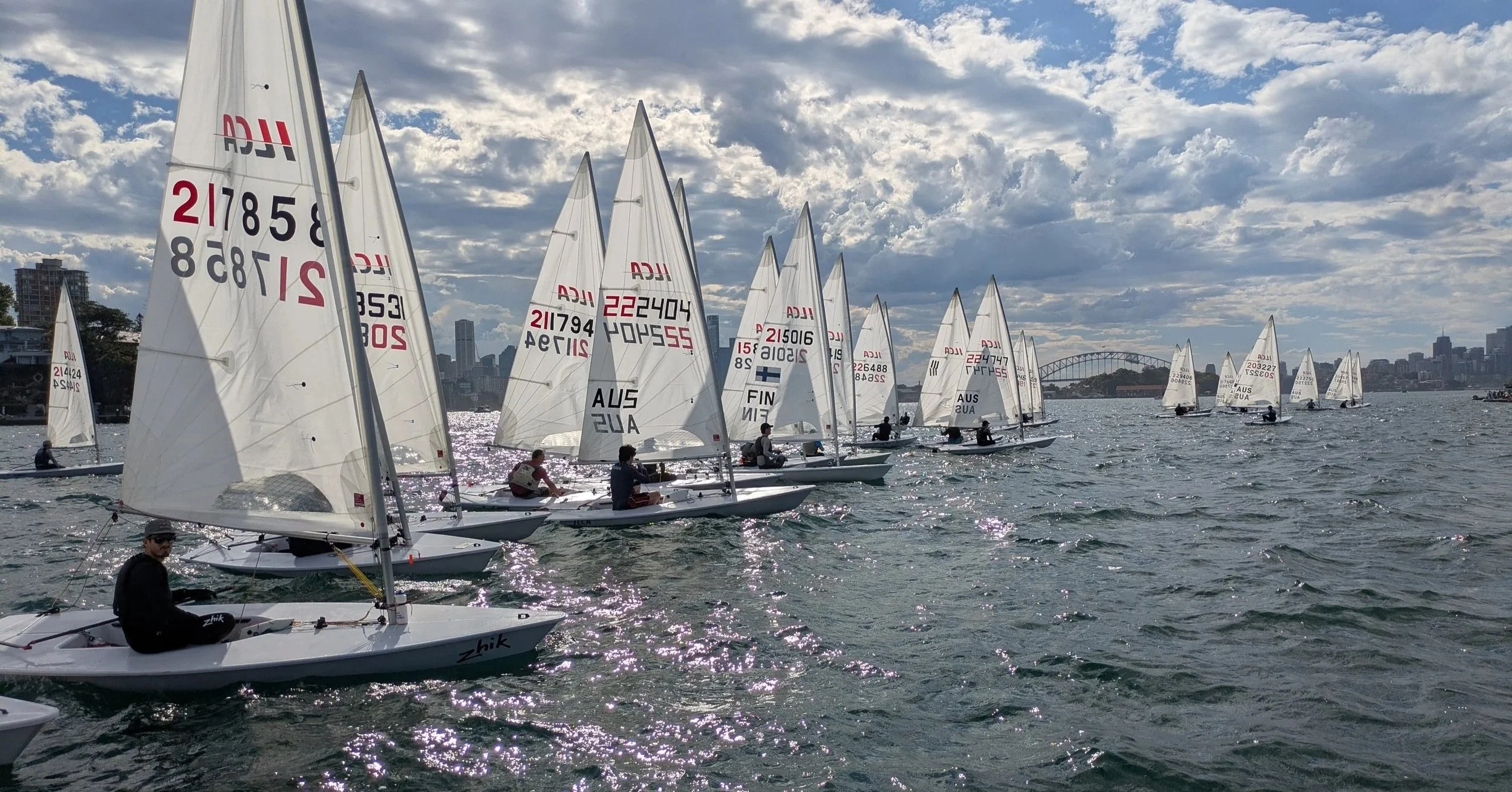
Sydney Harbour hosted a large weekend of single-handed dinghy racing on 14 and 15 November 2026 when 130 competitors contested the New South Wales and Australian Capital Territory ILCA State Championships at Double Bay Sailing Club. Australian Sailing's official 19 November report confirms that six races were completed in changing conditions, with major wins across the ILCA 4, ILCA 6 Open and Youth, ILCA 6 Masters and ILCA 7 fleets. Hiro Jacobsen, Sylvie Stannage, Bruce Savage and Alexander “Zander” Bijkerk were the principal fleet winners. The event is significant for the under-twelve-metre leisure-boat sector because it brought youth, open and older competitors together in small one-person craft on a busy urban waterway. This is a verified report of a completed regatta, not a preview of racing still to come or a prediction of future championship results.
An unusually large entry in a compact fleet
The organising ILCA NSW and ACT association records 130 boats across three rig variants, with 29 ILCA 4 entries, 66 ILCA 6 and 35 ILCA 7. Because the ILCA 6 category was so large, officials separated Open and Youth competitors from Masters to create four racing fleets. Those figures help explain the demands on the organising club, which had to manage launching, race starts and safe movement on the harbour while supporting a wide range of competitor experience. The national sailing body likewise reports six completed races across the two days. It would be misleading to describe all 130 dinghies as having started simultaneously in one race. The divisions existed precisely to provide manageable competition arrangements for the different groups.
The host club and its contribution
Double Bay Sailing Club provided the local organisation for the championship, with support from volunteers and race officials. The class association has praised the club's contribution and notes the scale of its established ILCA sailing community. A major regatta requires far more than a course laid out on the water. Launching areas, boat storage, competitor briefings, race management and safety arrangements must all function together. Volunteers may also give up their normal opportunity to sail so that visitors can compete. The harbour is an attractive venue, but the size of the fleet adds demands that are not encountered during an ordinary club afternoon. The competition's completion is a testament to the practical organisation involved, although it does not establish that every individual sailor experienced the event in exactly the same way.
Conditions tested sailors on both days
The official reports describe an eight-to-fifteen-knot northeasterly on Saturday and a stronger fifteen-to-seventeen-knot southerly on Sunday. Wind shifts and changing strength made tactical decisions important, especially for sailors trying to maintain a consistent result across several races. Such figures are retrospective conditions reported by the organisers, not a forecast for future sailing. A small dinghy responds noticeably to changes in breeze, boat balance and steering, so a competitor must adapt rather than rely on one setup. The shift in wind direction also changes the relationship between the course and the surrounding harbour. Good racing requires technical boat handling combined with the ability to observe changing conditions and avoid becoming fixed on a plan that no longer suits the water.
Hiro Jacobsen takes the ILCA 4 title
In the ILCA 4 fleet, Hiro Jacobsen recorded four race wins to secure the championship, according to the class association. Ethan Wilkinson won the other two races and finished second overall, narrowly ahead of Ali Kernaghan in third. Sijia Deng was fourth overall and the highest-placed female sailor. This sequence shows why a six-race championship rewards consistency as well as individual victories. A participant who wins one race but has a difficult result elsewhere may not achieve the same overall standing as someone who repeatedly finishes near the front. The official outcome should be taken from the final published scoring, and this article does not invent additional points or claim knowledge of tactical decisions that were not directly reported.
Sylvie Stannage leads ILCA 6 Open and Youth
Sylvie Stannage headed the ILCA 6 Open and Youth fleet, with the association describing four race wins and a second among her counting results. Ian Goh finished second and took the Under 19 recognition, while Wilbur Bright was third and the leading Under 17 sailor. Those age-group distinctions matter because a large championship can provide meaningful comparisons among sailors at different stages of development without removing the overall fleet standings. The source identifies the finishers and their relative places; it does not establish how every individual manoeuvre or wind shift affected those results. The lesson for club racers is that strong starts, steady boat speed and sensible tactical decisions are important throughout a series, not only during a single impressive race.
Bruce Savage wins the Masters fleet
The separate ILCA 6 Masters division was won by Bruce Savage, who the official class report says counted three wins and two second places. Stuart Wallace finished second, with Rick Longbottom third in the fleet and recognised in the Great Grand Masters category. Vanessa Dudley was the leading woman in Masters. This division demonstrates the continuing appeal of competitive dinghy sailing across a broad range of ages. Master sailors often bring deep experience to small-boat racing, but they still face demanding weather, physical exertion and the need to maintain equipment. A well-organised championship creates a fair opportunity to compete while respecting the different classes and divisions. Readers should use the organiser's final standings for the complete list of awards and age categories.
Zander Bijkerk closes strongly in ILCA 7
Alexander “Zander” Bijkerk took the ILCA 7 title, finishing with four consecutive race wins in the final four races, according to the original reports. He defeated defending state champion Campbell Patton, while Healy Ryan finished third. That result underlines the importance of maintaining momentum through a multi-race regatta. A championship can change substantially after the first day, especially when the conditions and the sailors' decisions evolve. The official result is a firm fact; an explanation that attributes every win to one unverified equipment change or tactic would be speculation. Competing on familiar harbour waters may provide useful local knowledge, but it does not eliminate the challenge of racing against a strong fleet. The winner still has to execute well on the course.
The role of sailing instructions and divisions
Large events often need adjustments to the way fleets are started and managed. The ILCA NSW and ACT class association reported a specific change to the sailing instructions so that the large ILCA 6 entry could be divided into Open and Youth and Masters fleets. Clear communication of that change helps competitors prepare for their assigned start, class flag and course arrangements. The details are important for safety as well as sporting fairness, since a confused fleet can create congestion or uncertainty near a start line. Clubs should use official notices to communicate any changes and ensure participants understand them. The experience of this regatta offers a practical example of why a race programme should be flexible enough to handle a larger-than-usual entry while retaining reliable procedures.
Racing on a busy harbour needs extra awareness
Sydney Harbour is shared by many kinds of water users, including recreational boats and commercial traffic. Even when a regatta operates in a designated racing area, competitors and organisers must consider navigation channels, surrounding vessels and the constraints of the shoreline. A dinghy sailor focused on a rival's sail trim still needs to maintain awareness of the wider environment. Safety boats and race management teams should understand local traffic patterns and the procedures that apply to their courses. The association's account credits the experienced Double Bay race team with arranging suitable courses within the available space. No specific incident or breach should be inferred from that description. Successful management means anticipating common difficulties rather than waiting for an avoidable problem.
Why the ILCA format develops technique
The ILCA is a single-handed dinghy in which the sailor is responsible for steering, sail control, balance, observation and race decisions. It offers a direct connection between technique and performance, since an inefficient movement can be felt almost immediately. Different rig configurations support different groups while retaining the class's basic emphasis on individual boat handling. The NSW and ACT event drew youth, open and Masters participants into this shared competitive environment. Training in one-design classes can help sailors identify improvements in their own performance rather than attribute every result to a difference in hull or equipment. Nevertheless, preparation and boat maintenance remain important, and competitors still need to ensure that their craft and rigging meet the applicable class rules.
What younger sailors can take from the results
The championship included competitors developing through younger age categories, with honours reported for Under 19 and Under 17 sailors within the ILCA 6 Open and Youth division. Racing against experienced participants can provide useful benchmarks, but those results should be approached constructively. A young sailor may benefit most from understanding one or two improvements to make before the next regatta rather than concentrating entirely on the finishing place. Coaches can help interpret starting decisions, speed and the effect of changing wind. Support from parents and clubs can also make it possible to travel and compete. The event's strong entry demonstrates opportunities for participation, but a single championship result cannot define an individual's long-term development or future prospects.
Volunteers and local facilities matter
According to the class association, Double Bay Sailing Club has a substantial ILCA fleet and volunteers worked hard to run the two-day championship. The practical demands included supporting approximately 130 boats, keeping the programme on schedule and coordinating racing with other harbour activity. A major event can create opportunities for a club to strengthen its volunteer organisation, but it also places a temporary workload on those people. Properly prepared equipment, communications and clear assignments help manage that pressure. The successful completion of six races does not mean that future events need no planning. Clubs should review what worked well, where arrangements could improve and how responsibilities can be shared so that volunteers remain willing to support competition.
Looking ahead to the summer sailing calendar
The ILCA NSW and ACT association points toward a busy Australian summer programme following the state championship. Sail Melbourne is advertised for 26–29 November, with Sail Brisbane in December and larger national and international events following in January 2027. Those are separate future regattas; their entry lists and outcomes should not be inferred from the Double Bay results. Competitors considering a broader programme need to account for travel, equipment transport, qualification requirements and rest between events. A series of regattas can build experience, but it should also be planned with realistic physical and financial demands. The November state championship provides a confirmed competitive reference point as sailors consider their next steps.
The verified outcome from Double Bay
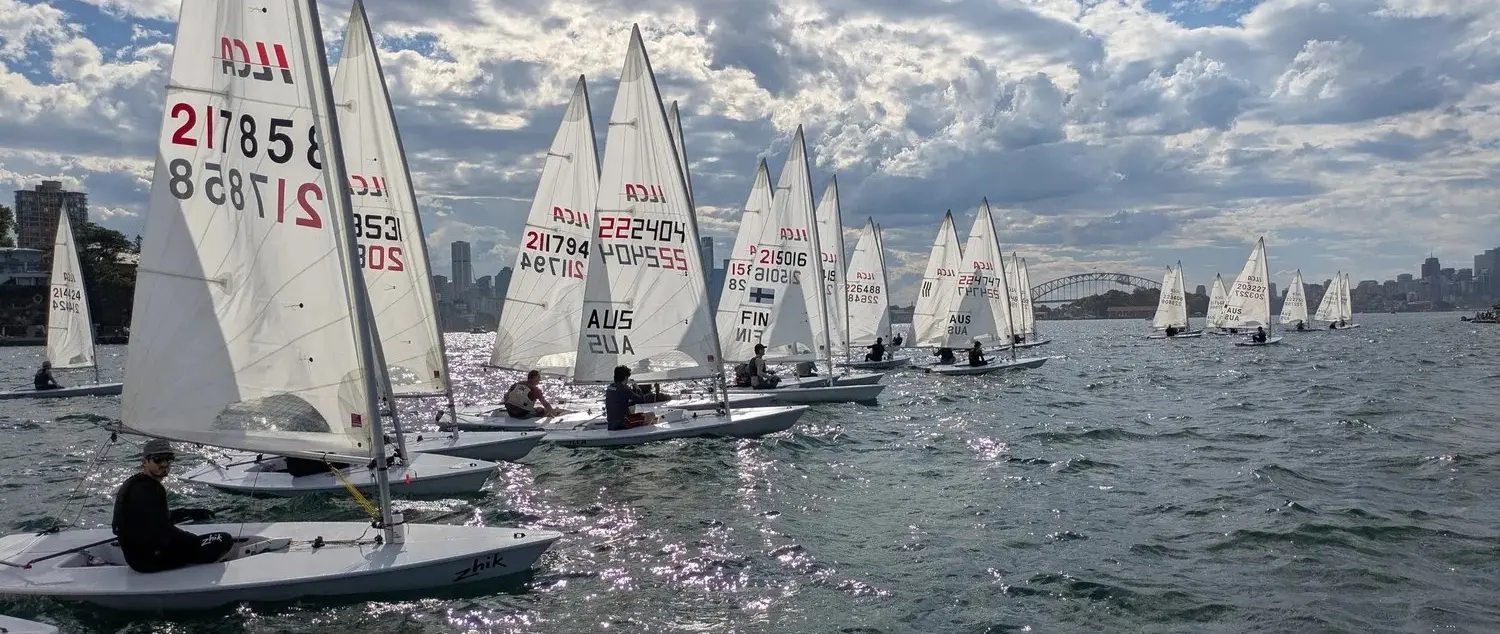
Australian Sailing and the ILCA NSW and ACT association confirm that 130 entries took part in the 14–15 November State Championships and that all six planned races were completed. The principal fleet winners were Hiro Jacobsen in ILCA 4, Sylvie Stannage in ILCA 6 Open and Youth, Bruce Savage in ILCA 6 Masters, and Alexander Bijkerk in ILCA 7. The conditions, class divisions and named results are supported by official reports. The photograph accompanying this article comes from Double Bay Sailing Club's actual 2026 regatta gallery and shows small dinghies racing on the harbour. The event illustrates the vitality of one-design sailing and the organisational effort needed to bring a large fleet together. For small-boat owners and clubs, its lasting value lies in the lessons about skilled sailing, fair racing and the people who make such competitions possible.
Original industry sources and image credits
Reporting based on Australian Sailing original 19 November 2026 regatta report, official fleet and results facts, ILCA NSW and ACT association official advance event notice and supporting regatta background.
Lead image: Original Double Bay Sailing Club photograph of 2026 NSW and ACT ILCA Championship fleet racing on Sydney Harbour, from official gallery. © Double Bay Sailing Club and original regatta photographer.. Original supplier image.