Furuno USA has introduced the RD Series of remote touchscreen displays, expanding the choices available to owners who want critical information visible away from a boat’s main chartplotter. In its original 10 November 2026 announcement, the navigation-electronics manufacturer confirms three models: the seven-inch RD726, nine-inch RD926 and 12.3-inch ultra-wide RD1226W. These units can display data from an existing NMEA 2000 network, including engine, navigation, fuel, tank and environmental information, without requiring a Furuno chartplotter to provide basic instrument readouts. Supported systems can also be controlled through additional integrations, and compatible iPhone content can be mirrored using an optional wired connection. For small motorboats and sailing craft, the release offers a way to place readable information near a secondary steering position, fishing station or cockpit without installing a second full multifunction display.
A November launch with three distinct sizes
The manufacturer identifies the products as a newly introduced RD family rather than a software revision to an older model. The RD726 has a seven-inch screen, the RD926 nine inches, and the RD1226W a wider 12.3-inch display. All three allow portrait or landscape installation, although the physical mounting arrangement and final panel clearance must be confirmed for the chosen unit. Furuno describes applications ranging from towers and overhead mounting locations to secondary helms and protected interior spaces. The sizes represent a practical choice rather than a simple ranking of quality. A compact helm with limited dashboard space may benefit more from a carefully positioned seven-inch data display than from an ultra-wide screen that obscures other equipment. The announcement lists orders as open, with first deliveries anticipated in late 2026, but does not guarantee availability in every country immediately.
NMEA 2000 is the essential connection
A key feature is the ability to read NMEA 2000 data using power and a compatible network connection. Many leisure boats already use this standard to exchange information among engines, tank senders, navigation instruments and other equipment. Furuno says the RD displays can transform available network messages into customised numerical readings, gauges, graphs and navigation information. That does not mean every older engine or analogue sensor will automatically appear on the screen. The boat must have a properly installed and configured network carrying the relevant data. Owners should ask their installer which readings will actually be present, whether additional gateways are needed and how the network is terminated and powered. An attractive screen provides little benefit if the underlying sensors are missing or unreliable.
A display where the skipper can see it
Smaller boats often have a single helm panel crowded with instruments, electrical switches and a multifunction screen. Additional equipment can compete for space and make important readings harder to locate at a glance. A dedicated instrument display offers the possibility of showing just the information needed for a particular task. When running at cruising speed, an owner may prioritise engine temperature, RPM and fuel economy. During a restricted-waterway passage, depth and heading could be more relevant. A sailor working in the cockpit may prefer wind, speed and course information. The RD Series supports custom data layouts, according to Furuno, so the owner can arrange different pages instead of relying on one all-purpose screen. Those benefits should be evaluated during a demonstration with representative information.
The range includes navigation-related pages
Furuno lists position, depth, course and speed over ground, heading, waypoint guidance and even highway-style display options among the types of information that can be presented. It also discusses set and drift, wind and velocity made good for relevant applications. The exact selection depends on sensors and the system into which a unit is installed. This is a useful distinction for owners who assume any touchscreen immediately provides navigation. An RD display is not automatically a replacement for a complete chartplotter, nor does the manufacturer claim that all functions are available without supporting equipment. It can provide an effective data station that complements an existing navigation arrangement. The skipper still needs an appropriate way to plan and monitor a safe route, including official chart information where required.
Engine and fuel monitoring in small craft
Owners of compact outboard-powered boats may want to understand engine RPM, tank capacity, fuel flow and estimated economy without repeatedly changing pages on the chartplotter. The RD Series is designed to display relevant messages when compatible engine interfaces and sensors are installed. This can help with ordinary running decisions, such as selecting an efficient cruising speed and recognising when an engine reading needs attention. Nevertheless, digital equipment should not encourage assumptions about range. A fuel calculation depends on valid calibration, sensor accuracy and the actual quantity remaining. A sensible skipper continues to maintain reserves and understands the consequences of rough weather or an unexpected detour. The product provides a clearer presentation of data; responsibility for interpreting that data remains with the operator.
Compatibility with onboard controls
The manufacturer's announcement describes integration with compatible NavNet Command Center installations when an RD display is connected to an appropriate TZtouchXL or TZtouchE multifunction display. In those circumstances, it may serve as an interface for supported third-party systems, including Victron electrical management, Dometic digital switching, lighting controls and other named accessories. This should not be mistaken for a statement that any RD unit can independently switch every kind of accessory merely by being connected to an NMEA 2000 backbone. The relevant companion equipment, software and data interfaces must be present. Owners should obtain a compatibility list for their exact installation and ask how a failed display or network component affects control of important loads. Essential safety functions should remain usable in accordance with the system designer's instructions.
An optional iPhone connection
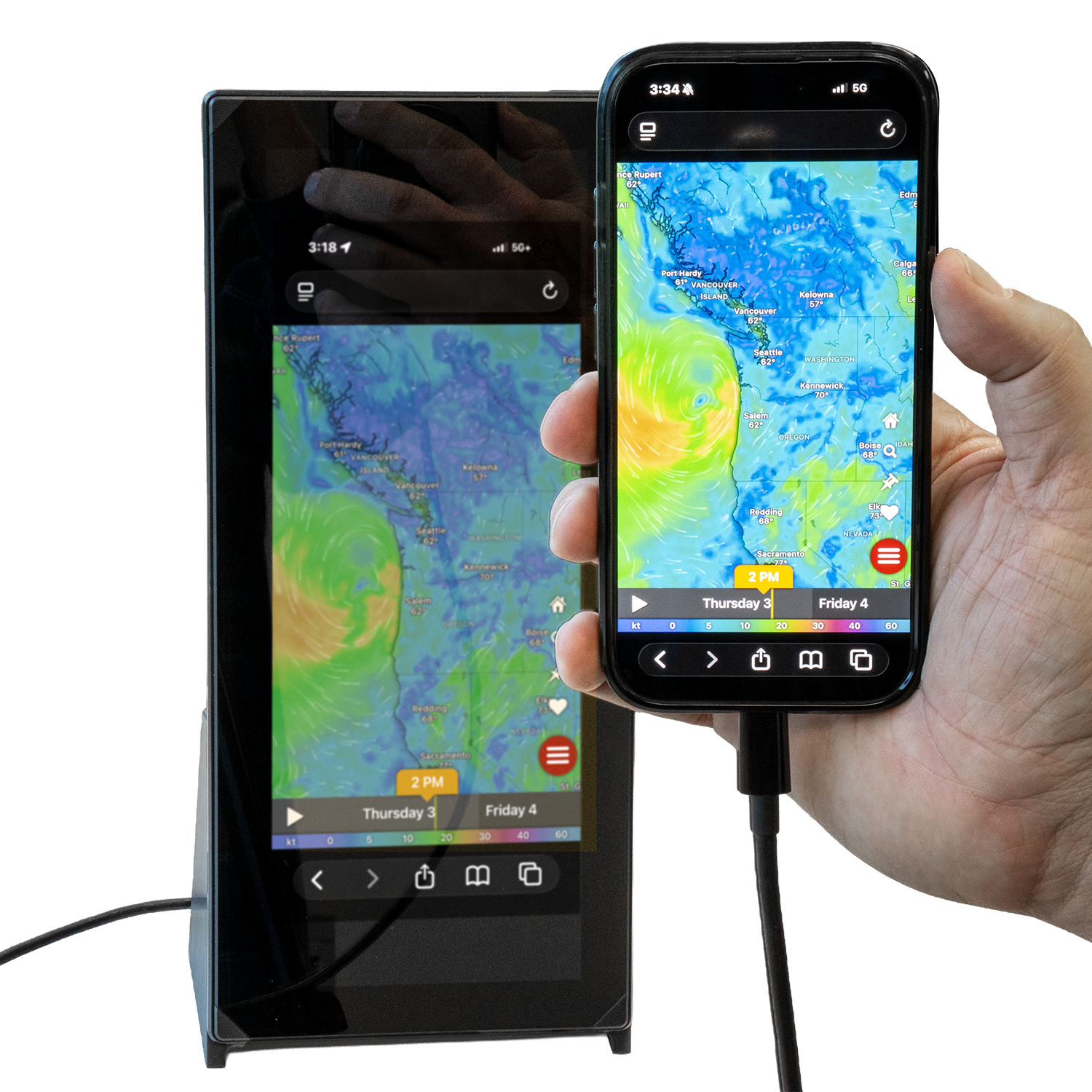
Furuno also identifies an optional iPhone mirroring kit using a wired USB Type-C connection. The company says compatible content, including its TZ iBoat navigation app, can be displayed on the larger screen. That could be useful for a skipper who already uses the relevant app, but it is not an unlimited promise that every mobile application will work or that the screen provides wireless mirroring by default. Buyers need to check phone compatibility, cable routing and the additional hardware required. A cable at the helm must be secured where it will not interfere with steering or other controls. Mobile-phone functions should not be treated as the sole means of safe navigation, especially when battery power, connectivity or device reliability are uncertain.
Screen brightness and installation protection
The company gives an enhanced sunlight-viewable LCD specification of up to 1,000 candelas per square metre and an IP56-rated enclosure. These are useful technical details for outdoor and semi-exposed installations, although the exact effectiveness of a screen depends on glare, viewing angle and the chosen mounting position. IP56 does not mean the product can be permanently submerged, and the manufacturer’s instructions remain the correct guide for exposure and cleaning. The two smaller displays have 1280-by-720 resolution, while the wide model uses 1920-by-720. All three accept 12-to-24-volt DC power, with flush-mount options and optional bracket kits for the seven- and nine-inch units. An installer should check cable clearance, ventilation and access for service before cutting a helm panel.
Comparing the prices responsibly
Furuno's November release gives US reference prices of $995 for the RD726, $1,495 for the RD926 and $2,295 for the RD1226W. These are manufacturer figures in a specific currency and market, not guaranteed installed prices in Europe, Australia or elsewhere. The final quotation may include network cables, power supplies, a bracket, sensors, interface modules and installation labour. Owners should also account for the cost of rectifying a poorly installed or outdated network. The cheapest approach may be an additional page on an existing chartplotter if the data is only needed occasionally. A separate display becomes more attractive when information must remain visible throughout a passage, or when a second helm or operating position genuinely needs its own readout.
The smallest boat can still benefit
A sophisticated instrument suite is not exclusively for large yachts. A trailerable fishing boat may use several electronic systems and have limited room to place them. A racing sailboat may need quick wind and speed feedback while leaving another screen for charts. A compact family cruiser with a sheltered cabin and outdoor helm may benefit from seeing key engine data at both positions. The value is in reducing distraction and keeping necessary information clear, not in adding electronics simply because a product is available. Owners should identify their highest-priority readings and decide which displays genuinely help maintain a better lookout. Electronic interfaces must never become a reason for a skipper to concentrate on screens at the expense of traffic and conditions outside the boat.
Practical questions before a refit
A marine electrician or electronics installer should inspect the existing NMEA 2000 network, power supply and mounting location before ordering. The buyer should ask whether the RD display can show the data already carried by the boat and whether any engine adapter, GPS receiver, wind sensor or tank gateway must be added. Check software-version requirements and whether a Furuno MFD is necessary for any planned control functions. Obtain a written installation plan, including how the equipment will be tested and what happens when the network loses power. Existing instruments should not be removed before the new arrangement has proved dependable. A careful retrofit can improve usability without adding unnecessary wiring or compromises to the helm.
What the introduction establishes
The verified news is that Furuno announced three new RD Series touchscreen instruments on 10 November 2026, published their main technical specifications and opened orders for expected late-2026 delivery. They offer customisable data presentation for owners who already have appropriate NMEA 2000 information available, with further integration where supported hardware is installed. Claims about visibility, compatibility and performance remain subject to installation and product documentation. The range gives small-boat owners a new option for improving access to useful information, but the decision to buy should be based on the actual data available aboard and the way the boat is used. Informed system design is more important than screen size alone.
Original industry sources and image credits
Reporting based on Original first-party furuno dated product or event announcement with direct verifiable facts.
Lead image: Genuine Furuno RD1226W original product image showing its compatible screen-mirroring function. © Furuno USA and original manufacturer photographer.. Original supplier image.